


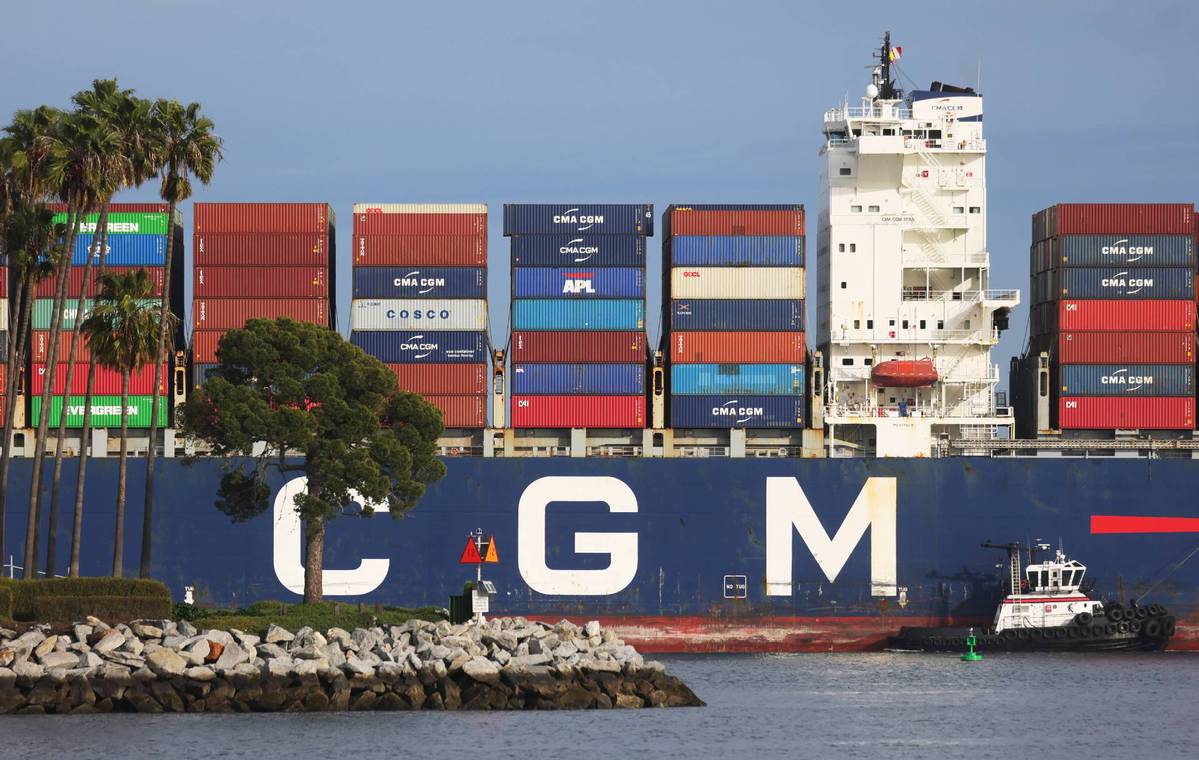
Global trade is suffering a so-called cargo crunch after a year in which the COVID-19 pandemic brought unparalleled disruption to international supply chains.
As ships line up at major world ports, packed containers are stacking up at quaysides while others are being shipped out empty.
What will surely turn out to be a short-term crisis has nevertheless raised questions about longer-term issues such as food security, now increasingly dependent on international supplies.
In recent weeks, shipping rates have spiraled, raising the prospect that the increased costs will be added to the bills of average consumers, already struggling with the economic impact of the pandemic.
Shortages of available containers where they are needed and congestion at many ports have combined to bring record-high freight rates and record-low reliability for seaborne cargo shipments.
One survey found that more than a third of containers were being delayed at major ports in Europe, the United States and Asia.
As the virus began to spread around the world a year ago, levels of global trade collapsed and shippers scrapped scheduled sailings. That left thousands of empty cargo containers stranded in the wrong place.
A rebound, led by the production recovery in China, has had the reverse effect of boosting demand for goods being shipped out of Asia at a time when there is a shortage of available containers.
The scale and nature of the disruption is illustrated by the situation at the US’ main Pacific port in Los Angeles. This time last year, empty containers were piling up as sailings were canceled. Then, as Chinese factories reopened, shipping operators had to scramble to get them back to Asia.
With demand for shipping capacity now far exceeding supply, rates on some routes have quadrupled, prompting an appeal from the World Shipping Council for traders to promptly return empty containers to make them available for the next customer.
The European Sea Ports Organisation called on all those in the maritime sector to keep the strategic role of maritime trade and ports in mind and do everything possible to increase predictable and stable operations in order to restore reliable schedules and fluid trade.
The present cargo crunch has come at a time of renewed international demand for Chinese goods, including medical equipment needed to deal with the pandemic and consumer goods being ordered online by consumers still confined by lockdown restrictions in many parts of the world.
While industry experts are warning that the cargo surge could last well into this year, the likelihood is that the hoped-for retreat of the pandemic and the easing of current bottlenecks in world trade will see a return to something like normal within the relatively short term.
The short-term crisis is a reminder of the interdependence between long-distance producers and consumers in an ever more integrated trading world.
In many parts of the world, the pandemic has sparked a debate on food security that raises the question about the wisdom of relying on supplies being shipped from the other side of the globe.
By the middle of last year, more than a score of countries had banned exports of agri-food products in order to stabilize prices and secure domestic supplies in response to the pandemic.
That did not pose an immediate supply threat to high-income importing countries that were able to switch their orders elsewhere. But it did mean higher prices for some products.
Coupled with ongoing concerns about the climate costs of shipping food around the world, the situation has prompted a “grow your own” response from some campaigners.
In the United Kingdom, which has faced the dual challenge of COVID-19 and post-Brexit trade disruption, researchers at the University of York urged the government and food industry to use the COVID-19 recovery to focus on growing more food domestically.
The challenge is not confined to the higher-income world. With the proliferation of food exports as general global trade grows, most of the world’s population is in countries dependent on imported food, to a greater or lesser extent.
In a post COVID-19 world, going back to more local food production offers potential benefits in terms of reducing food waste and cutting greenhouse gas emissions. The downside is that it could make consumers vulnerable to sudden shortages brought on by droughts or floods.
Some researchers believe the shock of the pandemic could see a return to eating more seasonal local foods rather than eating out-of-season items from the other side of the world.
The likelihood is that the passing of the immediate COVID-19 and cargo crises will see a return to normal. It might, however, be a small positive outcome of a devastating pandemic if the situation forced the world to reassess how it trades its most vital commodity-food.
The author is a senior media consultant for China Daily UK. The views do not necessarily reflect those of China Daily.
Recent Comments