

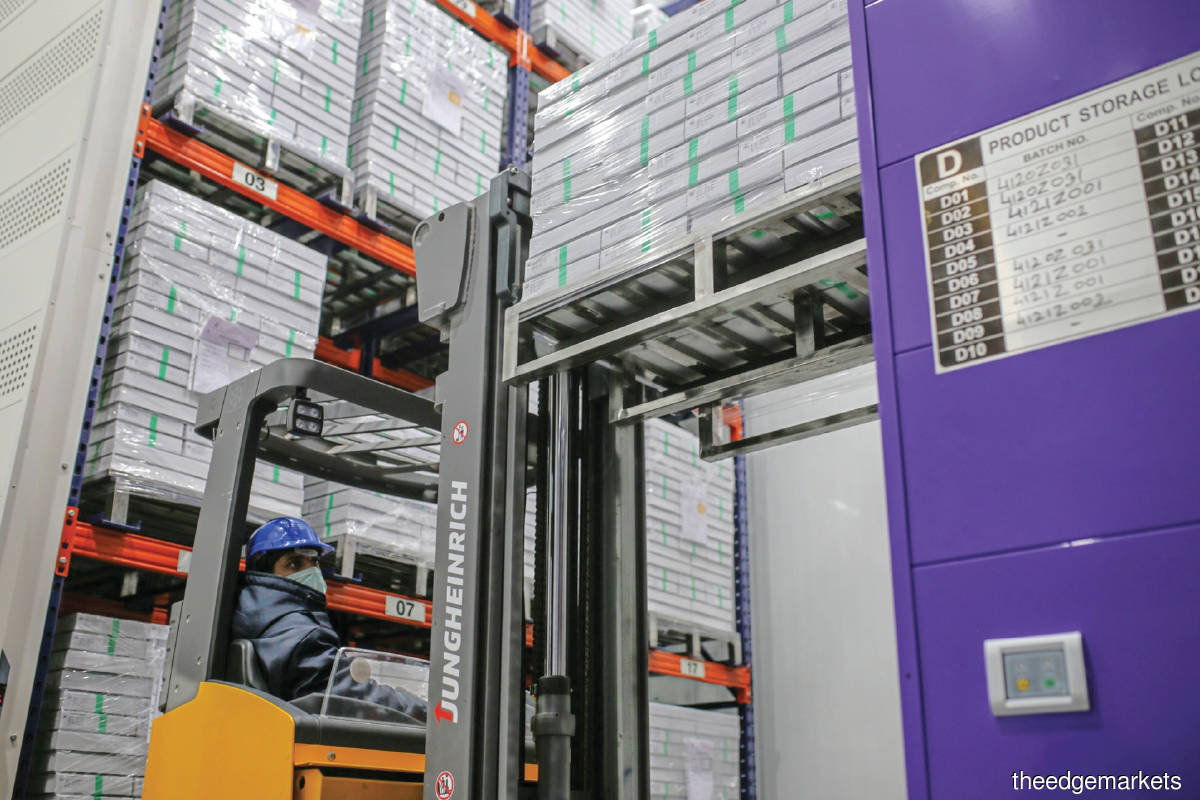

THE global rollout of Covid-19 vaccines has brought on a slew of new logistical challenges for vaccine manufacturers and logistics providers. While the capacity to meet the transport needs is adequate for now, it will not be enough as more players enter the Covid-19 vaccine manufacturing space, experts say.
One of the three major challenges for vaccine makers is to get the vaccines out as quickly as possible, says Christina Yi, chief operating officer at US company Covaxx, a unit of United Biomedical Inc.
“We cannot compromise on the safety and efficacy of our drugs. As such, manufacturers like Covaxx will take on additional business risks and costs that would not typically be economically viable in other circumstances such as moving forward with manufacturing multiple formulations on a large scale while waiting for the clinical trial results to determine the dosage amount,” she says during a panel discussion at the recent Covid-19 Vaccine Summit on Global Access and Distribution — Makers and Movers 2021.
Finding the capacity to manufacture the vaccines is yet another challenge for vaccine companies. “Covaxx is fortunate that we have the capability to produce hundreds of millions of doses within our corporate network. However, that is still not enough. So, during this time, we have to widen our production capacity by working with global partners to help meet our target of delivering one billion doses by end-2021,” Yi says.
According to her, the third challenge vaccine makers face is the worldwide distribution of the vaccines. Covaxx is partnering with AP Møller-Maersk for worldwide delivery of its vaccines.
As more vaccines are being rolled out, there will be increased pressure on available capacity and it is something logistics providers have to manage, says Michael Culme-Seymour, adviser at the World Economic Forum and World Health Organization. “The challenge would be when the fanfare [around Covid-19 vaccines] dies down and the volume of vaccine increases because, in six months’ time, we may have up to 20 companies producing vaccines. Do we then have the infrastructure [to support] and will Customs and regulators have enough capacity to manage the day-to-day customs clearance of the vaccines? That has to be seen.”
Culme-Seymour notes that, until now, most Covid-19 vaccines are being rolled out in countries with good infrastructure. However, the last-mile delivery would be a challenge for logistics providers in less developed countries that lack basic infrastructure.
“Distribution to these countries will take longer even though vaccines are desperately needed there. We have seen in recent weeks how some of the vaccine makers like Pfizer and AstraZeneca have had to cut deliveries of their Covid-19 vaccine to the European Union, owing to problems with production, which is in the early days. The situation right now is fluid and we have to address this with flexibility — by being able to react quickly,” he says.
Logistics providers ready for vaccine distribution
Another panellist, Andrea Gruber, head of special cargo at the International Air Transport Association (IATA), says in terms of preparedness, logistics providers — from air freight forwarders, airlines and airports to ground handlers — are ready to provide logistical support.
“The air freight industry has been handling and transporting vaccines and pharmaceutical and life science products for years. The air cargo process is robust. However, the new challenge is the scale that is increasing in terms of providing the vaccines rapidly globally. This is where we are raising awareness within the [airline] industry and with key industry organisations and governments to gain an understanding of the factors to take into account for large-scale transport and distribution of vaccines,” she says.
She cites the limited amount of dry ice that airlines can use on board an aircraft as one of the early issues in transporting Pfizer’s Covid-19 vaccines, which require a storage temperature of -70°C.
DHL vice-president of life sciences and healthcare for Asia-Pacific Leonora Lim points out that the rollout of Covid-19 vaccines has only just begun and logistics capacity is still manageable at this point.
“The biggest concern for me today is the situation with sea freight, where there is port congestion and resulting delays and equipment shortages. This is driving a lot of customers to opt for air freight. That could cause a situation as the vaccine evolves further,” she says.
DKSH Holdings (Malaysia) Bhd (DKSH Malaysia), the Malaysian unit of the Swiss logistics and supply chain management services provider, is ready to handle Covid-19 vaccines at its existing cold-chain facilities in Malaysia.
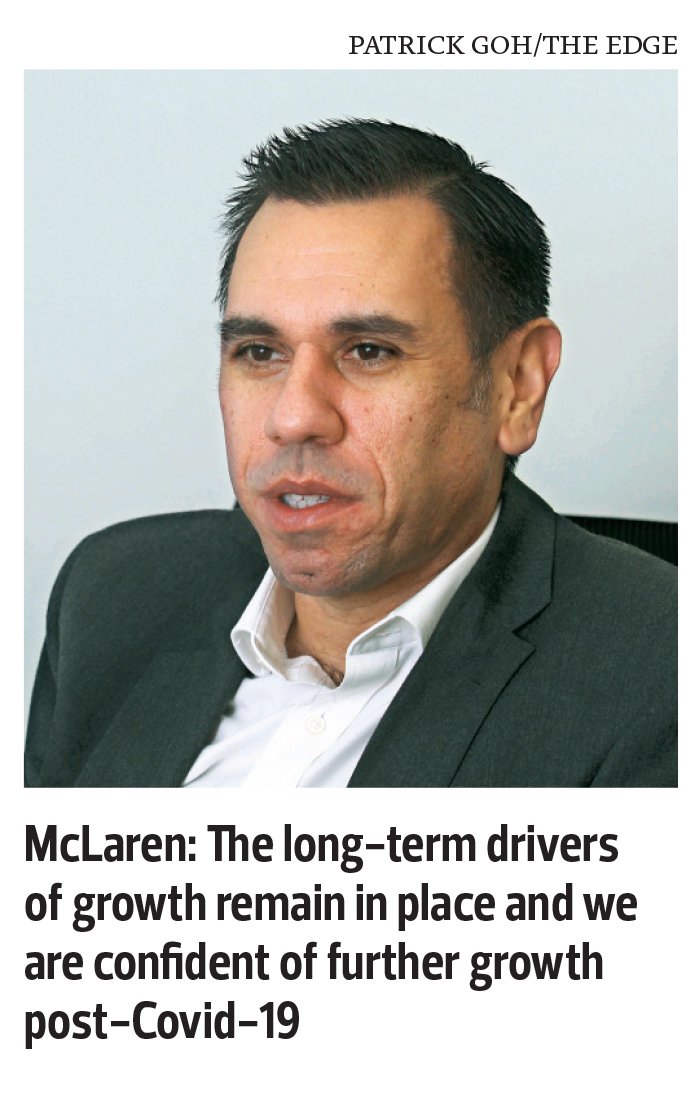
“We will look into the specific requirements of any potential Covid-19 vaccine where required. We will ensure supply to the market if or when clients request for this. As an established market expansion services provider, we have the full suite of services to serve clients, as well as a wide capillary network for distribution to the private and public healthcare sectors,” its head of country management Nicholas McLaren tells The Edge.
On the impact of the second round of the Movement Control Order (MCO 2.0), which came into effect on Jan 13, McLaren says the group continues to operate with no major disruption to its business operations as it provides essential services to serve the fast-moving consumer goods and healthcare-related industries.
He explains: “We had developed a business continuity plan, and rapidly and successfully implemented it. Our supply chain and field sales operations experienced no significant interruptions, and our office-based staff smoothly transitioned to working from home and continue to do so with no productivity issues.
“Overall, we have successfully weathered the storm despite some impact in some of our segments. We have benefited from our well-diversified portfolio of business interests, our deep market knowledge and our preparedness. The long-term drivers of growth remain in place and we are confident of further growth post-Covid-19.”
Still, McLaren remains cautious about the market outlook in 2021, noting that the ramifications of the MCO 2.0 have yet to be fully known. DKSH Malaysia’s net profit increased 45% year on year to RM31.58 million for the nine months ended Sept 30, 2020, even though revenue dipped slightly to RM4.81 billion.
Pharmaniaga Bhd, one of the two companies chosen to package the Covid-19 vaccine in Malaysia, stands ready to mobilise the capacity at its existing small volume injectable plant in Puchong, Selangor, for the Covid-19 vaccine fill-and-finish process, its managing director Datuk Zulkarnain Md Eusope says, adding that the pharmaceutical group is in discussions with the authorities to repurpose the plant.
“We plan to perform fill-and-finish operations for five vaccines with large demand and carry out a trading business for six vaccines with low demand. We also plan to own the intellectual property (IP) of one product to be manufactured here and distributed worldwide,” he said at a separate webinar on Feb 2. Pharmaniaga is partnering with China’s Sinovac Life Sciences Ltd to supply 14 million doses of Covid-19 vaccine to the Malaysian population.
Collaboration a solution to supply chain challenges
Dan Culverhouse, head of global supply chain management at DKSH, sees significant distribution challenges arising in some markets in Southeast Asia. “There is a lot of focus on how we can move these vaccines around the world, but I think the real challenge comes from distributing them within the country itself,” he says, citing Thailand as an example, as its population is spread out over a vast geographic area.
Nevertheless, he does not see ultra-low-temperature Covid-19 vaccines being a big part of the distribution challenge in Southeast Asia.
“We would be looking more towards chilled vaccines where there is available capacity. And what is going to make this rollout successful is the collaboration between us and other partners or logistics providers.
“We have to remember that nobody is doing this altruistically. We are all in business here. What we have to do is be real about where our strengths are and where they are not. In the latter situation, we have to make sure that we are talking and partnering with specialists that have the expertise even if they are commercial rivals. We recognise that we can’t do it all ourselves and we will always make sure that, if we are going to take on this [vaccine distribution] responsibility, we must partner with whoever is necessary to ensure its success. You have to go past it just being a commercial opportunity. There is a moral opportunity in all of this as well, and we take that very seriously,” adds Culverhouse.
Culme-Seymour highlights three areas that Southeast Asian countries have to focus on for the campaign to encourage more vaccinations to be successful. One is local manufacturing.
“We have seen AstraZeneca agreeing to produce vaccines in Malaysia and Australia. Indonesia is looking to produce its own vaccines in collaboration with Sinovac as well. This will remove the whole challenge and headache of flying vast amounts of vaccines across the world and provides a long-term solution.
“The second challenge is counterfeits. We already know that you can go on the website to buy fake Covid-19 test certificates. We know that organised crime is looking at the IP of the pharmaceutical and logistics companies because there is a massive opportunity for them to launch fake vaccines out there. Thus, the logistics [sector] has to come up with a robust blockchain sterilisation system to protect the vaccines, from the manufacturing plants to the point of vaccination,” he says.
Culme-Seymour also sees the disposal of biomedical waste, including personal protective equipment kits worn by healthcare professionals as well as needles and syringes posing a challenge to countries in Southeast Asia.
“There is going to be a lot of injectables that must be incinerated, but there are many countries in the region that don’t have these facilities or not at a big scale. This is where logistics companies can help play a role in disposing of and destroying the biomedical waste,” he says.
Recent Comments