

Following is a transcript of the video.
Mark Matthews: This building, it’s almost living and breathing.
Narrator: Every day, American Airlines loads up 715,000 pounds of cargo onto planes. And Dallas-Fort Worth is home to the airline’s largest cargo operation. Live animals, food, PPE, and Legos end up on flights headed as far as Shanghai or Frankfurt. But getting the right cargo on the right plane in time for takeoff is no easy task. It takes a team of 220 people to haul and fit thousands of pounds of freight into planes.
Matthews: It’s 100 miles an hour. There’s no ramp-up. Immediately, you’re drinking from a fire hose.
Narrator: That’s Mark. He took us inside American’s 171,000-square-foot cargo facility to see how crews keep cargo flying, even as COVID-19 halts air traffic around the globe. To keep moving freight, American Airlines launched cargo-only routes for the first time in 36 years. In 2020, the airline sent out 5,000 cargo-only flights across 39 new routes.
The massive cargo facility in Dallas is located here at the airport. It’s broken down into inbound cargo here and outbound cargo here.
Matthews: This is where the magic happens.
Narrator: The outbound center handles shipments from trucks that will then be loaded onto planes. Some trucks come from as far as Guadalajara and Mexico City.
Matthews: This is the drop-off dock back in the back, and so that’s where the shipments will come in.
Narrator: Goods are unloaded and go right into the tracking system.
Matthews: That way the load planners can see how much freight we’re planning for a departure. There’s an army of forklifts, and we’ll try to keep you safe while you’re here. A lot of PPE, personal protective equipment, lately. Ventilators, latex gloves. Candy. Laffy Taffy. And this is from São Paulo, Brazil.
Narrator: Just like passengers and their bags go through airport security, so does cargo.
Matthews: They come over here, and they go through screening. Every piece of cargo gets screened.
Narrator: Workers are looking for anything that doesn’t belong. Once everything is screened, the goods are moved to their designated locations in the warehouse — even animals. [barking] In 2019, American moved 40,000 animals.
Matthews: It’s not unusual to see 100 live animals a day. We have one that’s waiting anxiously for his owner to pick him up.
Worker: Little Joey.
Narrator: Fruits, veggies, herbs, and flowers head over to one of these three fridges.
Matthews: This is our perishables cooler. Most of our fresh fruits and vegetables come from Mexico or Central America, sometimes from South America. Next week we have about 20,000 pounds of blackberries going to London.
Narrator: This area is for human remains.
Cherryl Fegurgur: We take care of our veterans. When they’re fallen soldiers, that are very meaningful that we do ship.
Narrator: And, finally, any oversized cargo heads to this section. A few hours before departure time, the cargo is tugged to a build station.
Matthews: So, here we’re seeing that they’re building up freight for one of our outbound departures onto a PMC.
Narrator: Workers build up cargo on these aluminum pallets called PMCs.
Matthews: Using the expertise that he’s developed over time, he’s looking at each shipment and deciding what’s the most efficient way that I can build this.
Narrator: But they can’t build the freight any taller than 65 inches, so it can still fit through the airplane door.
Matthews: You never know if it’s going to be raining in London when you get there, so we protect everything from the elements by wrapping it in plastic. So they’ll have plastic on the bottom, they’ll put plastic over the top, wrap those two together, and then put the cargo net over it to restrain everything.
Narrator: If it’s food, flowers, or herbs, they’re loaded into temperature-controlled containers.
Matthews: They have batteries that maintain the temperature inside the unit. It’s like shipping a refrigerator.
Narrator: These bundles of cargo, once built, are called unit load devices, or ULDs. Each ULD goes to be weighed. A single container can’t be over 3,500 pounds, but the pallets can hold even more weight. While it depends on weather, route, and if passengers are on board, a Boeing 777-300 can carry up to 125,000 pounds of cargo. Any more, and the plane could struggle to take off. So it takes a lot of knowledge of the weight and dimensions of every plane to get this right.
Matthews: A lot of expertise in building. Many of these guys have 40 years or more.
Narrator: Finally, the ULDs are loaded onto tugs and driven out to the plane.
Matthews: So, this is what we call the backyard. This is where we stage wide-body cargo that’s ready to go to the aircraft, and so all of these lanes have a letter. In our system we can see what lane they’re in, so that the drivers know what to go get and what to take to the aircraft. This is the London departure that we were watching them build the freight for earlier today. It’s all right there, about to be loaded.
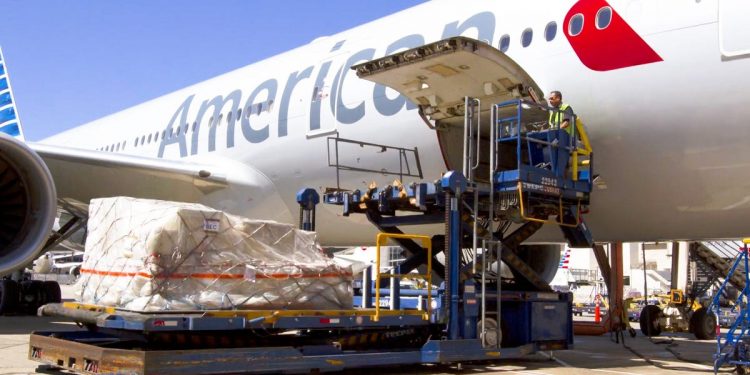
Narrator: On this Boeing 787, workers have three doors they can load cargo through. The front and aft, or back, doors are the biggest. The cargo is brought up to the height of the plane using a lift. The lift and the plane have rollers on the floor to easily move the heavy load.
Matthews: He controls the rollers from a control panel over here on the side of the aircraft.
Narrator: This is the hard part. It’s like a game of Tetris, trying to figure out what combinations of containers and pallets will fit snugly. But a plan helps. Teams figure out where each ULD should go to best use the space and balance out the weight on the plane. After everything’s in the right place…
Matthews: There’s floor locks that come up, and they keep the cargo from shifting.
Narrator: Through the smaller door in the back… Matthews: Which we call the aft bulk…
Narrator: Workers load any bulk cargo. That’s anything that’s not built into a container or onto a pallet.
Matthews: That’s typically where we’re going to put live animals or really anything that is connecting to this flight.
Narrator: And all this has to happen quickly.
Roger Samways: Consumers’ expectations, as far as delivery times, continue to increase, right? We want our goods faster.
Narrator: On average, workers have about an hour to load and lock all the ULDs and any free-loaded cargo before the plane takes off. And this whole process happens in reverse for incoming planes carrying cargo.
Matthews: The freight’s off the aircraft. Our runner will come and pick it up and take it back to our cargo facility. From there, it goes through our breakdown process, where we take it all off of the PMCs and separate it based on airway bill number. And then, from there, we stage it in one of those locations that we saw earlier, so that whenever the customer arrives, we can load it on their vehicle. And we have four hours from the time the aircraft locks in until it’s got to be ready for the customers to pick up.
Narrator: In 2019, airlines worldwide moved 122 million pounds of freight every day, but coronavirus made this work even harder. In 2020, airlines averaged only 101 million pounds daily. When passenger volume dropped 75% in April, the airline cut passenger routes that usually carry cargo. Fewer routes also meant fewer direct flights. That led to a lot more cargo connecting through Dallas.
Samways: It might have originated in Asia or Europe, you know, and it’s passing on to Latin America. And that introduces a lot of additional complexity. You have to physically handle the freight a lot more often.
Narrator: But cargo still needs to be moved, even if the world has stopped traveling.
Samways: We live in a globalized world where not every country produces everything they need. From cellphones to laptops, to clothes, to food, relies on air-cargo transportation.
Narrator: But even with the introduction of cargo-only flights, the airline has still lost billions.
Samways: It’s a drop in the ocean, but in no way does the additional cargo revenue that we’re generating offset the 75% drop in passenger revenues that we’ve been seeing this year. No big surprise we’re going to post losses next year.
Narrator: So until passenger traffic returns to normal, American plans to continue flying and packing these cargo-only flights.
Samways: The goal, obviously, ultimately, hopefully quickly, is for those aircraft to return to passenger service.
Matthews: Probably a theme going into next year will be that everything’s fluid and we have to remain flexible.
Recent Comments