


Air cargo rates are climbing sharply again, especially for shipments via Asia, after the slowdown for the recent Chinese New Year holiday was more muted than usual. And there is little prospect for price relief the rest of the year, analysts say, with the supply of large, intercontinental aircraft still far below pre-pandemic levels and ocean capacity oversubscribed.
Market watchers describe conditions for air shipments as volatile. COVID-19 has changed life and economic conditions so much that air logistics professionals say it is too difficult to make assumptions about where the market is headed.
Unusually high import demand and a shortage of widebody passenger planes pushed up airfreight rates out of Asia by 50% for the first half of February after a small pullback in bookings following the high Christmas season. Businesses are now paying about 2.5 times more to book air shipments on core lanes than in recent years, according to FreightWaves SONAR and other indices.
Many factories in China kept producing this year instead of closing for the spring festival after the Chinese government discouraged people from traveling to visit families. Airfreight volumes correspondingly only dropped 30% for the week of Chinese New Year that began on Feb. 12, about half as much as the industry experienced the previous two years, according to information provided by CLIVE Data Services. And aircraft load factors only dipped 1% compared to about 20% in 2019 and 2020.
The lack of a production pause added to the backlog rippling up the supply chain from heavily congested U.S. and European ports where vessels, in some locations, are waiting a week at anchor for a berth. Ocean carriers are completely booked and don’t have enough containers to meet surging demand from companies trying to fill e-commerce orders or replenish depleted inventory from last year.
Container space on ocean vessels is at such a premium — the spot rate from Asia to the U.S. West Coast is about $5,000 per forty-foot equivalent unit (up 260% year-over-year) and to Northern Europe it’s more than $8,000 — that shippers are once again shifting freight to air. Shipments should be booked at least three weeks in advance to make a voyage, logistics practitioners advise. Converted to average airfreight pricing, shipping the contents of a container by air to Europe would cost $110,000, Robert Frei, business development director at The Air Cargo Index, said in a recent market report.
Overall, week-over-week volumes drifted down 3%, but capacity fell more — by 5% during the third week of February, according to data service World ACD. Supply and demand varies by region.
Demand for air cargo out of Asia is expected to increase and keep rates elevated in the coming weeks, analysts say. And capacity purchasing out of Europe is already nearing the November peak season level, according to search data for electronic bookings on the WebCargo platform. Air rates from Germany to the U.S. are dramatically higher than a year ago.
The amount of airfreight is creating ground-handling backlogs at major European airports. Adding to the disruption are imports of personal protective equipment that often arrive on an ad hoc basis with little ability to plan logistics. The special handling requirements for PPE shipments, such as riding in the cabin of temporary passenger freighters, are causing additional work and delays, German forwarder Senator International said in a weekly customer update.
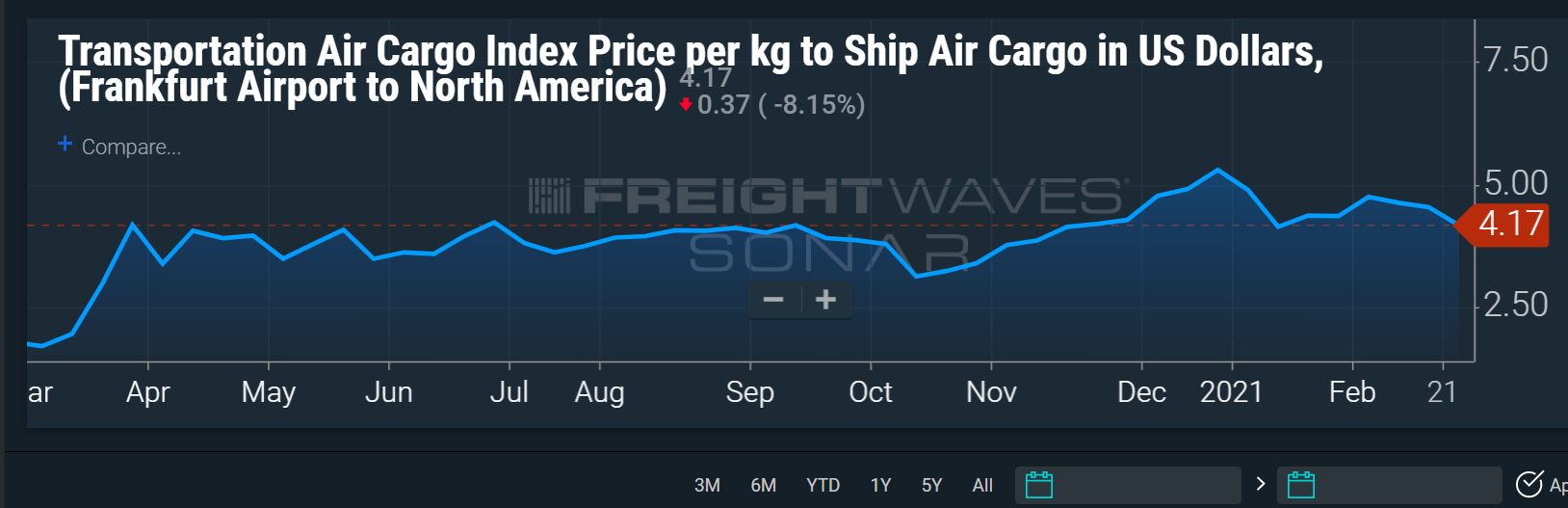
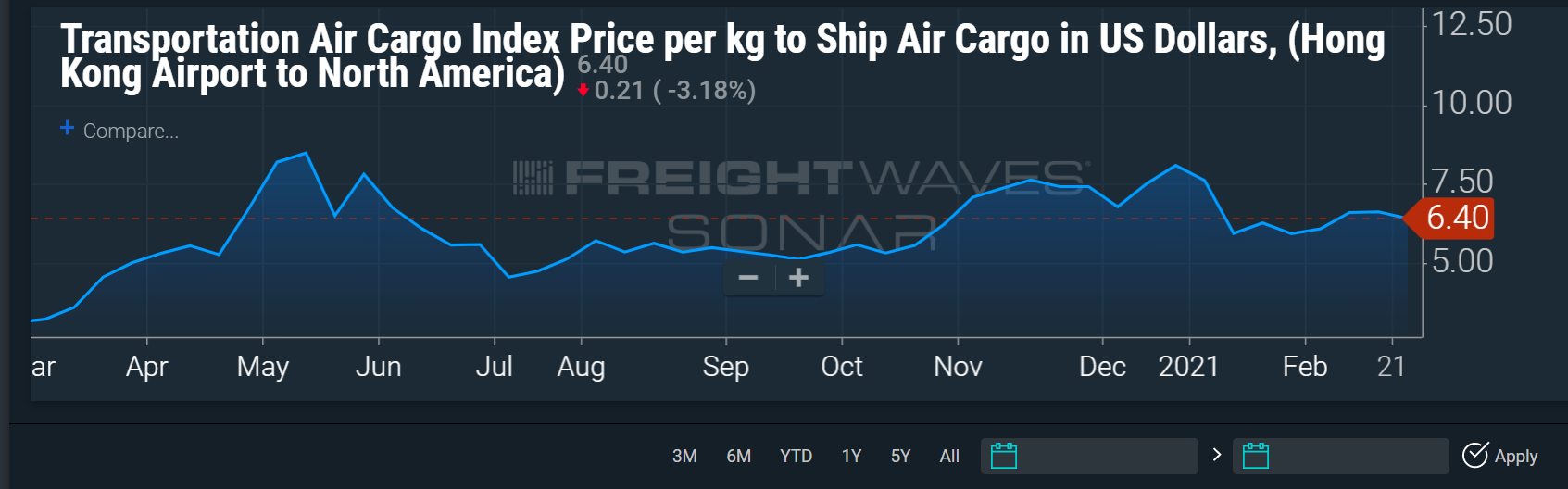
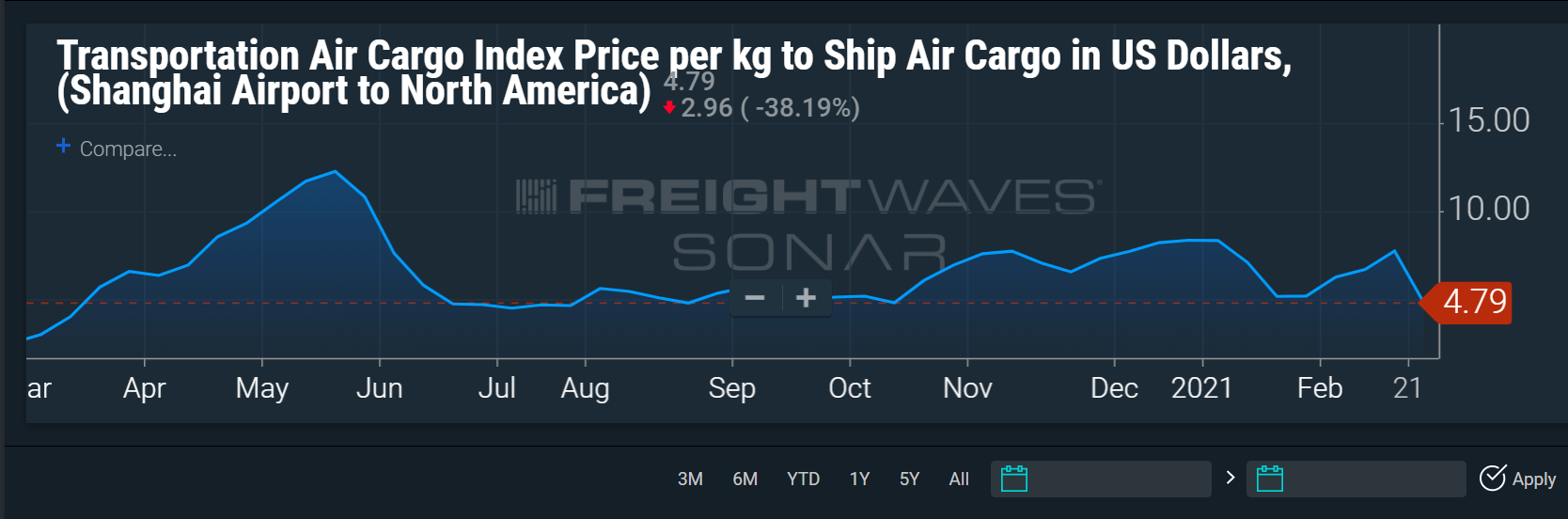
Rates out of China declined slightly for about a week, helped by additional charter flights entering the market and fewer airfreight moves than anticipated during Chinese New Year, but freight forwarder Flexport said in a recent client note it expects a rapid return of volume and higher rates this month. Markets in North Asia, Taiwan and Southeast Asia remain strong, with rates averaging between $7 and $8.50 per kilo to North America and slightly less westbound to Europe.
Supply and demand drivers
The surge of air and ocean shipments comes at a time when demand typically begins to level off and then decline after Chinese New Year.
Commodities filling aircraft these days include electronics and communications equipment, auto parts and e-commerce orders.
And drug companies are ramping up production of COVID-19 vaccines, which will start to compete for aircraft space with regular cargoes. Early fears that airlines would be overwhelmed by a huge wave of new vaccines being rushed to the field, and would prioritize them over less critical shipments, never materialized. But new vaccine approvals, extra manufacturing capabilities and better logistics planning by governments is increasing the pace of shipments.
In the U.S., the Food and Drug Administration on Friday approved a third COVID vaccine, made by Johnson & Johnson (NYSE: JNJ), which began shipping Monday. Since taking office 39 days ago, the Biden administration has significantly boosted weekly allocations of vaccines for states. And pharmaceutical companies say they are on track to deliver 700 million doses across the U.S. by midyear, with Pfizer doubling its production by mid-March. As the U.S. population gets immunized, more production will be available for export.
Consumers are at the heart of the U.S. economy and there are strong indications that they will increase their buying even more in 2021, although more spending on services could materialize later this year as more people are vaccinated and feel safe to mingle in public.
Retail sales swelled 5.3% in January, normally a slower month, according to the Department of Commerce.
The National Retail Federation last week forecast retail sales will grow 6.5% to 8.2% to as much as $4.4 trillion, on top of 6.7% growth in 2020. That compares to average retail sales growth of 4.5% the past five years. The e-commerce component is forecast to grow 18 to 22%, the trade association said.
Aircraft supply also suggests transport purchasers for goods face a daunting rate environment for the rest of the year.
Passenger airlines have removed about 30% of their seat capacity since January in response to new coronavirus outbreaks and border closures around the world. Overall, supply is about half what it was a year ago before the industry went into a self-induced coma for several weeks, according to travel data provider OAG Aviation.
Airline executives and analysts say immunizations and pent-up travel demand should result in passenger traffic rebounding in the second half, but the problem for shippers is most of that activity is likely to be in short-haul, domestic leisure lanes. Long-haul international lanes between large manufacturing and consumption markets are expected to take at least until 2024 to reach pre-pandemic levels, which means widebody flights with belly space for cargo will remain quite limited.
Bruce Chan, vice president of global logistics at investment bank Stifel, said in a recent blog that the air cargo market won’t return to normal until 2023.
Incremental freighter capacity continues to trickle into the market, but it’s not enough to move the needle.
DSV Panalpina A/S (DXE: DSV), for example, has added three intercontinental charter routes to give its customers more flexibility shipping goods. A weekly Luxembourg-Sao Paulo flight began operating last week. A four-times weekly round trip between Luxembourg and Johannesburg begins April 1. And a weekly connection from Shanghai to Rockford International Airport, outside Chicago, and back began Monday.
San Francisco-based Flexport in the past week added an additional charter frequency, operated by an airline partner, from Hong Kong to Los Angeles, and inaugurated a twice-weekly charter operation from Taipei to LA.
MAS Air on Feb. 19 began operating a Boeing 767-300 freighter between Mexico City and Frankfurt three times per week for German logistics company Senator International. The outbound charter connects through Quito, Ecuador.
French freight management company GEODIS has purchased control of a freighter that will begin operating weekly flights from Shanghai to Guadalajara, Mexico, beginning Wednesday. The company said it is the only direct service on that route.

Meanwhile, United Cargo is temporarily subtracting some capacity in March after the airline pulled down two dozen Boeing 777-200 passenger aircraft to check for a potential engine problem and shifted other aircraft to compensate for the temporary loss. Another constraint on air shipping is the recent quarantine restriction in Hong Kong for returning pilots, which reduced the number of available pilots at Cathay Pacific and forced it to cancel many long-haul flights.
On the positive side, United said it will start daily nonstop service between Boston and London Heathrow with midsize Boeing 767 aircraft, although the date is still undetermined. Additionally, Lufthansa Airlines said it will reintroduce five trans-Atlantic routes for its summer season, beginning March 28. Sister carriers SWISS and Austrian Airlines will resume multi-frequency weekly routes from Zurich and Vienna, respectively, to several cities between late March and May.
Click here for more FreightWaves/American Shipper stories by Eric Kulisch.
RELATED NEWS:
United Cargo’s March schedule dented by removal of Boeing 777s
For airlines in 2020, cargo no substitute for people
Reversal of fortune: Capacity drains from air cargo market again
Hong Kong quarantine disrupts FedEx, Cathay Pacific crews and cargo
Recent Comments