

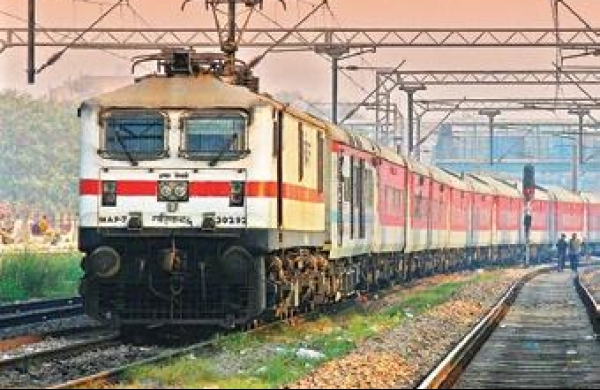

Even as you read this, something exciting is happening. A special train is snaking its way from Finland to India. From Helsinki to Mumbai (at the Nhava Sheva port) in just about 22-25 days.
This freight train is carrying paper products for a Swedish company, but it is not so much what it is carrying that is important as the fact that this journey is being made at all. This is no ordinary train ride.
This journey opens a historic new route for transporting goods via rail between Europe and India via Russia, Azerbaijan and Iran. This route not only reduces the freight transport distance between Russia and India from around 40 days to approximately two weeks, but also provides an alternative to the traditional sea route through the Suez Canal.
It is part of something called the International North-South Transport Corridor (INSTC), which seeks to build transport routes that connect Central Asia, Europe, Iran, Russia and India. It seeks to build multi-modal transport linkages and systems that bring closer together a region of great energy and commodities producers with its consumers, and connect cities like Mumbai, Baku (capital of Azerbaijan), Moscow, Astrakhan (in southern Russia), Tehran and others more intricately in trade. Two test runs had been done in 2014—Mumbai to Baku, and Mumbai to Astrakhan—which had shown that significant benefits in costs and speed could be achieved using such routes. Other routes involving Turkmenistan and Kazakhstan are also being considered.
This project is part of the overall push for rail freight to go to places it has not before. In the last one year (June 2020-21), according to government data, freight loaded by Indian railways rose from 93.59 million tonnes to 112.65 million tonnes, and its earnings increased from Rs 8,892.68 crore to Rs 11,186.81 crore.
This growth is on the back of a major push to use the full capacity of India’s railway prowess as one of the world’s biggest passenger and freight networks. The country’s railway networks carry 1.2 billion tonnes of freight each year across a 68,000-kilometre network.
Whether in reinvigorating railway ties with Nepal, building dedicated freight corridors at home or moving to a more sustainable energy-based railway system with the increasing use of electricity, rail freight has been an area of much action in recent times. Even in the middle of the pandemic, the Indian railways was able to complete the work of dismantling and reconstructing the Valsad road overbridge on the Western Dedicated Freight Corridor in Gujarat in a record 20 days.
A recent report from the government think tank NITI Aayog has suggested that the progressive shift of freight traffic to the railways would significantly lower India’s logistics costs and make it more sustainable as the railways themselves become greener. This is reversing the old trend of declining freight share of rail travel versus road. India’s road networks need decongesting and rail-based freight travel is easier, faster and cleaner. Fewer trucks mean decreased emissions, and, as the report suggests, better, cleaner freight logistics could assist India in cutting emissions by 10 giga tonnes of carbon dioxide, 500 kilo tonnes of particulate matter and 15 million tonnes of nitrogen oxide by 2050.
With the pandemic, around the world, new, sustainable logistics routes are being constructed to boost supply chain resilience—not just from natural obstacles but also political ones, as sea routes become more contested.
I wanted to write on rail freight in this column because under the bedazzlement of technological advancements and a profusion of mobile apps, artificial intelligence, machine learning, a SaaS (software-as-a-service) boom and other such wonders, often the basic brick-and-mortar changes in the economy get drowned. They do not receive due attention even though reform in these areas is key to transforming the economy.
Railways is close to my heart because my father is a retired railway man, and I have felt for a long time that its potential is yet to be fully utilised in the country. There has, in the last few years, been a lot of change in the railways—basic things like fixing sanitation, stations and getting new trains that create the railways experience as that, ‘an experience’, rather than merely travel. This is particularly relevant in a country that has some of the most scenic routes in the world and a vast network.
But even in this conversation, the focus remains on the more glamorous part—passenger transport. The change of ambition in rail freight is, in a sense, as exciting, and understanding what it could bring to India in terms of logistical, strategic and environmental benefits must be properly contextualised and understood.
Hindol Sengupta
Vice President & Head of Research at Invest India, GoI’s national investment promotion agency
([email protected])
Recent Comments