

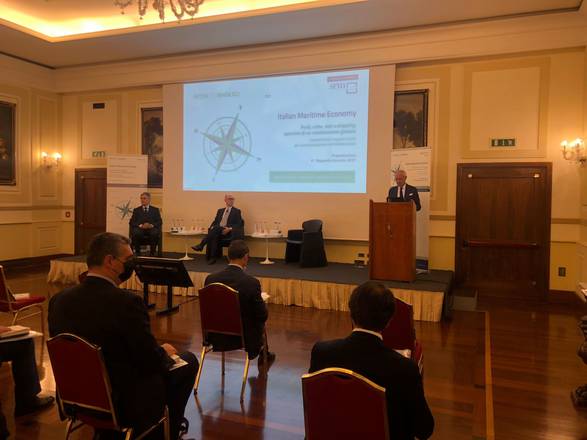

(ANSAmed) – NAPLES, 08 LUG – The 8th annual edition of the report “Italian Maritime Economy” was presented in Naples on Wednesday by SRM (Study and Research of the Mediterranean) research centre.
It showed that 90% of international cargo travels by sea and that maritime transport and logistics are worth about 12% of global GDP.
According to the most recent forecasts by the International Monetary Fund (IMF), global GDP is set to increase by 6% in 2021 and 4.4% in 2022, reflecting a stronger economy aided by this year’s vaccination campaigns and increased financial support in some of the world’s largest economies.
The SRM report clearly analyses how Covid-19 affected equilibrium in global maritime trade, which, however remained the main vehicle for trade.
SRM President Paolo Scudieri said the meeting to present the report has become an annual tradition in Naples and represents a time to reflect on shipping, ports and logistics, which together represent 12% of global GDP and 9% of Italian GDP.
“SRM has had another year of intense activity, highlighting with its studies the economic ‘weight’ of the entire supply chain of the sea economy, which is an asset for the country’s competitiveness,” Scudieri said.
“We have grown the Observatory, convinced that sea transport is an essential resource for our country’s manufacturing system, which has a permanent need to internationalise business and send its goods to foreign markets rapidly, efficiently and economically,” he said.
The report showed that starting in the second half of 2020 there was a demand for goods that partially substituted that for services due to changes in consumer habits during the pandemic, and this generated a surge in e-commerce, which grew by 30% on 2019.
Regarding overall sea transport, an increase of 4.2% is expected in 2021 for total volumes greater than 12 billion tons, higher than pre-Covid-19 levels, and a further increase of 3.1% in 2022.
Looking at the Mediterranean in particular, the Suez Canal showed substantial resilience during the pandemic year, surpassing one billion tons of goods, with nearly 19,000 transiting ships.
It therefore remains a strategic hub for Mediterranean traffic, continuing to represent 12% of global traffic and 7% to 8% of global oil traffic.
The Egyptian government allocated 16.9 Egyptian pounds (1.07 billion dollars) for investments for 2020-21, aimed at carrying out development projects in the Suez Canal.
In May it began new work to enlarge the Suez, with a plan to widen the southern entrance by 40 metres towards the eastern shore of the Sinai and to excavate the seabed to increase depth from 20 to 22 metres.
The second lane, inaugurated in 2015, will be lengthened by about 10 kilometers, further increasing the capacity of the canal and making it more resistant to accidents such as that of the Ever Given.
These works are expected to be completed within 24 months.
In general, the biggest issues that impacted marine traffic, especially on the routes of the Far East-Mediterranean and Far East-USA, were congested ports due to infections, huge increases in freight rates, the lack of empty containers and canceled routes, known as “blank sailing”.
Freight rates reached record levels on the main routes and show no signs of slowing.
They are expected to be high in 2021 with a 22.6% increase, followed by a 9.4% decrease in 2022.
Meanwhile, naval gigantism and strategic route domination by large alliances continue; orders for ships over 15,000 TEU are expected to grow 17% by 2023. (ANSAmed).
Recent Comments