

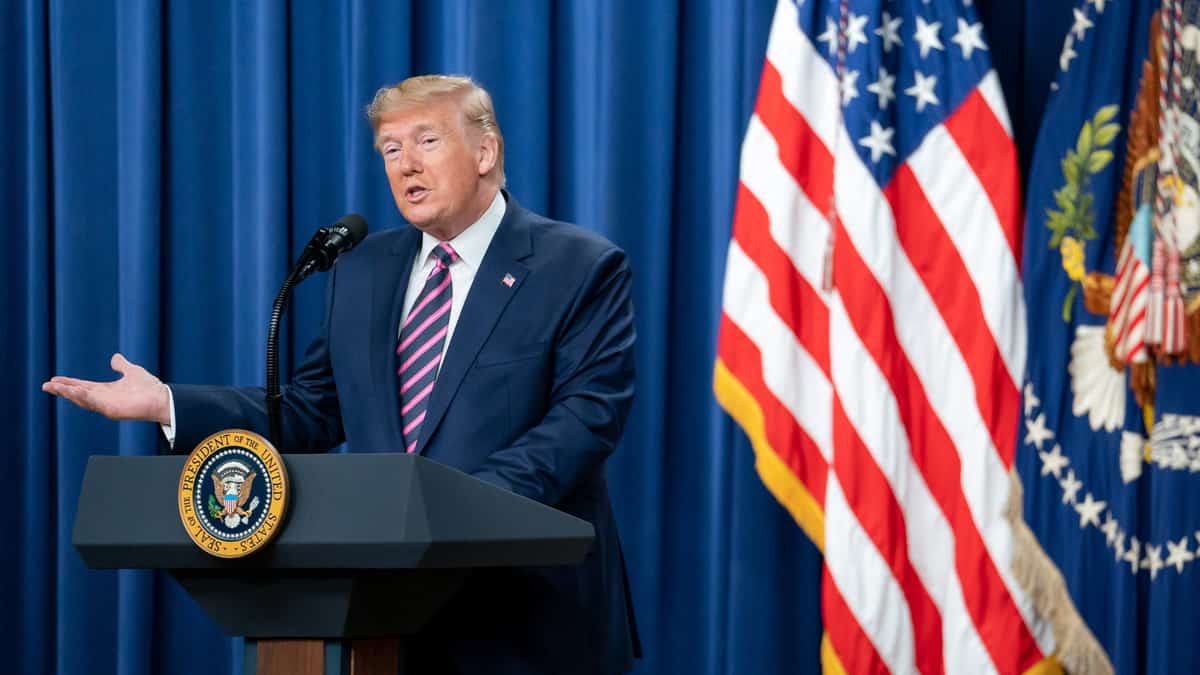

The trade war launched by U.S. President Donald Trump has precipitated years of negative sentiment for ocean-shipping stocks. Finally, some relief is in sight.
The new phase-one agreement halts new tariffs that were to go into effect on Dec. 15 and marks a first step toward getting U.S.-China trade flows back to levels seen prior to Trump’s election.
Trade tensions have been an ever-present overhang on the performance of U.S.-listed shipping stocks because so much of ocean-shipping demand is contingent on Chinese imports and exports of commodities and containerized goods. What’s bad for China’s economy is bad for shipping stocks.
“Phase one … sets up a positive market backdrop for the shipping sector as we approach 2020, which is in sharp contrast to market dynamic a year ago,” affirmed Clarksons Platou Securities analyst Frode Mørkedal in a client note on Dec. 16.
“Although the tanker and gas markets have enjoyed very strong rates over the past few months, there has remained an overhang on equity performance, in our view, driven by investor concern of an ongoing trade war,” said Mørkedal. “The container and dry bulk sectors in particular have underperformed, with both now positioned to see improved market dynamics in 2020 and potentially stronger share performance.”
Multiple shipping analysts highlighted sentiment upside from U.S.-China trade progress. “This trade agreement should help improve sentiment around global trade and economic development, benefiting shipping as a whole,” said Randy Giveans, shipping analyst at Jefferies.
According to Evercore ISI analyst Jon Chappell, “A trade deal should lift the sentiment cloud that has hovered over the dry bulk equities for much of the last year, as it removes some tail risk on China’s economy and [some risk of] further escalation.”
Three years in the crossfire
For those within New York’s ocean-shipping financial community, a forewarning of Trump-era sentiment risk came within hours of the election results.

It was Nov. 9, 2016, at the Plaza Hotel on Central Park South in New York. A Marine Money forum happened to be scheduled for the morning after the election. A crowd of several hundred bankers, investors and journalists shuffled into the venue bleary-eyed and in shock (most lived in Manhattan, a district that voted heavily for Hillary Clinton).
One of the scheduled speakers happened to be Wilbur Ross, then a Trump campaign adviser, soon to be secretary of commerce. Back in November 2016, Ross was heavily focused on shipping through his funds’ private investments in Navigator Gas (NYSE: NVGS) and Diamond S Shipping (NYSE: DSSI).
Ross appeared surprised at Trump’s election as well. At one point he mistakenly referred to “President-elect Clinton,” quickly adding, “Please don’t repeat that.” During his presentation, he laid out what he thought would be the Trump trade strategy.
“People say he’ll just lunge in and put on all kinds of tariffs, which will make for a World War III of trade. Fear not. That’s not at all what he has in mind,” said Ross.
“This is not going to be a blunderbuss. What I believe there will be instead are negotiations, product by product and country by country, in a very systematic way, with our country adopting something like the mentality of a large industrial customer. A large industrial customer plays off suppliers against each other. We’ve never tried playing off what I call our suppliers – namely our trading partners – against each other,” he said on the day after the election.
“There’s plenty of room for redirection of goods,” he continued, assuring the audience that “this doesn’t involve a trade war. What it would involve is redistributing our trade deficit more appropriately and changing the surplus and deficit figures of a variety of other countries.”
Three years later, the reality is that the Trump administration did indeed take a “blunderbuss” approach to trade relations with China. And by any definition, there has been a trade war.
As Ross predicted that morning, the U.S. has negotiated with China as if was a business conglomerate negotiating with an industrial partner. Some of the audience members at The Plaza who heard the speech feared that trade deals were not like business deals, that such a negotiating process would not go smoothly, and that shipping equities (and financier transaction fees) would inevitably be caught in the crossfire. All of which turned out to be correct.
Sector-by-sector effects
The phase-one deal is a first step in the right direction for ocean-shipping fundamentals and sentiment, most immediately affecting container and dry bulk demand.
For container shipping, the deal has halted the implementation of 15% U.S. tariffs on $160 billion worth of Chinese containerized goods ranging from laptops to cell phones, toys and clothes that had been scheduled to go into effect on Dec. 15. It cuts the tariffs implemented on Sept. 1 on $120 billion of Chinese goods from 15% to 7.5%, but leaves prior 25% tariffs on $250 million of Chinese goods in place.
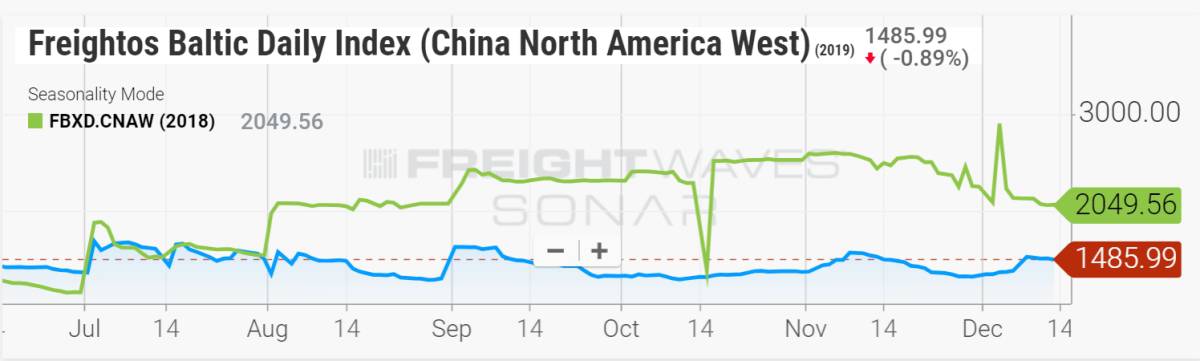
This at least temporarily averts the worst-case scenario for trans-Pacific container shipping demand, but the damage already has been done. Box-shipping pricing data tracked by the Freightos Baltic Daily Index shows year-on-year declines of up to 40% during the second half of 2019.
In dry bulk, the phase one deal calls for Chinese purchases of U.S. agricultural exports; U.S. officials have cited expectations for $40 billion to $50 billion of purchases annually over the next two years, versus pre-tariff levels of $24 billion. However, there is a high degree of skepticism on this aspect of the deal.
According to Ben Nolan, shipping analyst at Stifel, “We believe the only real shipping beneficiaries [of a trade deal] would be dry bulk, LPG [liquefied petroleum gas] and petchem [petrochemicals], and perhaps a small beneficial impact on containers with effectively no impact at all on tankers or LNG [liquefied natural gas].”
The first phase does not cover LPG or petrochemicals, but Nolan nonetheless views them as “the eventual big winners” due to the fact that these “are among the commodities of greatest demand in China.” In a recent interview with FreightWaves, Dorian LPG (NYSE: LPG) CEO John Hadjipateras highlighted the same potential upside for LPG.

On the crude- and products-tanker side of the equation, Nolan noted that “Chinese oil demand is expected to grow by the slowest pace in years for 2020 and [when removing LPG volumes] could actually be negative, which should not be surprising as Chinese automobile sales are down 10.3% year-on-year through the first 11 months of this year. Paired with slower U.S. oil production, any change in tariffs is unlikely to have any impact on the flow of oil between the two countries.
“Similarly, while Chinese LNG buying from the U.S. has stopped entirely and they have great aspirations longer term, in the short term, demand has stalled and current LNG prices do not justify the freight cost of shipping trans-Pacific,” said Nolan. “Consequently, trade deal or not, we would not expect much incremental Chinese buying of U.S. LNG until prices improve, which may be several years out.” More FreightWaves/American Shipper articles by Greg Miller
Editor’s note: Freightos has a business agreement with FreightWaves that includes editorial coverage.
Recent Comments