



Image Credit, Adidas
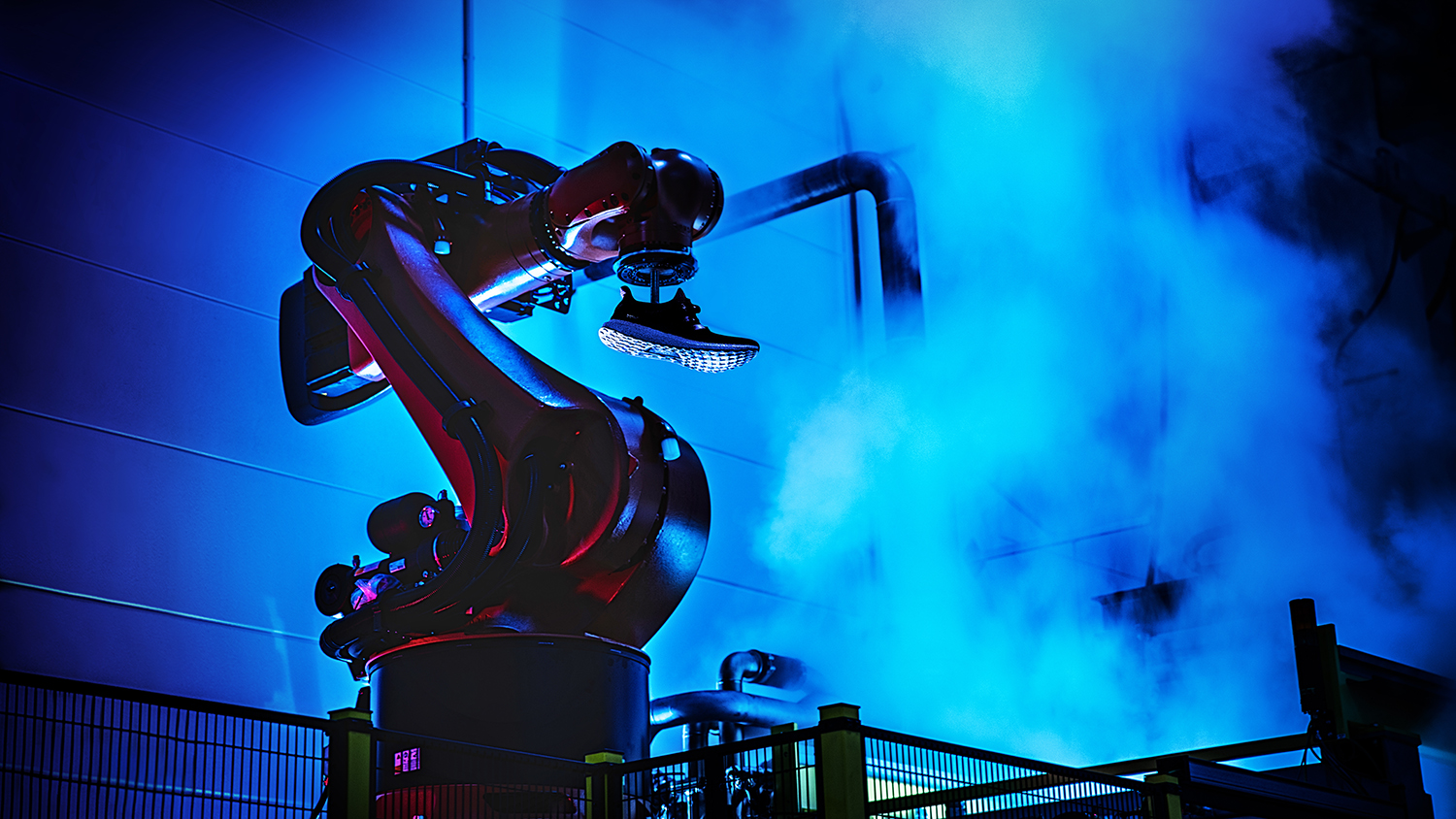
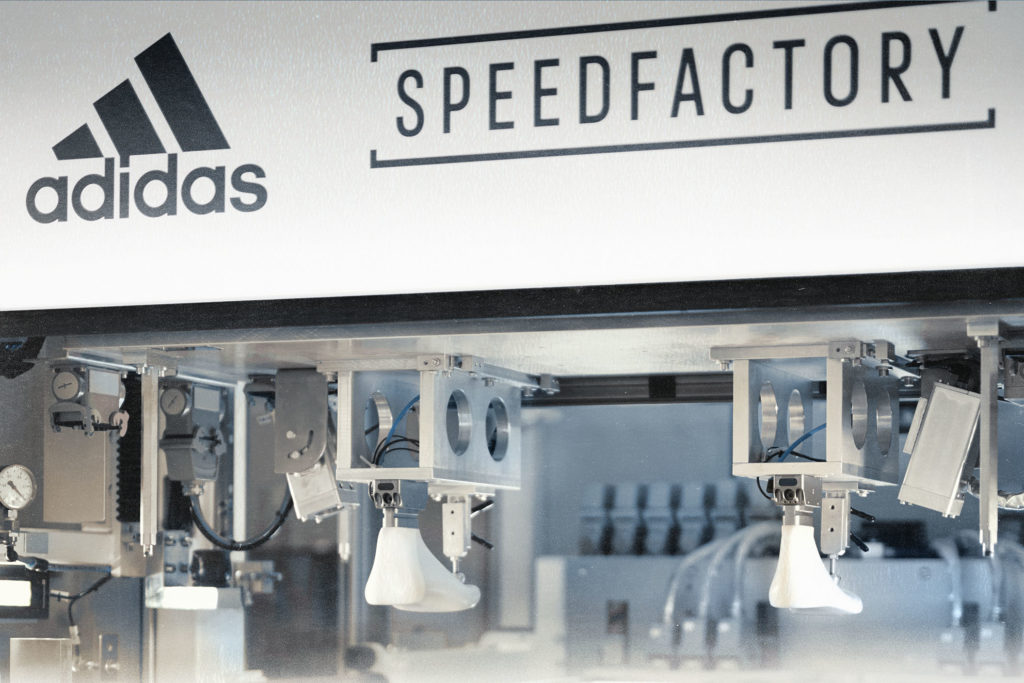
With the announcement that Adidas will be shutting down its much-hyped USA and Germany Speedfactories, highly automated production plants driven by robotics and 3D printing, and relocating them to Asia, the media has been quick to assign the whole endeavor as a failure.
The scale of the Speedfactory project was grandiose. The goal went beyond creating automated 3D printing factories that produced high-performance and customized shoes, to create a new manufacturing paradigm for the 21st century. One that reversed the tide of off-shoring, brought back high-wage jobs to aging economies, decoupled cost from complexity to allow new degrees of consumer customization, and greened the supply chain by relocating production from concentrated global pockets to distributed, responsive and local hubs. As the Economist wrote, “This factory is out to reinvent an industry.”
Adidas shutting down its Speedfactories in the USA and Germany and relocating them to their Asia sites goes counter to these goals. It could rightfully be judged as a failure. This is true if the KPIs we use to judge success are entirely derived from the over-hyped and feverishly optimistic messaging from industry reporters and Adidas’s own communication teams. If we take a more corporate, if admittedly less sexy, perspective on the Speedfactory saga, its relocation to their Asia supply base is a very astute and strategically-minded move. Ultimately, Speedfactory was a supply chain success interpreted as a PR failure.
The whole story
To truly appreciate Speedfactory as an innovation success story for Adidas, we need to widen our field of view. The Speedfactory wasn’t conceived in isolation but is one manifestation of a much larger initiative at Adidas called “Creating the New”, a 5-year strategy to maintain the Adidas brand in a rapidly developing technological and consumer landscape. Head of Global Sales at Adidas, Roland Auschel, explains this strategy focuses on 3 areas, “Where does the consumer live today, how do we want to create products [and] how do we build the brand going forward?” In short, the focus is on cities, speed, and open-sourcing.
As part of this strategy, Adidas has conducted multiple experiments that give a middle finger to convention. A close cousin to the Speedfactory was the “AdidasKnitForYou,” a pop-up shop that substituted store shelves for digital knitting machines and allowed customers to co-create their jumpers and have them produced in the store, in real-time, in-front of them. This was another example of how Adidas is tinkering with production and retail models in-line with their focus on speed, cities, and open-sourcing. The KnitForYou project closed in March 2017 to zero reports that it was an abject failure, counter to the Speedfactory narrative. It succeeded however against its mandate to deliver valuable insights into customer phycology when confronted with the ability to co-create and customize.
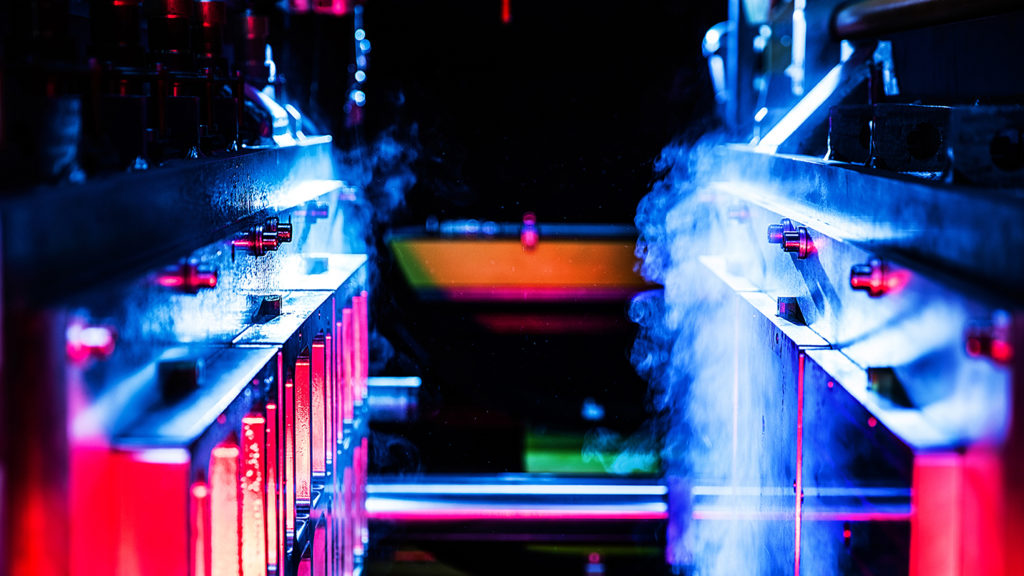
Image Credit: Adidas
The Speedfactory was the big brother of the KnitForYou pop-up, by scale, investment, and expectation. It was a continuation of the Adidas strategy to focus on its three strategic imperatives which were essentially customization, automation and localization. Let’s explore the story of the Speedfactory using these three metrics.
Customize
Let’s start by looking at customization. The strategy consultancies, McKinsey, Accenture, Bain, BCG, etc. demand that consumer goods companies invest in customization if they want to stay relevant in the coming years, with BCG projecting retailers will need to increase their investment into customization and personalization up from an average of 0.7% to 18% in the next three years; an increase of 2500%. Adidas CEO Kasper Rorsted agrees saying, “Digital has a tremendous impact on the way you can tailor your product. Customization will grow more popular over time, starting at the high end.” Kasper, I’m sure, would put Adidas at the high end.
Equal to the value of customization are the barriers preventing it, the most relevant to this critique being finding manufacturing platforms that can enable “mass personalization” i.e. flexibility at scale. The Future Team at Adidas, the group charged with developing solutions for disruptive changes that are 2 to 5 years out, recognized 3D printing as a potential technology solution to square this circle, so they invested heavily into several additive technologies, most notably Carbon’s CLIP process, to validate whether 3D printing is a viable solution here.
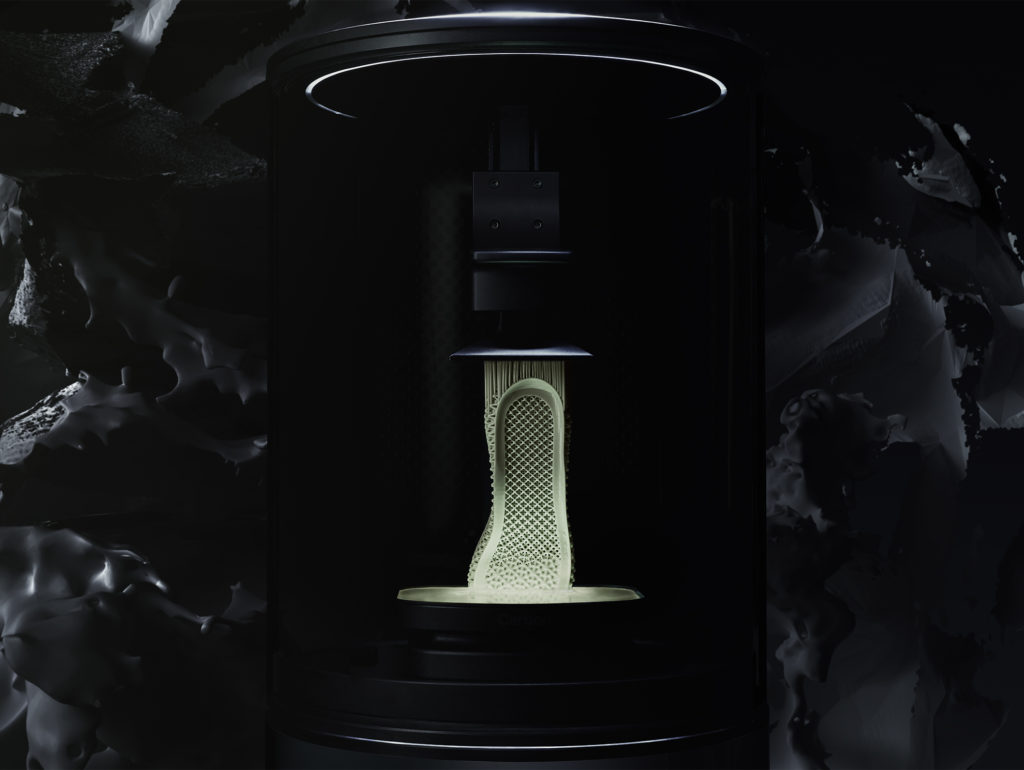
Image Credit: Adidas
First, 3D printing does not require tooling to produce a part, merely digital design data to drive the printer. Second, 3D printers can produce multiple different parts during the same printing cycle, allowing for batch production of multiple different parts. Third, because material is deposited layer-by-layer rather than formed or subtracted, there are few restrictions on what geometries can be fabricated, which reduces the time spent in re-engineering part designs to comply with manufacturing constraints. Thanks to this versatility, Adidas need not standardize components of their shoes, specifically the injection molded midsoles, and can instead allow customers to impart meaningful design changes to parts of their products that were out of reach of customization. 3D printing therefore addresses the demands of those big consulting firms; we can now start to meaningful customize.
There are limitations to 3D printing for this application, specifically high-performance athletic shoes, such as material durability and part longevity, and the ability to scale production in-line with the expected production runs of Adidas products. For context, Adidas produced 402 million pairs of shoes in 2017. The most optimistic projections for the 3D printed line of Futurecraft shoes numbered in the low hundreds of thousands, or less than 0.3% of total unit production. So 3D printing, in principle, can enable customization, but a common roadblock to making “mass” customization viable is scalability. How did Adidas tackle this problem?
Automate
Shoe manufacturing is a labor intensive process, which is why over 90% of Adidas products are manufactured in low-wage economies such as Asia. To manufacture the same products in higher-wage economies, a large workforce is simply not economically viable in most cases. To make it work, you need to reduce your workforce and automate. Automation means higher throughput, better utilization of capital investment and economies of scale, with the drawback that your ability to vary your products is greatly reduced due to a need to standardize processes.
Here’s the kicker: 3D printing, for all its modern mystique as a production process of the future, is still very much a labor intensive process. From design optimization to part cleaning, a large proportion of the total printing cycle requires human operation. Very few 3D printing technology vendors have brought to market truly automated systems—by which I mean a machine architecture that is built with automation in mind from the ground up. There are numerous examples of industrial and desktop platforms that integrate ad-hoc robotic systems for simple actions such as part loading and unloading. Companies such as 3D Systems, Carbon and EOS are pushing the envelope on this front, but we as an industry are still merely retro-fitting automation to our existing machines; we are not designing machines with automation in mind.
This is where the Speedfactory delivers innovation. The headline story you most often see is the use of Carbon printers paired with Kuka robotics to automate the process of part handling. Carbon themselves also introduced the Speedcell automatic part removal and wash station system. That’s not the story. The innovation is Adidas’s attempt to automate some previously manual processes, and then integrate these stages into a near wholly automated production workflow, à la the Speedfactory. From digital weaving to pressing to molding and finally to 3D printing, the success of the Speedfactory was not about a single production technology, but the marriage of multiple existing digital processes. 3D printing was simply the missing component to that chain that allowed for the transition from standardized to customized within a highly automated “high volume” production environment that minimized manual labour.
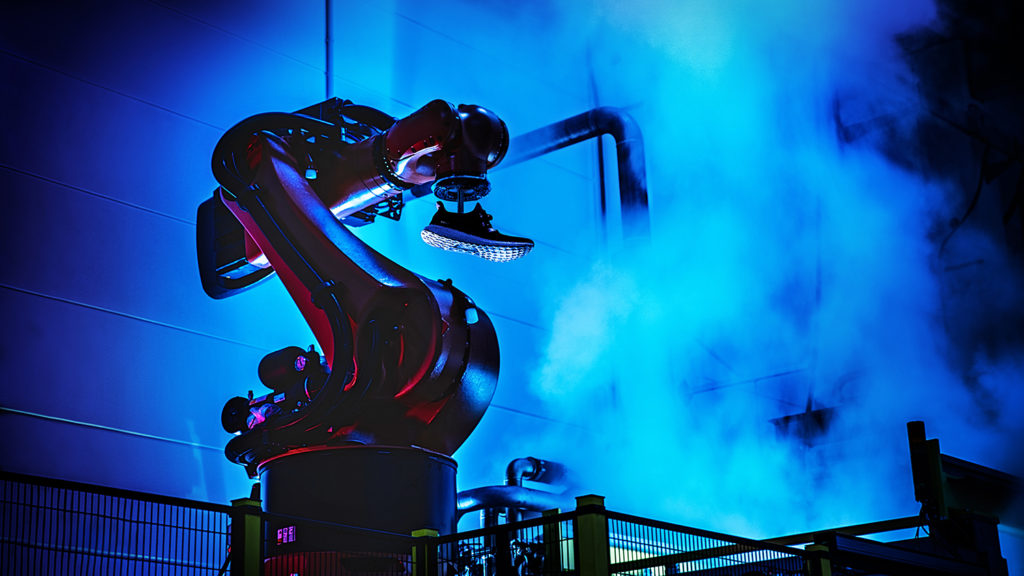
Image Credit: Adidas
Localize
Where the Speedfactory “failed” was in its goal to plant manufacturing at the heart of Adidas’s biggest market cities; localization. The benefits of relocating production closer to the point of consumption are real, from an ability to better respond to regional, short lived product trends to compressing the supply chain and always having product on the shelves. Gil Steyaert, Adidas executive board member, agrees saying “We have ambition to have 50% of our sales from under what we call Speed programs. That means that product, which would be reproduced or created in the season is for the same season.” Steyard further explains that having not only your warehousing, but also your production, local to your market is in line with “the fast fashion model where we can bring product closer to the consumer.”
In practice however, the allure of localization can be fatal. The benefits of super-fast fulfillment to local, micro markets and the ability to respond to rapidly recycling consumer trends must outweigh the costs: duplication of capital assets and facilities, a higher-wage workforce and scrapping of economies of scale. In this equation, for all the customization and advanced performance that 3D printing brought to the product, manufacturing athletic footwear locally to reduce delivery lead times to stores and ensure the latest product is on the shelves was not a substantial enough value proposition to justify the cost of the required infrastructure, technology, organizational management, and workforce. The doors were destined to close on the Speedfactories. All, however, is not lost.
Two out of three
In its 3 years, the Speedfactory program delivered to Adidas a trove of insight on how digital technologies, 3D printing included, can change the face of their supply chain going forward into the next decade. Adidas is now closer to “the future of shoemaking” Gerd Manz, Adidas’s VP of technology innovation would say.
Working with Carbon, they have validated additive processes, materials, designs, and digital workflows that allow significant levels of customization within their products that was previously impossible. This new degree of consumer design interaction with their products not only opens up new growth and differentiation opportunities, but ultimately it drives a deeper engagement between consumers and the Adidas brand, something at the core of their “Creating the New” strategy. “It’s mass customization at scale” exclaims Joseph DeSimone, CEO and cofounder of Carbon. This is the innovation in product.
Working with Oechsler, the automation, manufacturing and polymer processing company, they have made significant strides towards digitizing and connecting a near-fully automated production process for a product that has historically been highly dependent on manual labor and assembly, or at best siloed digital manufacturing processes. This is an innovation in process.
Walk before we run
“We have a really aggressive plan to scale this” says James Carnes, vice president of strategy creation at Adidas. With what we’ve uncovered in our critique of the Speedfactory experiment, taking the local approach is not going to be the most cost-effective way to scale the product and process innovation Adidas has pioneered behind the doors of the Speedfactories. As Martin Shankland, Adidas executive board member responsible for global operations explains, the most rapid and cost-effective way to see a return on the investment is to apply the Speedfactory technologies to their Asian manufacturing base.
“The Speedfactories have been instrumental in furthering our manufacturing innovation and capabilities. This was our goal from the start. We are now able to couple these learnings with other advancements made with our suppliers, leveraging the totality of these technologies to more flexible and economic, while simultaneously expanding the range of products available”
This is the bottom line: Adidas has pioneered multiple technology and process solutions during the Speedfactory program, and although the goal of “bringing back jobs to America” brought a warm nostalgia, it was the most tenuous in terms impacting the bottom line. Supply chain disruptions currently plague the company, and this is in part why there is a reluctance to charge forth with establishing a totally new supply chain hinging on expensive labor markets and experimental technologies. But in our view, whoever made the call to close shop and transplant the metaphorical guts of the Speedfactories to Asia made the right call. Adidas needs to focus on shoring up its established and expansive supply chain and focus on that bottom line.
But the Adidas Future team has placed the company in a strong position to disrupt the marketplace in the near future, having developed the capacity to deliver customization experiences beyond what their competitors can achieve and consumers expect. Once the current storm has passed for Adidas and its supply chain, we should expect to see the descendants of the Speedfactory again. Stories of its death have been greatly exaggerated.
Oliver Smith (Senior Innovation Consultant)
Oliver’s focus is on 3D printing strategy and innovation. He has created multiple unique innovation methodologies and tools that allows him to communicate the myriad capabilities and possibilities of 3D printing to our clients and work with them to not only apply this unique technology to innovate their products, services, business and operating models, but to form a coherent strategy for taking their ideas from concept to reality.
Blueprint is an additive manufacturing consultancy, bringing together more than 15 years of knowledge and experience across the industry. As the world’s leading additive manufacturing consultancy, Blueprint regularly assists future-ready companies achieve additive success. Based in Eden Prairie, Minn., and Milford, U.K, the firm offers a unique, technology-agnostic perspective on all things additive, from strategic advice to design optimization services. More information is available online at www.additiveblueprint.com.
If you want to discuss this article or your additive manufacturing strategy, the team at Blueprint is here to help. Let’s say hello.
Recent Comments