

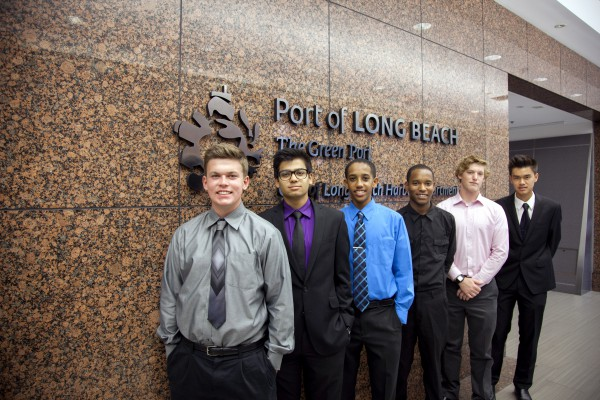

The Port of Long Beach in California has a unique challenge when it comes to its workforce. Currently, it doesn’t have a problem attracting people to the industry, but it wants to ensure that is the case for the future.
“As workforce development efforts have spread across the country, in our area we too are expanding the scope of our efforts,” explains Mario Cordero, executive director of Port of Long Beach. “We need to both identify what the future opportunities will be in our industry and to let the younger generation know that there are exciting opportunities in maritime.”
The maritime business at Long Beach Port, the second-largest container port in the U.S, is crucial to the area with one in five jobs directly or indirectly, totaling 50,000 jobs.
This translates to about $9 billion in economic output and $3 billion in income in the City of Long Beach. In the five counties of Southern California, it has an impact of 576,000 jobs and $89 billion in economic activity.
In 2018 it had its busiest year ever with total throughput of just over eight million TEU.
While the Port has always been active in creating programs to fill its pipeline, such as Julio’s New Ride, a video that introduced high school kids to marine and logistics back in 2005, lately it has been stepping up its efforts from the high school level to the college-level internship programs.
High School Level
One of the key programs at the high school level is the Port’s partnership with Cabrillo High School and the Long Beach Unified School District to create an Academy of Global Logistics.
The Academy introduces high school students to career opportunities in global trade and logistics and provides training and education programs which include certifications and degrees offered by Long Beach City College and California State University, Long Beach.
The goals are to:
EXCITE – Create excitement around international trade, logistics and supply chain management by bringing real-world experiences to the classroom.
ENGAGE – Engage parents, students, teachers and administrators, industry partners, and the community in program events to develop a support system for student success.
EMPOWER – Empower students with the knowledge and skills for entry-level career opportunities and/or to pursue higher education either at a community college or four-year university.
Community College Level
At the community college level, in 2018 the Port created a Maritime Center for Excellence in collaboration with the Long Beach City College.
“Our new program is a real point of pride for us,” says Dr. Reagan Ferragamo Romali, who is Superintendent-President of the Long Beach Community College District.
“Our emphasis in our entry-level jobs in the supply chain that will lead to employment at the Port, which is an employer of choice in our area,” Romaili added.
The program, which is open to the community at large as well, fills the gap between jobs that require a high school diploma but less than a four-year college degree.
The training programs, which takes place on evenings and weekends, offer programs that run between 30 and 80 hours and focuses on in-demand occupations, such as:
- Logistics Manager
- Transportation Supervisor
- Logistics Specialist
- Customer Service Representative
- Dispatcher
- Warehouse and Distribution Supervisor
These classes, which provide certificates, have attracted 108 students, 99 of whom have completed the training.
The program is the district’s first industry partner in its Long Beach College Promise, which is an opportunity for students to attend tuition-free, and then move into a high-paying local job. This program, which is paid for through scholarships, “attracts a wide-range of students which might not otherwise be able to afford this type of education,” says Romali.
Some of the funding comes from the Port which has awarded $775,400 in scholarships to 464 students since 1993.
College Internship Level
At the college level internships at the Port allow students to see up close the wide variety of jobs. To secure an internship a student must be currently enrolled at a two- or four-year college or university or be a recent graduate of a four-year college or university with plans to matriculate to a master’s or higher degree program related to the work area of the internship.
The Port of Long Beach offers paid internships to college undergraduate and graduate students in a variety of fields:
- Business Development
- Construction Management
- Design
- Environmental Planning
- Engineering
- Finance
- Information Management
- Maintenance
- Risk Management
- Security
- Transportation Planning
Proving multiple levels of training is essential to attract as many people as possible to this industry. “We need to ensure that our future workforce has the skills that the 4th industrial revolution or IoT requires,” says Cordero.
And Cordero believes that as a region, and as a country, we need to take a long hard look at how we are training future workers and at what cost. We need to broaden our view of jobs, degrees, the standard of living and educational debt, he says.
Codero also believes a broader view of employment will include jobs that deal with environmental concerns. This is why in 2005, the Port of Long Beach branded itself as the Green Port. And despite predictions that being environmentally conscious would cost it jobs, which it did not, now 15 years later “we are leaders in sustainable development,” Cordero points out. “You grow green and you also grow your business.”
Eventually, Long Beach wants to achieve zero emissions by switching to electric vehicles and equipment. It’s already working on a trial at Pier T, where the California Energy Commission is helping to fund the installation of fast-charging infrastructure and the purchase of four battery-powered yard tractors. It will be the world’s first heavy-duty, DC fast-charging system for off-road vehicles at a seaport.
These forward-looking projects will also translate into attracting more talent. “Our students have grown up in a culture in California that talks about alternative fuel and low emission,” says Romali. “They view these efforts as a good career for their family but also good for the world.”
Recent Comments