



Key takeaways:
- As an increasing number of luxury brands and retailers ban fur and exotic skins, stock of “vegan” products has increased by 258 per cent across the UK and US in 2019.
- In response, the fur industry is promoting fur as a sustainable and natural option by investing in industry-wide certification programmes and educational outreach.
- Fur is still in fashion, but critics question the use of the material as both natural and faux options fail to provide assured sustainability credentials.
In 2019, luxury brands and retailers disavowed fur. Prada, Phillip Lim, Farfetch and Macy’s, among others, joined an expanding group of industry leaders that already included Chanel, Burberry and Yoox Net-a-Porter Group in removing real animal fur from production and sales floors. Brands attribute the bans, which in some cases include other exotic skins like crocodile and snake, to consumer demand. In September, a poll of 2,000 British and American residents indicated that two-thirds of British adults and 47 per cent of US adults consider fur an inappropriate material.
Aesthetically, however, fur hasn’t fallen out of fashion, and retailers and brands are providing consumers with alternatives to animal-hide products with options like faux fur and “vegan” leather. According to Euromonitor International, the production of both genuine and artificial fur increased by 120 per cent in 2019, reaching an aggregated value of $25 billion. Data from Edited shows that across the UK and US, “vegan” products in stock have increased by 258 per cent year-on-year, most prominently in the footwear, accessories and outerwear categories.
In parallel, sales of real fur have been declining. According to data from Italy’s Associazione Italiana Pellicceria, retail sales have decreased by 50 per cent from 2006 to approximately €800 million in 2018. Finnish auction house Saga Furs’s consolidated net turnover for the year ending 31 October 2018 was €45.7 million, a 13 per cent year-on-year decrease. Available data from the Fur Information Council of America estimates that the world’s total fur retail sales in 2019 will amount to around €22 billion, a small but not negligible fraction of the €281 billion personal luxury goods market. (Data on fur retail sales for previous years is not comparable as the Fur Information Council of America changed its methodology in 2018 to include mark-up factors.)
Industry associations don’t believe fur bans or changes in public opinion have significantly affected fur sales. Instead, they point to economic fluctuations, especially in China, which is one of the largest fur markets. (Around 80 per cent of Italian fur is exported to China, according to AIP). But as environmental concerns mount, the fur industry is on the defense. In response to the rise of faux alternatives, fur associations are vehemently promoting their product as a naturally sustainable choice, in hopes of bucking beliefs that alternative furs are the more responsible option. That involves educating customers on environmental impact, animal welfare and traceability.
“We are aware that consumers demand more transparency and they really care about animal welfare,” says Jesper Lauge Christensen, CEO of Kopenhagen Fur.
Marketing fur as a sustainable option
Fur industry associations stress the material’s long lifecycle, the fact that it’s biodegradable and the absence of harsh chemicals in its processing as proof of real fur’s inherent sustainability. According to Roberto Scarpella, president of AIP, fur dressing mainly consists of water, salt and alum (a chemical compound). Other more hazardous substances, like formaldehyde, dyes and bleaches, can be used when pelts are dyed, but the associations say the impact is minimal compared to the production of faux fur, which is still most commonly made of synthetic materials like polyester or modacrylic.
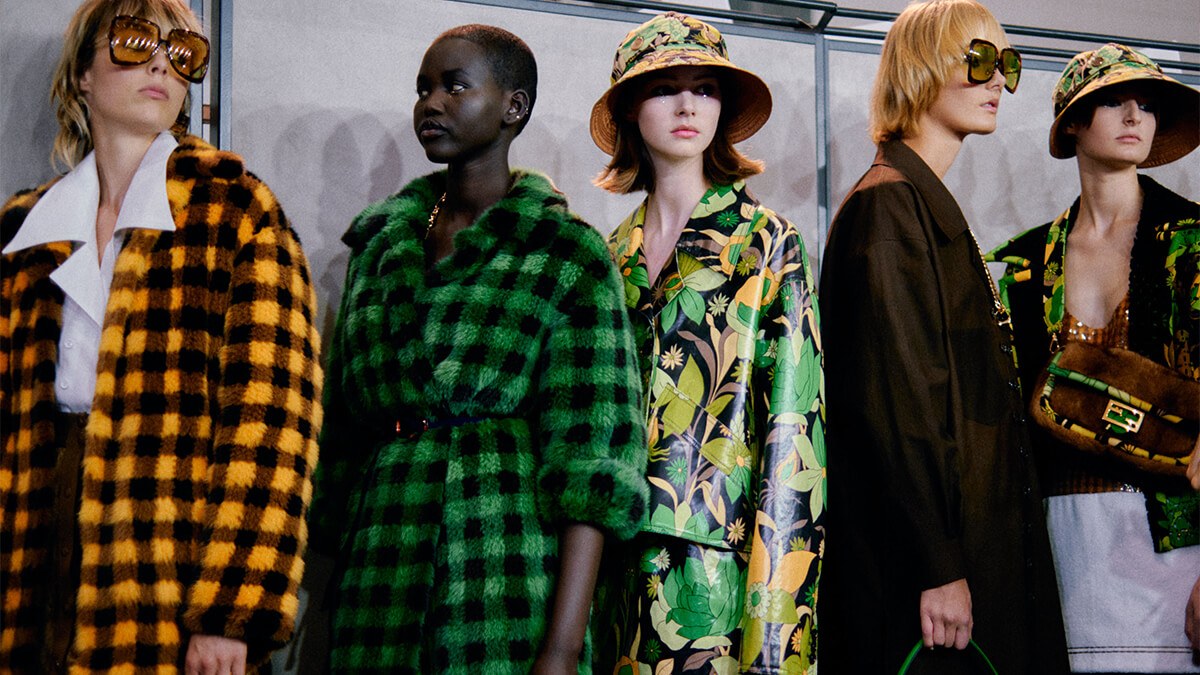
Looks from the Fendi Spring/Summer 2020 show.
© Jamie Stoker

Animal farming raises other environmental issues, in particular, greenhouse gas emissions from feed supply and manure. Christensen admits that the industry needs to find a way to emit less CO2 in production, adding that the association aims to bring CO2 emissions from fur farming in Denmark to zero by 2025. (In July, the Danish government agreed on a political plan to cut greenhouse gas emissions by 70 per cent by 2030.) To do so, Kopenhagen Fur has started using plant-based feed, like soybeans, and separating manure to be used as fertiliser or converted into energy, techniques already in use in the farming industry.
The industry has been active in promoting its inherent sustainability and work to lessen environmental impact, and associations have especially engaged with young designers. “There is interest in the use of fur from young designers and new modern brands that have a strong sustainability element in their design philosophy and brand values,” says Tia Matthews, senior spokesperson at Saga Furs.
Initiatives include the opening of “fur studios”, where designers are invited to work with in-house furriers, outreach programmes focusing on the use of fur and talent show sponsorships. Since 2014, Kopenhagen Fur has been running “Imagine Talents”, an international design project that brings together fur manufacturers and students from universities, including London’s Royal College of Art and Japan’s Mode Gakuen. The British Fur Trade Association (BFTA) has collaborated with 12 educational institutions offering lectures, skills training and loaning fur machines.
Searching for transparency
Together with the promotion of its sustainability credentials, the fur industry says it’s working towards transparency, developing certifications with a specific focus on animal welfare and traceability. “What consumers are really focused on is true transparency to be able to make that informed decision,” says Sarah Needham, knowledge exchange manager at the Centre for Sustainable Fashion. “The entire fashion industry is going to have to make sure people understand the ramifications of their choices.”
Saga Furs has been implementing its Saga Certification since 2005, a programme including 31 criteria spanning animal health, farm hygiene, breeding and environmental management. Fur farms, audited by second- and third-party external inspections, need to meet all of the criteria to receive the certification, which is valid for one year. Saga, which has included a traceability system in its certification since 2017, is also developing tracing with RFID technology, which will allow consumers to recover the fur product’s supply chain path by scanning a tag with their phones.
Another certification promoted by the industry is Welfur, which assesses the welfare of mink, fox, and Finnraccoon farms in Europe according to four principles: good housing, feeding, health and appropriate behaviour. Saga Certification, Welfur and similar international certifications from the US, Russia, Canada and Namibia have been included in FurMark, a programme developed by the International Fur Federation (IFF) that aims to ensure good practice along the whole supply chain, from fur farms to dressers and dyers and up to retailers. Both LVMH and Kering recognise FurMark as a credible certification. (Kering had no specific comment to add, while LVMH didn’t reply to requests for comment).
Left: a look from the Saint Laurent Fall/Winter 2019 show. Right: a look from the Louis Vuitton Fall/Winter 2019 show.
© Left: Getty Images; Right: Jamie Stoker

Critics remain sceptical. Fur farming is “fundamentally flawed and could never provide animals with life-worthy conditions”, says Claire Bass, executive director of Humane Society International/UK, pointing to the industry’s practice of keeping animals in cages. While traditional farming has started to move away from the battery cage system and incorporate schemes that meaningfully assess needs and behaviours of animals (like swimming or digging), Bass doesn’t see the fur industry doing the same. “Their entire economic model is credited on battery cage intensive farming,” she says.
Researching alternatives
In the US, large meat producers like Tyson Foods, Inc., Perdue Farms and Cargill have explored alternatives to meat production. By investing in startups researching cell-based meat or developing their own plant-based product lines, these companies are future-proofing their businesses should these alternatives become mainstream. A similar embrace of alternative research for fur production that doesn’t harm animals has yet to be seen in the industry.
AIP’s Scarpella says that identifying alternative natural products is beyond the association’s reach, adding that investments are mainly directed to reinforce the product image of sustainability. Keith Kaplan of the Fur Information Council of America believes it’s an area the industry is closely following, but he wasn’t able to confirm if any investments were made. Saga’s Matthews says projects are being discussed within the fur industry, but she declined to provide further details.
Production diversification could be difficult for the industry, which is anchored to highly specialised trades like farming and dressing and has considerably smaller means than the meat industry. (Tyson Foods made $40 billion in revenue in 2018. Kaplan estimates total global fur retail sales amount to around $24 billion.)
Faux fur developer Ecopel, meanwhile, recently unveiled a bio-based fur with Stella McCartney. Ecopel’s work might make it more suited to develop advancements in natural fur production, but the two sides of the industry would have to come together. “If there is a commitment to spare animals and create a new vision of luxury with bio-based fur or recycled fur, we could never say no,” says Arnaud Brunois, communication manager of Ecopel.
For consumers, reaching a definitive conclusion about the sustainable value of real versus faux fur is not straightforward. Studies that should provide more clarity often state opposing claims depending on the variables considered and whether they were commissioned by fur associations or animal rights associations. Bass disputes the fur industry’s sustainability claims, citing studies that have found high levels of formaldehyde, alkylphenols and alkylphenol ethoxylates in selected fur samples.
Needham recognises the complexity of assigning a sustainability label to these materials and believes, ultimately, consumers and brands should start questioning the need to wear fur altogether, be it natural, synthetic or plant-based.
“The first port of call is to really consider whether this is actually a material and an aesthetic that we need in our wardrobe,” she says. “If you have animal welfare concerns, maintaining that aesthetic by supporting faux fur contributes to the longevity of fur in our fashion landscape.”
To receive the Vogue Business Sustainability Edit, sign up here.
Comments, questions or feedback? Email us at [email protected].
More from this author:
Prada is first in industry to sign sustainability-linked loan
London’s creative studios are disappearing. The Trampery wants to help
Recent Comments