

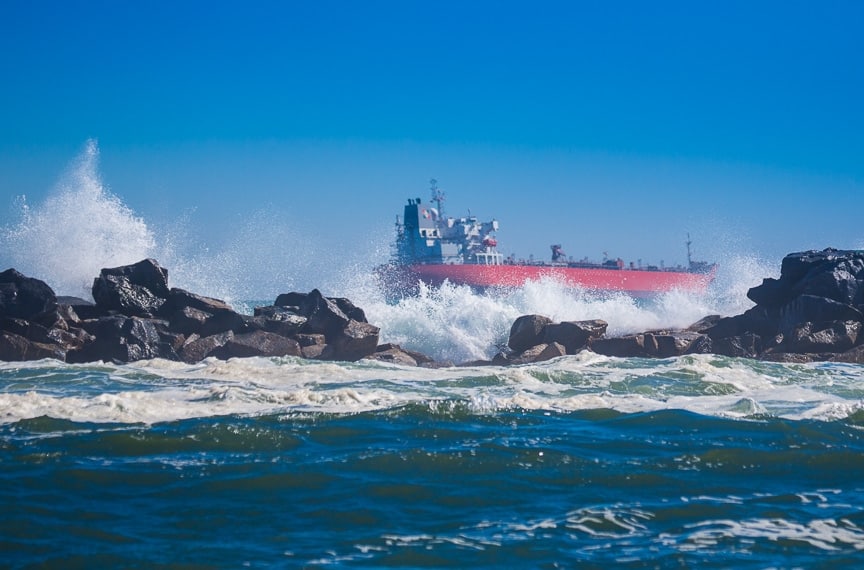

Speakers at a “Storms, Flooding and Sea Level Defense Conference” in Oakland, California, warned attendees about myriad dangers to coastal and inland residents in coming years from rising sea levels.
Sponsored by the Propeller Club of Northern California, the event featured about three dozen speakers, including representatives from seven of California’s ports, and had more than 150 attendees. Several speakers came from the Netherlands to speak about their efforts to address the issue.
Stas Margaronis, president of the Propeller Club of Northern California and organizer of the December event, noted that sea level rise is affecting ports and communities along all coasts and at inland locations, such as along the Mississippi River.
About 26 million people live in California’s coastal counties, and over 600,000 will be exposed to flooding by the end of the century, said Patrick Barnard, a research geologist with the U.S. Geological Survey’s Pacific Coastal and Marine Science Center. Globally, he noted 1 billion people are expected to live in coastal zones. In 2013, California enacted a law, AB 691, that required managers of tidelands and submerged lands to address the impacts of sea level rise.
Ricardo Lara, California’s insurance commissioner, told the conference that while the state has promoted and funded programs to encourage the use of renewable fuels, “along our coasts and at our ports, we also need to become much more resilient.”
Speakers noted that sea level rise and storm surges can be combated with “hard” infrastructure such as seawalls and levees, nature-based infrastructure such as wetlands and moveable infrastructure such as flood gates.
“Nature has already put key structures in place to defend from extreme weather, but nature will not prepare for this level of weather we are having now, which is why we need to come together and figure out how do we help promote and strengthen our natural infrastructure,” said Lara, who pointed to efforts to improve wetlands in California and other parts of the world to restore coral reefs and mangroves.
Justin Luedy, an environmental specialist in planning and environmental affairs at the Port of Long Beach, said that port has already seen flooding from so-called “king tides” that occur when high tides coincide with perigee, when the moon and Earth are closest.
In August 2014, Hurricane Marie caused significant damage and shut down facilities such railroads, fire stations and fuel facilities for several days.
Marie was 400 miles away, and it was a “sunny, beautiful day in Long Beach,” Luedy said, but because the storm was traveling at just the right angle, waves caused $28 million in damage to a breakwater at the port, the Navy Mole and Pier F shoreline.

The port prepared a Climate Adaptation and Coastal Resiliency Plan in 2016 looking at how much of the port would be flooded by sea level rise of anywhere from 16 to 55 inches and 100-year storms.
Adrienne Newbold, a senior civil engineer at the neighboring Port of Los Angeles, said the port has included sea level rise in its policy and planning and capital projects.
Michael DiBernardo, deputy executive director of the Port of Los Angeles, said 5 million jobs and a third of California’s economy rely on goods movement in and out of ports.
“In recent years, the increasing frequency and disastrous toll of California wildfires have captured the attention of our nation, but sea level rise in the decades ahead will be just as important. Without long-term planning, … sea level rise will have effects on our ports and our economy.
“We need to work together on common strategies and solutions,” he said. While the costs of some of the projects are daunting, “inaction is not an option.”
Giles Pettifor, environmental manager for the Port of Hueneme, noted that the port is located on one of the submarine canyons created by the Santa Clara River over the millennia.
“What that means for us is that we have a wonderful deep-water access channel straight into our harbor,” he noted.
But he added, “Anybody who is a surfer knows that deep-water canyons provide the best big wave spots.”
Like Long Beach, his port was affected by big waves generated by Hurricane Marie in 2014.
“I’m not as worried about actual water levels rising. I’m much more concerned about that Marie-type wave inundation and that being exacerbated in the next decades,” he said.
In 2014, he said, the port’s riprap seawall was overtopped, and waves poured into the port’s reefer rows.
Hueneme is a major port for ships moving refrigerated cargo as well as automobiles, and the refrigerated ships are required to use shore power when they dock. An inundation could damage that power infrastructure.
Elaine Forbes, executive director of the Port of San Francisco, notes that in addition to sea level rise, the port must deal with the additional complication of being located in earthquake country.
She also noted that the tides and other natural phenomena do not conform to political jurisdictional boundaries.
Brad Benson, the Port of San Francisco’s waterfront resilience program director, noted that a century ago, a three-mile seawall was constructed off the coast of San Francisco and filled with 30-40 feet of mud from San Francisco Bay. Many of the port’s wharves and other property are built on the land, which he said does not perform well in seismic events.
As in Long Beach, parts of San Francisco have flooding problems during king tides, and the port also faces challenges related to groundwater and stormwater runoff.
Most of the cargo-handling in the San Francisco Bay area has moved to Oakland or other ports, and Benson says since the late 1990s the port has entered into public-private partnerships to renovate the port’s historic structures to improve their resilience to both earthquakes and flooding.
One area of particular concern is the area around the port’s historic ferry building, where the ground has dropped more than a foot since the building was constructed. It is subject to periodic flooding. Of major concern is the presence nearby of subway tubes for the San Francisco Municipal Transport Agency and Bay Area Rapid Transit (BART), flooding of which he said could be “catastrophic” for the region.
Kristine Zortman, executive director of the Port of Redwood City in South San Francisco Bay, spent $17 million on a new wharf that can withstand 3-5 feet of sea level rise as well as an 8.9 magnitude earthquake.
She notes that a catastrophic earthquake could create massive power outages and fires and a possible tsunami, and leave more than 120,000 persons in need of emergency housing. It could further require removal of up to 40 million tons of debris.
If freeways and bridges collapse, the wharf could be used as a staging area to move first responders to where they are needed in the region.
While the focus of the conference was on efforts to understand the effect of sea level rise on California ports, Niels Aalund, president of International Propeller Club, noted that there is great concern about the potential damage if a Category 4 or 5 hurricane came up the Houston Ship Channel, which he said is where 60% of strategic jet fuel and 25% of gasoline are produced.
Aalund said it is crucial to act before a disaster and said he was pleased with increasing media attention to the issue of sea level rise and storm surge.
He said Rice University and Texas A&M have collaborated on studying the design of a coastal barrier, estimated to cost $22 billion to $32 billion including gates at the entrance to Galveston Bay and the Houston Ship Channel.
Margaronis told students attending that the meeting was “dedicated to what you as individuals and collectively, as a younger force in the world, are going to need to do to address the issues of sea level rise, of global warming, of resiliency. Unfortunately, you are coming on the battlefield on a very late date. Our hopes and our prayers are that you will prevail.”
Recent Comments