



From the moment a food or beverage product’s lifecycle begins, the way in which it is managed is critical. With consumers now more educated and aware of ingredients, sustainability, and environmental impact than ever before, it is vital to understand the pitfalls that can occur as well as the tools that can make the process smoother.
The need to properly manage data may not be the first thing that springs to a product creator’s mind. But when it comes to delivering nutritional benefits or making health claims in particular, good data management is essential—from start to finish. Especially now that lifecycles are becoming shorter and shorter, effective data management begins with supplier and ingredient selection and runs through recipes and ingredient combinations all the way to accurate labeling. Consumers expect labels to tell them what’s in a product, where its ingredients have come from and how they have been processed. For manufacturers to successfully deliver this, being able to hold all supplier, ingredient, and product data together in one integrated system can help to avoid costly mistakes. It ensures transparency, both internally and externally, and ultimately, watertight data can help to improve production efficiency, speed, and cost control.
Answering Consumer Questions
When today’s generation “C” connected consumers visit a grocery or convenience store, they take a close look at what a product label says and often go directly to the website of the product to find additional product information. More often than not, they compare similar products and make their final decision based on whether or not any of them tick all of their boxes. They might want vegan confectionery or gluten-free bakery. They may be seeking to avoid E-numbers or palm oil, or they may be looking for certain vitamins, minerals, or levels of dietary fiber. When shopping for functional foods in particular, shoppers want to know how the product works, as well as what it claims to be able to do. Does it, for instance, have scientific backing, and has its efficacy been properly proven?
Over and above concerns for their own health, increasing numbers of consumers also have questions about sustainability and ethics. Are the ingredients “fair trade”? What is the country of origin? Are the raw material producers transparent? Is the brand owner committed to environmental protection or the preservation of biodiversity? What is the packaging made of? Consumers have never placed higher demands on food and beverage products than they do today. And thanks to smartphones and our increasingly connected world, it has never been easier to get answers to all sorts of questions and gather information about ingredients as well as the companies behind them. With transparency now a “must” rather than a “perhaps,” the pressure on manufacturers is growing.

Photo © Shutterstock.com/Brian A Jackson
The need to diversify has added to this pressure. Today’s discerning and demanding customers now expect to be able to buy products that take all conceivable individual preferences into account. But having to satisfy these demands has made production a lot more complex for most manufacturers and has added pressure all along the supply chain—which is also expected to be transparent. Overseeing the entire process, intervening if necessary, and being able to make the correct claims on the final product is extremely labor-intensive as well as almost impossible to achieve without digital systems.
The Constraints of Old-Fashioned Procedures
In order to remain strong and increase their share of today’s food and beverage markets, organizations must operate quickly and efficiently. Operations have to be more streamlined, and producers have to be ready to seize every opportunity to gain a competitive advantage. Those that still use traditional supply chain processes based on spreadsheets and old-fashioned change-management procedures simply cannot compete with those that utilize innovative process solutions like the ones that are now available for material and recipe management.
Manual data entry and modification can be expensive and inaccurate. Often, the same data will be recorded repeatedly: details of raw materials and specifications will be collected again and again, instead of being reused and modified. This simply wastes time. Physically archiving data hinders its usage. Rather than being able to adapt to new requirements quickly, companies miss market opportunities because of time-consuming new recipe creation and high product development costs. Redundant details and out-of-date information are further barriers to innovation and a drag on efficiency. A digital PLM (Product Lifecycle Management) system can remove these barriers and enable companies to adapt quickly to market changes, use existing data, and alter recipes in line with customer demands.
Centralization Reduces Costs
A company may hold product specification data separately within different departments. However, not having a central, pooled resource makes retrieving and managing data extremely time-consuming. This practice can also deliver incomplete or inaccurate information. If, as is regularly the case, specification data is held in different languages, it is even harder to update.
A PLM solution enables manufacturers to manage specification data in a single central system that can be updated and modified easily. This information can then be used efficiently by different departments in unique geographical locations and languages.
Compliance Made Easy
In order to be able to make totally accurate claims, it is vital that there is company-wide, cross-functional cooperation between everyone working on a product. Food technologists, marketing experts, and designers must all have ready access to product-related information, and they must be able to share it with each other. PLM solutions facilitate this. Updates are timely and dynamic. From the raw ingredients to the finished product, a PLM system compiles reports populated with accurate information about ingredients as well as their places of origin.
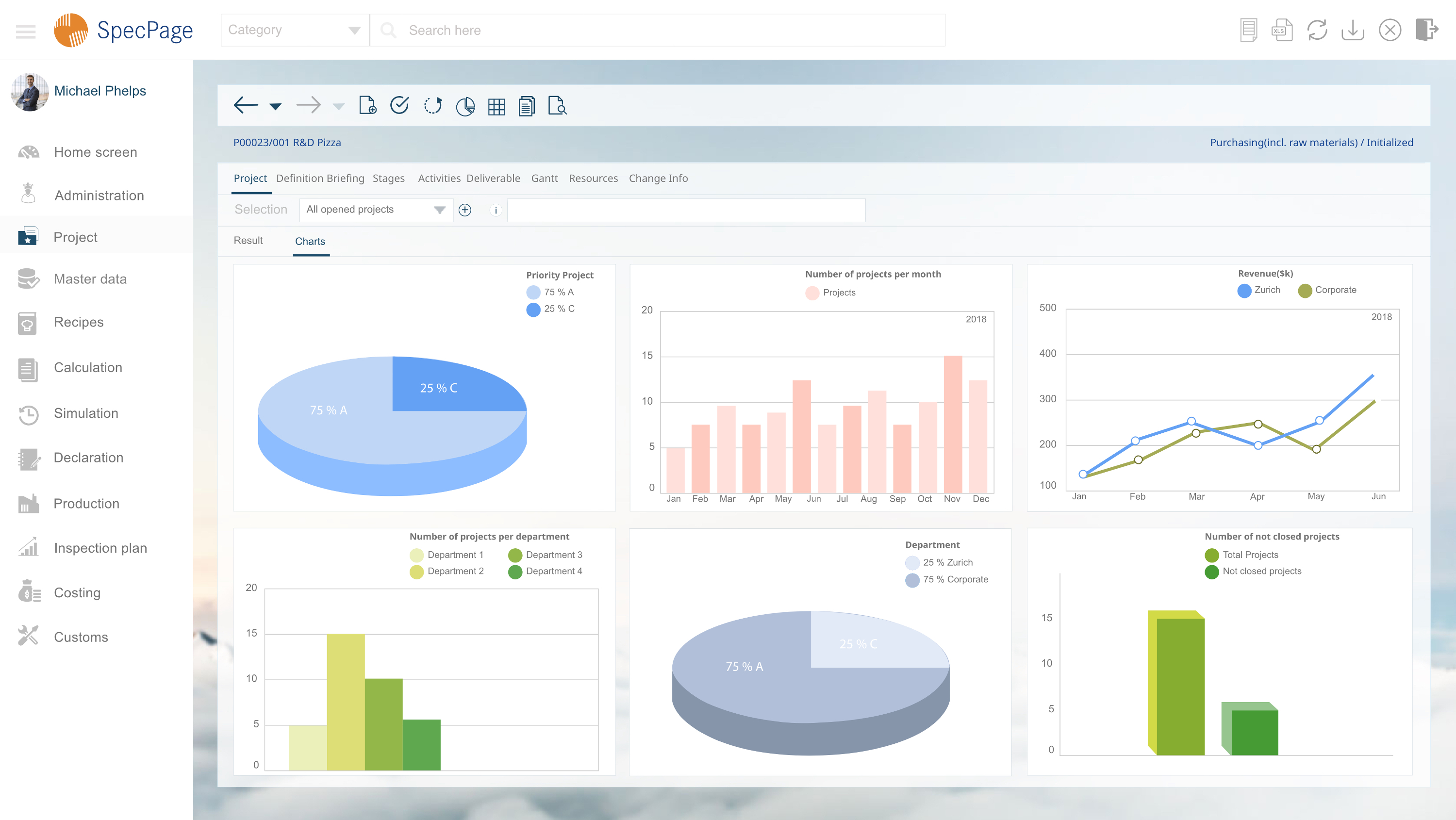
SpecPage Product Lifecycle Management system
As a special function, PLM systems also make sure that legal requirements for ingredients and nutrition tables are always adapted correctly for the markets the product will be sold in. The software takes into account the international regulations in all of the countries that will receive the product and prepares the label information in the appropriate languages. Thus, the digitalization of labels helps to avoid costly mistakes while also maximizing consumer confidence in a company’s products. It also ensures that all ingredient information on pack, including health claims and credentials, are compliant, making it easy for manufacturers to be as transparent as possible—something that today’s health-conscious consumers are looking for.
Integration Delivers Benefits
In the face of increasing pressure on productivity, flexibility, quality, transparency, and safety, a company-wide PLM solution offers many benefits. Its integrated approach allows manufacturers to bring innovative products quickly and efficiently to market, thus delivering the optimum return on investment. It allows for comprehensive management of data throughout every stage of the product lifecycle—from initial idea to eventual marketing. And finally, as well as enabling a company to make the best possible use of resources and expertise, a PLM system will also help to drive innovation, cut risks and costs, ease compliance, and maximize profits.
Brent Cutler is president and chief operating officer of the Americas at SpecPage. SpecPage is a leader of enhanced digital PLM and PDM process solutions dedicated exclusively to food and beverage producers. Its advanced, user-friendly software solutions are designed to accurately integrate and provide cross-functional support for the most complex aspects of formula-based product development. The company serves more than 300-plus customers and is well-positioned on every continent. Its sole focus is to help companies achieve and sustain growth and success across global markets by delivering seamless, connected, data-driven solutions. To learn more, visit www.specpage.com.
Recent Comments