




Ron Keith, Founder, Riverwood Solutions
As the Year of the Pig draws toward its close, it’s time for manufacturing and supply chain professionals worldwide to finalize their operational plans for the Chinese New Year. The Lunar New Year, also referred to as the Spring Festival or Chinese New Year (CNY), has been celebrated in China since the early Shang dynasty in the 11 century BCE. With the advent of a more accurate and comprehensive solar calendar, Emperor Wu of the Han dynasty fixed the date of the official celebration as the first day of the first month of the traditional Chinese calendar, and this has remained the holiday period for 2,100 years.
Many factories shut down or work with skeleton crews up to two weeks prior to the holiday, which is officially seven days — January 24-30, 2020. Around 10 days before the CNY begins the great chunyun migration, the largest annual migration on the planet. This year, some 90 million Chinese will travel between 75 and 3,000 kilometers to visit relatives, typically in the province of their ancestral home. Chunyun is arguably the single most disruptive annual event in the global supply chain. Manufacturers must plan and carefully manage operations to minimize the impact on customers and key operating metrics.
Thanks to our friends at Baidu and the Chinese Ministry of Transportation, we have a pretty good data on chunyun travel patterns. Most of the migration and supply chain disruption happens in the period leading up to the beginning of the official holiday period. The chart below shows that most of the travel is concluded by the end of the official holiday period.
 The most popular destinations during the Spring Festival are Chongqing, Beijing and Guangzhou; cities experiencing the highest levels of “additional congestion,” in order, tend to be Beijing, Harbin, Chongqing. Most OEMs adjust production between late December through early April period to accommodate for the holiday. A typical set of rules, guidelines and assumptions that we use with our consumer products customers is as follows:
- Step up product and process quality surveillance immediately before the holiday. Not only are the factory workers a bit distracted by the holidays, but the support staff is also thinking about their travel plans, family dinners and celebrations. It is not uncommon for quality to suffer immediately before the holiday.
- Plan on two full weeks of lost production. Even though the official holiday is just one week, we find that most factories will lose about two weeks of production in total.
- Have all incoming material for the post-holiday re-start on site and through incoming inspection at the factory at least a week before the holiday. Although the Customs Office adheres to the holiday schedule, the backlog they return to is always enormous. Not only are there significant delays after the holiday, incoming material is most likely to be lost during this period.
- Avoid, if possible, NPI activities immediately prior to the holiday. Not only are the people distracted with travel and holiday planning but getting around China becomes increasingly difficult and time consuming. Should your NPI build not be completed prior to the start of the holiday, an already stress-filled event is going to get exponentially more difficult.
- Outbound shipments of finished goods or subassemblies need to be at the port 10 days prior to the start of the holiday. The ports are very busy with both inbound and outbound freight at this time, and your normal lead time to loading can increase significantly.
To illustrate this last point, I’ve constructed a graph of total TEU volume for China’s four largest ports for the first three months of 2019. Keep in mind when reviewing the graph that Chinese New Year always falls between January 21 and February 20, but most often comes between January 25th and February 16th. It is interesting to note how much more significant the container volume drop is in Shenzhen than in the other major ports. This is because Shenzhen sees perhaps the largest proportional flow of outbound holiday travelers of any major city in China.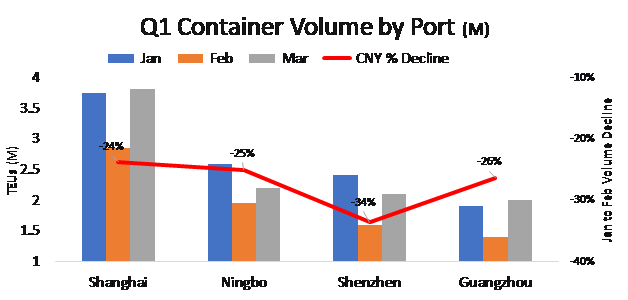
- Understand who the key people are on the line and supporting the line in the factory. Make sure you have a training matrix for all the key process in the factory and that you are not relying on a limited number of trained operators for any critical processes. Factories with less desirable work environments, and factories located in undesirable locations, generally see a dramatic increase in employee turn-over in the post-holiday period. It is not uncommon for 6 percent to 8 percent of the direct labor force to simply never return from the Lunar New Year holiday, preferring to remain home with their family or find more desirable employment.
- Have some of your staff or your representatives on-site at the factory beginning a day or two after the end of the holiday. Inevitably there will be issues — testers that fail to boot up or AWOL process engineers and reduced line staff. Make sure that management knows that you, and/or your representatives in country, are there to help in any way you can.
- Institute additional external and independent quality checks; in-process inspections; and out of box audits for at least the first two weeks after the end of the holiday. Many factories must be completely restarted after the holiday and quality issues arise. This situation is exacerbated as all factories experience turnover from the holiday, and much of the turnover is in lower paid jobs such as inspectors.
The 3,000-year-old tradition of celebrating the Lunar New Year in China is one of the oldest and richest cultural events in the world, and one that should be honored and appreciated by everyone. Proper planning, execution, open communications with factory leadership, and a few extra feet on the ground during key periods, can minimize the impact on your supply chain.
Recent Comments