




Make no mistake, in the time-critical service industry, service failures could literally mean the difference in life and death. It could mean grounding an aircraft and the loss of up to $150,000 per hour. It could mean a patient not receiving the notification of critical results.
Traditional freight forwarding methods tend to be both time-consuming and opaque. This causes frustration across all segments of the logistics industry. It can be especially problematic, however, in the time-critical space, which involves the movement of everything from relief supplies to live human organs.
Companies like hospitals and automotive manufacturers often need to receive equipment and other goods within a short window of time to avoid operational shutdowns. For these companies, service failures are terrifying.
Tech-enabled freight forwarder Airspace Technologies works to soothe these fears by providing quick service alongside unparalleled visibility. The company’s proprietary technology also gives Airspace a leg up over its competitors by enabling precise pick-up time estimates, according to Airspace Co-founder and Chief Technology Officer Ryan Rusnak.
While other forwarders cannot guarantee pick-ups within a certain time frame, many of them often pad the pickup window causing them to be quite long, often over an hour. This allows for a considerable margin of error without having to consider a pick-up “late.” Airspace, on the other hand, works to provide precise and realistic time frames based on the various factors affecting the shipment, according to Rusnak.
“When an order gets placed at Airspace, we have a machine calculate all of that in a few seconds,” Rusnak said. “The company feeds traffic, flights, location, mode and even customer preferences into a neural network to calculate the best route for the shipment. We even automatically dispatch the drivers by sending push notifications to their mobile device.”
Airspace’s technology allows the company to provide companies with short and accurate pick-up windows based on location, as well as other factors, Rusnak said. This, combined with the technology’s ability to dispatch a driver in a matter of seconds, ensures all customers receive an experience tailored to them.
“Traditionally, medical couriers request 60-90 minutes for the driver to arrive on site after the order has been dispatched. Airspace goes a step further and guarantees to have a driver arrive on-site for pickup within 60 minutes in all major metro areas,” according to a recent white paper the company produced about eliminating on-demand shipping delays. “Due to Airspace’s Auto Dispatch, the time it takes for a driver to arrive on-site for pickup is 33 minutes, on average, in the Denver market. Auto Dispatch enables shipments to be picked up faster and ultimately cut down on the total transit time to help eliminate delayed shipments.”
In the recent white paper, the company explained how it helped a Denver-based clinical diagnostic laboratory streamline its shipments. Before working with Airspace, the lab was working with a traditional courier and experiencing delays on one-fourth of its critical medical shipments.
“By enabling the clinical diagnostic laboratory’s internal operational team with real-time order creation and auto-dispatching, Airspace reduced the time that staff spent placing orders by 388%, creating a more efficient environment and saving an average of 35.8 minutes per each shipment,” the white paper reads. “The clinical lab saw a 148% improvement in the time it took for a driver to arrive on-site while increasing the volume of shipments 10 times.”
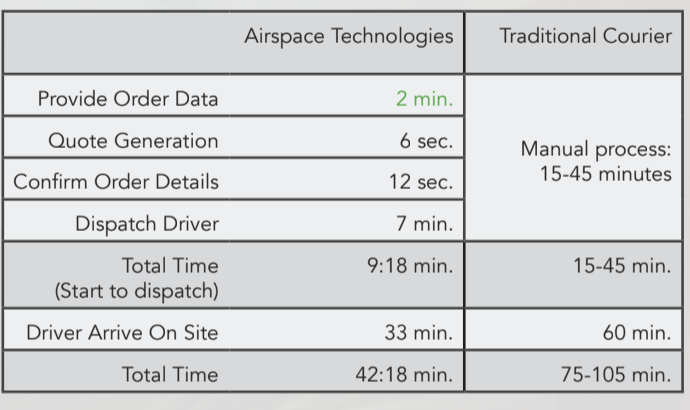
The laboratory featured in the white paper has seen a reduction of delayed shipments from 25% down to .005% since working with Airspace.
“The technology has also allowed them to reduce the number of couriers they work with, reduce human error and create a more optimized work experience for their clinical testing teams,” the paper reads. “This translates to an average savings of 9,407 minutes every week for the Denver market alone or 35.8 minutes per shipment.”
Recent Comments