

It’s a Wednesday morning, and as commuters make their way toward the city along Bulleen Road – a busy thoroughfare in Melbourne’s north-east – several vehicles detour into an easily overlooked, unsealed car park.
A team of geographers gather on the shores of the brown and shallow Bolin Bolin billabong, a stone’s throw from modern Melbourne but a world away, where the dull roar of traffic fades behind the warbling of magpies and the rustle of the breeze through the trees. The fragile tranquility is broken as the scientists fire up an electric drill and get to work.
Led by Wiradjuri man Dr Michael Fletcher, a renowned geographer from the University of Melbourne, the team constructs a pontoon, which they then float to the centre of the billabong. From there, Fletcher and his crew will drill and extract four sediment cores from beneath the still water. Inside these muddy cores are clues about the hidden, potent history of this place stretching back several millennia.
“We’re trying to really reimagine Melbourne, as it was prior to British invasion and under Aboriginal management,” Fletcher says.
By analysing the sediment – from the traces of pollen, and layers of charcoal and organic matter, to the DNA of lost creatures and micro-organisms – with the local Wurundjeri Woi Wurrung elders and community, Fletcher will add to the collective knowledge of this secluded spot.
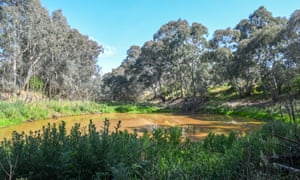
This coring exercise is phase one of a research program using scientific and Indigenous knowledge to document remnant billabongs across Melbourne. It’s about “helping Melbourne reconnect to its hidden treasures,” Fletcher says.
The Wurundjeri Woi Wurrung people are the traditional owners of the Bulleen and Heidelberg area, which was connected to Melbourne through the Birrarung river system. The Melbourne area was once so lush with waterways and bushland that palaeontologist and conservationist Tim Flannery likened it to a “temperate Kakadu”.
The billabong off Bulleen Road, now bordered by sporting fields, golf courses and roads, was part of a vast system flowing out from the Birrarung – the Yarra river.
It’s hard to conjure what has been lost. Where Crown Casino sits today “was a giant swamp”, Fletcher says. “There was a waterfall where Elizabeth Street flows into the Yarra, and where Spencer Street was, there was actually a rock bar across the river.”
Yarra “improvement” works in the late 1800s, at the height of the gold-rush expansion of “marvellous Melbourne”, severed the Bolin Bolin billabong and others like it from the river. Natural flooding was interrupting day-to-day life as the city grew, Fletcher says.
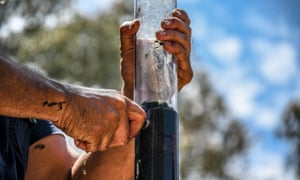
This billabong is one of five that remain in urban Melbourne. With the rest long since filled in or turned into tips by colonisers, this place is all the more precious, providing an “ecological window into what the billabong system used to look like”, Wurundjeri Woi Wurrung elder Uncle Dave Wandin says.
Fletcher has studied many similar sites across Australia, and observes that the removal of Aboriginal land management after colonisation led to ecosystems becoming less diverse and less healthy.
By midday, he has collected the first of four cores, after rowing out to the pontoon with his crew and using a two-metre-long metal stick to push a clear plastic tube deep into the earth beneath the metre-deep water.
Back on shore, he holds the long-buried treasure. Wurundjeri Woi Wurrung elders including Wandin and Alice Kolasa, and water and land managers from the Wurundjeri Woi Wurrung cultural heritage corporation, join the scientists in the field to discuss the coring and analysis.
They focus their attention on the first core. A full laboratory analysis will take about six months and involve high-tech geothermal scanning. But this core already tells the story of the billabong’s post-colonial decline.
The top section – containing the most recent sediment – looks more like tar than earth. There’s a distinct change in colour about a third of the way down, from deep, jet black to a lighter, healthier brown.
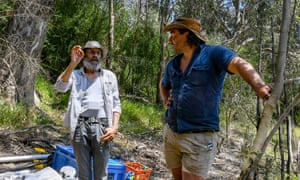
“There’s a definite change from here,” Fletcher says, pointing to the bottom of the tube, “into this really black muck. I think this black muck is going to be post-British kind of pollution. It really stinks, and it’s just yuck.”
Wandin is a key fire knowledge holder and helped to develop the Victorian traditional owners’ cultural fire strategy. He hopes the analysis of charcoal within the core will provide clues about traditional Indigenous practices in burning and managing the site. This could inform the use of fire to promote natural regeneration around the billabong, rather than relying on chemicals to control weeds.
“I look at a landscape and try and imagine what it was … and that’s going to give me information,” he says. “Hopefully we’ll find out from the charcoal in this the frequency of burning and the type of burning.”
Fletcher and Wandin discuss how the area around the billabong has become cluttered with trees and wild undergrowth. They point to one enormous red gum which shows the changes that have played out. It branches outwards, rather than upwards – a sign it grew in a much more open landscape, not among today’s closely grown “mess”, as Wandin describes it.
Listening in on this exchange is Delta Lucille Freedman, project manager for the Wurundjeri Woi Wurrung corporation, who is conducting a cultural values study of the Bulleen-Banyule Flats area on behalf of the Department of Environment, Land, Water and Planning. What she hears resonates with archival material from Melbourne surveyor Robert Hoddle and pastoral holders, who frequently wrote that this landscape was a thinly wooded grassland. Observations of broader Wurundjeri Woi Wurrung country indicate it was burnt in the warmer months.
The grasses are now pasture grasses rather than native ones, which has an impact on insect health. If the seeds of the old vegetation can be sourced, significant replanting could be undertaken by the Wurundjeri Woi Wurrung Narrap rangers, an Indigenous land management team.
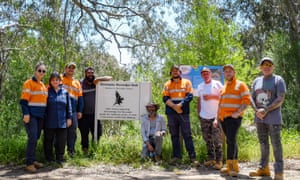
“From an anthropological perspective, it was not a natural landscape but a cultural landscape that was shaped over millennia by Wurundjeri Woi Wurrung beliefs, traditions and land management,” she says.
Back in 1840, in the early days of colonisation, Woi Wurrung people made a request to the Port Phillip Aboriginal protectorate for a permanent reserve to be established in this area. Because non-Indigenous settlers were already on the land, Nerre Nerre Warren reserve was chosen instead, but the Wurundjeri Woi Wurrung continued to live in the area and practiced their traditions on this land until they were moved onto Acheron Station in 1859.
“When we were kicked out, we weren’t allowed to go back down into the city,” Wandin says. “This is sort of the closest where we felt comfortable, where we weren’t really interfering.”
The Bolin Bolin billabong was an important area for ceremonies and dances involving neighbouring clans, a gathering place, and had an ecosystem that could support between 300 and 500 people, he says. The Wurundjeri Woi Wurrung people would have fished for eels by burning the reeds in the still water here, knowing they would congregate in the warm shallows. They could then be fished with a spear.
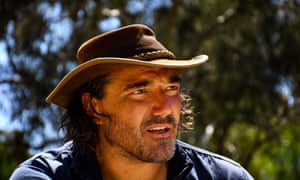
“It’s like a day spa for an eel,” Wandin jokes. They would have come here to shed fat and then migrated north in their epic journey to the saltwater of the Coral Sea to breed. In running water, the Wurundjeri Woi Wurrung would have used stone eel traps, a common practice across Victorian Aboriginal groups.
“It looks beautiful, it looks nice and green – but it’s not its natural landscape,” Wandin says. “But it doesn’t mean we just leave it alone and do nothing.
“We call it caring for country today, but it’s caring for our mother … she nurtured us, she nurtured our ancestors and she’ll continue to nurture us if we look after her in the way that she’s been looked after for tens of thousands of years.”
Recent Comments