


When it comes to cargo delivery, the name of the game is coordinated logistics.
In America, the end of the year for most is a very busy time. You’ve seen the broadcast television-news images of the holiday travel madness.
Car- and truck-overwhelmed freeways and long airport lines. Such scenes leave indelible images imprinted in the mind.
The day after Christmas, as many as 115 million Americans were expected to take to the waterways, skies, rails and roads; not sure which but either 90 percent or 90 million were expected to drive.
Now, compound that with cargo movement and delivery and it is amazing how the entire mobility apparatus doesn’t cave under all that weight, everything and most everyone managing to come through the encounter, ordeal unscathed. It’s pretty incredible when you think about it. Just think how much easier it would be for everyone and everything affected if things in this regard ran much more smoothly and efficiently. That would be rad.
Well, when you think about it and minds are put to it, there is every reason to believe things really can be that way.
Time to look at logistics – organized, coordinated logistics.
So, let’s take a page out of history analyzing the shipping practices of two former western U.S.-based freight railroad carriers – Atchison, Topeka and Santa Fe or ATSF or simply Santa Fe and the Southern Pacific or SP. The cargo carried was for all intents and purposes the same but the shipping practices of each railroad couldn’t have been more different.
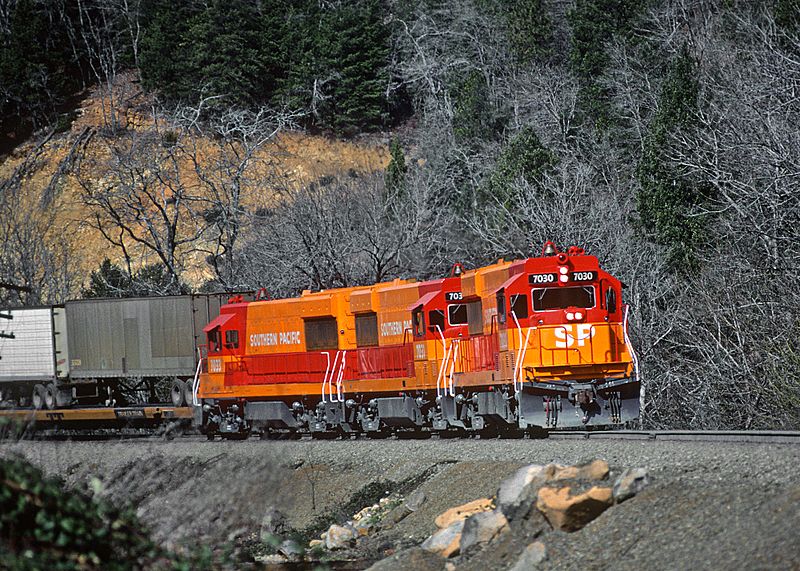
Take railroad containerization, for example. SP was co-creator of the doublestack (container-stacked-on-container) concept. This was a way of piling on more containers via their being stacked two high on a given length train. The Santa Fe subsequently answered the call with its patented “10-Pack, Fuel Foiler” cars, each articulated set capable of carrying 10 trailer loads. For the SP it was about quantity. For the Santa Fe, it had built its reputation on speed and quality, a hallmark of that particular western U.S.-based railroad.
Running longer trains with more freight on board, meant fewer numbers of operating personnel were required to move the cargo, presumably. Running shorter trains with less onboard freight meant a greater number of operating employees were needed to move a given number of trains over a given distance. Fewer trains also means, fewer emissions polluting the air. More trains means greater amounts of air-entering emissions.
There was one common operating philosophy however, the two railroads did share: Where time-sensitive lading was concerned, each ran what are known in the industry as expedited trains. These were the highest-priority trains on each railroad. They were known by the names “Sprint” on the SP and “Q” on the ATSF.
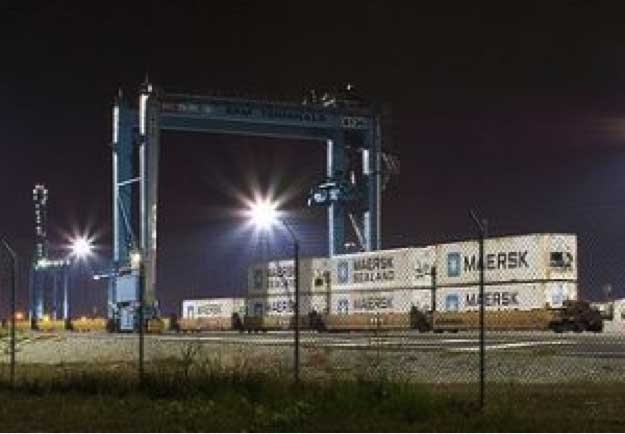 These two services grew out of what has come to be known as the “trailers-on-flat-cars” (TOFC) and “containers-on-flat-cars” (COFC) concepts. The idea here was to allow freight railroads to better compete with trucking concerns and to reduce the number of trucks on roadways for what would have been the longer portions of truck hauls. In large measure, this type of cooperative arrangement worked out favorably for what had historically been two competitive interests. As a result, a tremendous amount of fuel was saved, air was spared, and each operation in the chain was made more efficient. It’s an alliance, arrangement that persevered to this day.
What about the delivery via railroad of automobiles rolling off of the factory assembly lines? It’s more of the same. Entire trains can be made up exclusively of what are referred to as, appropriately enough, autorack cars, each autorack conveyance carrying a minimum of one and perhaps as many as 15 automobiles. Sure the automobiles could travel in car carriers over the road, but compared to train-hauled movements of such which would amount to fewer such moves, would take myriad more movements using trucks.
Less is more
What is interesting is that there are fewer railroad companies today moving the same or perhaps even more freight, and probably fewer employees than what was the case a half a century ago. All of which says that through better utilization and logistics and coordination of services, train operations, if not trucking operations, have gotten more efficient.
And, to think: it was about 40 years ago that freight railroading in America was teetering on the brink of collapse. That railroading didn’t and rebounded the way the industry has, speaks volumes!
And, all because of organized and coordinated logistics.
Images: Roger Puta (upper); William Grimes (lower)
– Alan Kandel
Recent Comments