

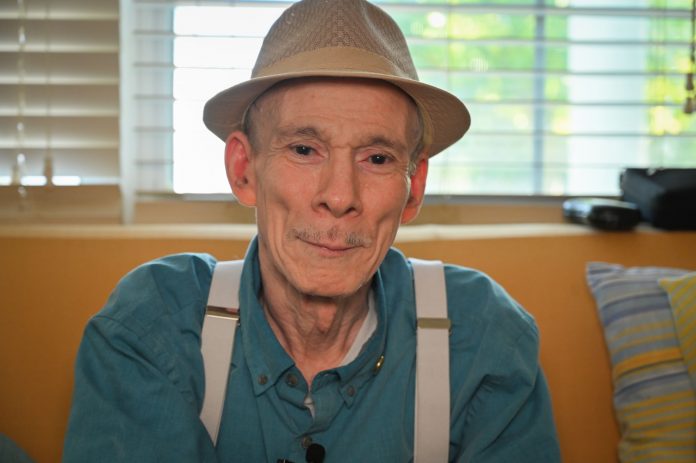


Samuel Abel Powery, 81, of West Bay was among the first generation of Caymanians recruited by National Bulk Carriers, joining the global shipping operation at age 17 as a messman, a job that required serving and cleaning up after meals.
The work allowed him to save enough money to purchase the home where he still lives in West Bay with his wife Redell. They married the day before Valentine’s Day in 1958 and went on to have eight children.
But before boarding his first ship, the oil tanker Petro Kure, in Marcus Hook, Pennsylvania, Powery had already received a maritime education of sorts in Cayman.
As a boy, he learned from his father how to ultilise the tools provided by the sea, turning washed-up coral into lime plaster for building houses. And as an adolescent, he joined the schooners that sailed the Caribbean in search of turtle.
As part of our series, ‘Founded Upon the Seas’, we have asked seafarers, like Powery, to share their stories with us. Below are three accounts, told in Powery’s own words, about his youth.
In the first segment, Powery describes the wattle-and-daub construction technique that old Caymanians employed to build their homes. Later, he takes us to a sandbar near Nicaragua’s Miskito Cay, where he toughed out a powerful storm. Finally, we end on an out-of-control cargo ship and a crying captain on the Bay of Biscay.
To hear these stories in Powery’s voice, listen to our podcast, ‘Cayman Stories’.
Firing up the kiln
One of the first things that I remember doing as work was helping my father gather some stones from the seashores. That was to build lime kilns.
Lime kilns is what the old-time people used to use to make their walls.
[There were] two or three, or four maybe, men that used to dig those lime kilns. These lime kilns were built from the stones from the sea, what you could find washed up, that the hurricane brought up.
I was just about 7. Sometimes I would help [my father] with carrying the wood to make the lime kiln. I used to cut the grape wood or the birch tree and I used to put that on my shoulder and carry it for him to put it on the lime kiln. I felt good about it. I felt like I was some use to him.
I used to go down there and help my father gather [the stones], then pile them up where he was going to build his lime kiln to get the lime to make these walls.
They used to take that lime and mix it in water and stir. And sometimes they called that a daub wall. The daub wall, they used to make it from wattle.
They used the bamboo and they split some grape tree, spread it down. And they used to take that and [plaster] it and then they used to take the shovel or whatever they had them days and plaster the wattle, plaster the bamboo boards, and then, you know, you got the daub wall.
Surviving Miskito Cay
I ran the Miskito Cay before I was with National Bulk [Carriers].
Some people might not even come to realise that [going to] Miskito Cay was going to sea. That was one of the first places that we started out going to sea.
We used to go out on the schooners. Some of those guys was with the National Bulk. They didn’t know anything about Miskito Cay. They didn’t know sailing or the schooners or the vessels. They just went, you know, didn’t give it a second thought.
A lot of us [sailed to] Miskito Cay and that was a dangerous place. I wasn’t quite 14 [when I started]. I was still a young boy. The immigration [official], she didn’t want to sign me off because I was still a schoolboy. The captain was there with me to see me signed off. He went with me to immigration and he begged her to let me go.
I guess [at sea] it would seem to be a little bit scary sometimes, but for me, I never got scared, never got seasick. It seems my stomach must be pretty strong.
We were going to get turtle. They’d have them tie a fin and you could bring them back to Cayman and they used to ship them to the States or to Key West.
[There was] a gentleman who went by the name of Mr. Osgood Christian. That was my first trip out. He had me as a cook. I might have been more of a mess boy, but I had to cook for them.
We were not really going to the key. We were on [sand]bars, where you see the shallow water up around the bar.
We used to make huts. And we used to have cooking and sleeping in that area. It wasn’t big, but it used to be three or four of us – three men in the boat and one cook for the four of us.
One experience that I had that was a scary experience was having a nor’wester come down, and it was only me in the hut.
The other ones had went to the key to get wood and water. They used to go down there somewhere around 11 o’clock, or maybe later.
They would stay all night and come up in the morning. Then, one morning, they couldn’t make it up because the nor’wester was too heavy. They couldn’t make it back to where I was in the hut, so they stayed down there. They were gone over one week.
The nor’wester blowed and blowed. It was a bit scary. I was so afraid in the nighttime that I had no company. I took one guy’s bed and put it on top of me.
And we were running out of wood to cook with.
So what I did was, to get the wood, I had to cut a piece of wharf that we had. There were some points sticking out that looked useless. I just sawed them off and made a fire. So that’s how I survived.
It was quite scary.
The guys out at the key, I was thinking that they were safer than me, you know. They were on the land, but I was out in the bleak ocean.
They didn’t know anything about me, what would happen to me, and I didn’t know what happened to them. You couldn’t take no chances or come to where I was and I couldn’t take no chances.
‘The poor captain cried’
One time that was scary was when we got caught in a storm up in the Bay of Biscay on one of those Liberty [cargo ships].
It was built for the war and National Bulk used to buy them. They used to carry freight from the United States or India or wherever it is.
And we got caught on the Bay of Biscay. What happened was, the ship was [supposed] to take water ballast [to stabilise the vessel] from the dock and I think the captain used to get a bit excited once the ship finished discharging what she had. He wanted to get her from the dock too quick, and he went and never stopped, and got the ballast that he should take.
When we go in the ocean, all we could do was [shift] the water in the ballast and that wasn’t enough. So, he’d done wrong. He went out and left the water that he should have took on the ship.
We went out there and I happened to be to the wheel. The storm caught us on the starboard bow [the right side of the ship], and I was on to do the 24-hour watch.
It started blowing and blowing the ship around, and I started giving the wheel to try to bring her back. And one old gentleman said that the wheel would lock. He said that the wheel was too tight.
That’s all I could do, just keep turning it and turning it and she wouldn’t come back up to string her around.
Nobody could get to the wheel and bring the ship back around. She was taken advantage of because she was up too high, she didn’t have that ballast to keep her down. Half her starboard was in the ocean. And the wind takes advantage and swings her. The poor captain, he cried, you know, it was so serious.
The sea would take her and roll her. The wind
with the ship would go up like that [to the side] and when she’d come down, she’d go like that [to the side] again.
I believe the people at home here were praying for us and there could be someone else in another part of the world praying for people at sea. So, we always remember to pray for them. Even now, if we saw a ship passing up and down here, we just don’t know what might happen to them. We pray for them.
Do you know a seafaring story that the Cayman Compass should share? Contact Kayla Young at [email protected]
Recent Comments