


Q: Please tell us about yourself and your business. How long have you been doing this, and what motivated you to get into it?
Melaragno: I started Compassionate Composting, an above-ground equine burial service, in the fall of 2012. I had recently purchased some agriculture/resource-protection zoned property abutting my existing property and wanted to establish an agricultural-based business.
Having experienced and heard about some rather horrific removal and disposal stories (of dead horses), I knew there was a significant need for a humane method that was also environmentally responsible. As an assistant instructor for the (regional) Technical Large Animal Emergency Rescue, I am experienced in the use of specialty equipment and mechanical handling techniques of large animals. My skills merged with the land purchase and my desire to offer a more thoughtful, respectful service for horse owners. I attended the Maine Compost School and went through the process to get a zoning ordinance amendment, also with the assistance and support of the Maine Compost Team.
Q: I know there are new laws where I live in Idaho and elsewhere in the country that prohibit rendering companies from picking up bodies of horses that have been chemically euthanized. Water quality laws or concerns might also prohibit burying a horse on personal property. Other than the landfill, is composting the only other options for “disposing” of a deceased horse?
Melaragno: Currently the most utilized options throughout Maine and New England include ground burial (depending on municipal and state laws), cremation, and composting. There are very few options for rendering in New England and very few (if any) landfills that accept large animal carcasses. Alkaline hydrolysis (using lye and heat) is another option but is not yet readily available. Each state has specific regulations regarding ground burial, composting, and rendering. In Maine those requirements are detailed in Chapter 211 – Rules for the Disposal of Animal Carcasses. Every state also has different laws and requirements about what they allow. For example, California does not yet allow carcass composting.
Q: How does the composting process work with a large animal body? How long will it take to decompose? Can the owner pick up and safely use the finished compost?
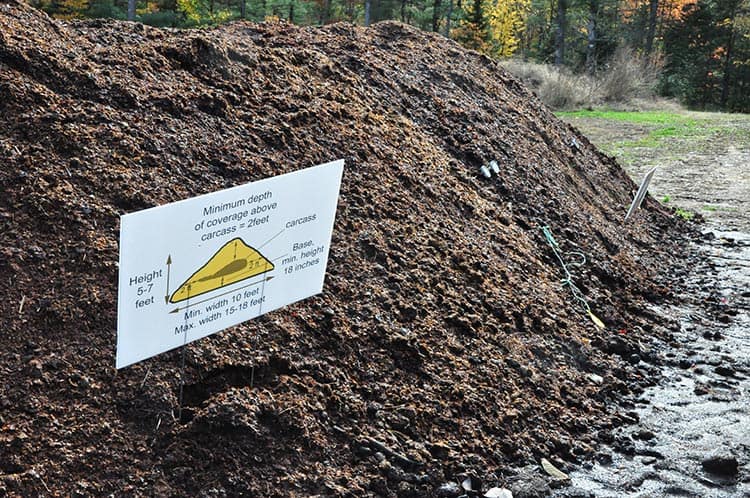
Melaragno: Most people are familiar with “backyard composting,” but it is important to note that the composting of large animals is a very different process. It is a thermophilic process (which reaches higher temperatures—between 106 and 252 degrees Fahrenheit—than traditional composting) with a specific “recipe” for bulking materials and shaping windrows. (Bulking materials are the carbon-based materials used in composting to add structure to a pile, such as shavings, dry leaves, landscaping materials, shredded paper, or animal bedding. Windrows describe the shape the bulking materials create.) The bulking material we use is stall waste from horse facilities. The animal is placed on a deep bed of bulking material in a large, long windrow, next to but not touching other animals. Then it is covered with more of the same bulking material. Standards for the shape and size of the windrow/pile must be followed to:
- Mitigate against potential odor issues;
- Not attract predators;
- Contain bodily fluids; and
- Maintain the best environment for proper composting.
In a properly constructed pile or windrow, all soft tissue is decomposed in four to five months. Only bones remain, which continue to break down at a slower pace. Temperatures are recorded to confirm that the process achieves at least 131 degrees Fahrenheit for three consecutive days, which ensures pathogen (disease-causing organism) destruction. The location of every animal is marked, and owners can return a few months later to obtain compost from that area. Occasionally, an owner opts to have a fully private above-ground burial, in which case they can get back all composted remains. No restrictions have been placed on the use of the finished compost. Studies regarding residues of sodium pentobarbital or other drugs commonly used in horses show very little or no remaining amount in the finished compost product. I encourage owners to use the compost as a soil amendment for landscaping or flower beds or to spread it in the fields where their horse grazed.
Q: What kind of permitting is required for a business like yours?
Melaragno: Every municipality and state will have different requirements and laws. I had to go through the lengthy and expensive process of getting a zoning ordinance amendment in my town. A Compost Management Plan is also required in Maine and must be developed with professionals such as the Maine Compost Team as well as the Department of Agriculture, Maine Department of Environmental Protection, Maine Extension Service, and the Maine State Planning Office.
Recent Comments