

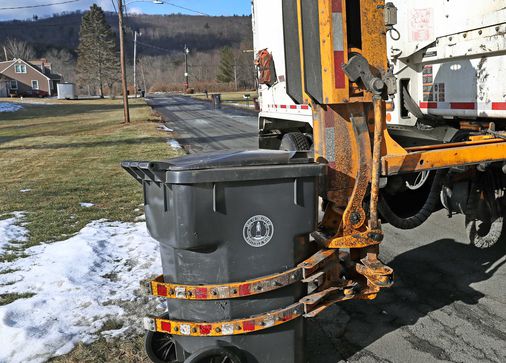

It’s a reckoning hitting home across Massachusetts. Boston, for example, is now paying nearly $5 million to have recycling collections carted away, up from just $200,000 in 2017. City officials said they do not plan to end the program.
The crisis began two years ago when China announced it would no longer accept large amounts of paper and plastic from the United States, which for years had exported huge collections of material there and elsewhere in Asia, because much was contaminated and unusable.
That decision has sent tremors through the recycling industry, leading to steep declines in the value of paper, plastic, and other recyclables. Waste Management, the nation’s largest recycling company, used to earn as much as $80 a ton for paper it collected; today, it gets nothing, officials said. The value of cardboard has plunged 70 percent, and it now costs more to recycle glass than the company can make selling it.
“There are once-in-100-year floods; this has been the equivalent to a once-in-500-year flood,” said Steve Changaris, northeast region vice president of the National Waste and Recycling Association, a trade group for waste companies. “We saw a loss of 40 percent of the market that consumed these materials.”
That collapse has reverberated widely. Until this year, Westfield and most other communities in Western Massachusetts paid nothing for recycling. Some even earned revenue from the region’s largest recycling plant, which turned their discarded paper and bottles into profits.

But the equation has changed, and by the end of January 74 communities across Western Massachusetts must decide whether to sign a new and much more expensive contract with a state-owned recycling facility in Springfield, whose contractor has said it was forced to raise its prices drastically.
“With current commodity prices at historic lows, the sale of those commodities does not cover the cost of processing,” said Garrett Trierweiler, a spokesman for Waste Management, which operates the Springfield plant for the Massachusetts Department of Environmental Protection. “As a result, new contracts for processing recyclables are typically written to cover the cost.”
As China has retreated from the international recycling business, other markets had taken some of America’s refuse. But now some of those countries have introduced policies similar to China’s to limit contaminated materials, drastically reducing US exports. Recyclables are often considered contaminated when they aren’t properly cleaned.
For example, Indonesia announced last year it would accept only minimal contamination in mixed paper — everything from newspaper to corrugated cardboard — sparking a drop in US waste exports to that nation by 95 percent, according to the National Waste and Recycling Association.
Just this month, India announced a similarly strict policy, halting all imports of mixed paper. After China changed its policy, India had become the dominant importer of mixed paper, taking in 40 percent of North American exports.
In Massachusetts, Michael Camara, chief executive of ABC Disposal Service, said the crisis shows no signs of relenting. The company’s recycling plant in Rochester, facing a 41 percent drop in prices, now has hundreds of bales of material waiting to be shipped to a processor, and the amount grows by the day.
“It’s a horrific situation, with high costs and limited demand,” he said. “At this point, it’s unclear whether we’ll be able to stay in business. Something needs to change.”
State environmental officials, who last year spent $7 million to help municipalities maintain and promote recycling programs, said they have sought to offset the financial impact on communities in Western Massachusetts by shortening the length of their contracts and opening up the plant in Springfield to 27 other towns in the region.
But little else can be done, they said.
Municipalities with programs that do not separate their recyclables, so-called single-stream collection, will have to pay on average about $150 a ton over a three-year contract to have their waste accepted at the plant; those where residents separate paper and plastic into different bins will have to pay nearly $100 a ton over a five-year contract.
“The new contract will be more expensive for communities due to a changed international market,” said Joe Ferson, a spokesman for the Department of Environmental Protection. “These costs are in line with what many communities across the state, region, and country are paying.”
Ferson said the department hasn’t been informed that any communities are pulling out of the agreement, which would likely require Waste Management to raise costs even more for those that sign their contracts. But some communities — including the largest in the region — now say that they are indeed likely to pull out.
In Springfield, which produces some 7,000 tons of recycling a year, officials said the new recycling contract would force the city, which now pays nothing, to pay $1.2 million a year, an untenable sum.
“That’s a huge number for us,” said Chris Cignoli, director of the city’s Department of Public Works. “We don’t have that kind of money. Nobody does.”
He has begun informing colleagues in neighboring towns that Springfield is considering other options, meaning a potential 35 percent reduction in single-stream recyclables sent to the state plant. Such a decision could force the state to end single-stream recycling at the Springfield facility, because it relies heavily on collections from that city, he said.
“It seems highly unlikely that we’re going to sign,” Cignoli said. “That means other communities are going to have to get their own houses in order.”

In Holyoke, where in good years the city earned as much as $70,000 from its recycling program, officials were also scrambling to find another option. If officials agree to the new contract, they’re facing annual costs that start at $160,000.
“This is beyond what we can bear,” said Michael E. Bloomberg, chief of staff to the mayor, adding the city is unlikely to sign on to the state plan.
“In a city that’s fighting to find every penny it can for education, public health, and potholes,” he said, “we’re now having a reckoning.”
Both Holyoke and Springfield are instead considering lower-cost offers from contractors.
At the recent meeting at the Public Works Department in Westfield, municipal officials raised concerns about being locked into an agreement with the state for another five years. As officials huddled around a conference table, many were exasperated.
Their discussion ranged from eliminating curbside recycling to whether to pass the costs on to residents in the form of higher disposal fees. Neither seemed viable, Billips said.
In the end, they decided to analyze the costs of delivering their recycling to another contractor farther away. They asked a consultant to look at the costs of converting the city’s transfer station into a facility that could accommodate recycling.
There were concerns raised about the alternatives, and little time left to decide what the city should do.
“This whole thing leaves a bad taste in my mouth,” Billips said.
David Abel can be reached at [email protected]. Follow him on Twitter @davabel.
Recent Comments