



As procurement becomes more digital, data-driven and strategically important, it’s increasingly clear that organizations need a new breed of procurement professionals. Tomorrow’s procurement professionals need to be equally fluent in technology, data and relationship building. They must be able to zoom in to analyze processes and data points, and then zoom out to deliver strategic insights and collaborate with suppliers. Some of today’s professionals will need to bone up on their job-specific skills, but most will need to add new tools like business acumen, interpersonal skills and deep work (the ability to focus without distraction on cognitively demanding tasks) to their toolkits.
With the availability of vast amounts of data, supply chain leaders continue to turn to analytics to help make business decisions. APQC has watched how organizations have steadily incorporated analytics into their business operations, as well as the technologies they have adopted to support their analytics efforts. APQC recently conducted research across the entire supply chain on the use of analytics. The survey of 202 respondents across 16 industries gathered insights on the types of analytics used and in which parts of the supply chain, how the efforts are structured and how organizations measure performance.
APQC conducted its last major survey on supply chain analytics in 2016, and some trends have remained constant. Supply chain professionals in both 2016 and 2019 indicated that their organizations have increased investment in analytics over the last three years. In APQC’s most recent study, it categorized supply chain analytics into the following five types.
- Descriptive. What is happening or has happened.
- Diagnostic. Why it is happening?
- Predictive. What will happen?
- Prescriptive. What should be done?
- Cognitive. Using machine learning, describing what could or should be done.
APQC’s research in 2019 found that many organizations have made great strides in their supply chain analytics efforts since 2016. However, they should keep in mind key enablers and barriers to analytics success.
Analytics trends
APQC’s research indicates that analytics has gained a foothold in business operations. Seventy-eight percent of respondents to the 2019 survey agree or strongly agree that analytics is ingrained in how their organizations conduct business and manage performance. This is an increase from 2016, when just under 60% of survey respondents indicated that they agree or strongly agree.
The research in both 2016 and 2019 looked at how organizations structure their analytics programs at the enterprise level and at the supply chain level. For its research, APQC defined analytics program structures as follows.
- Centralized. Managed through a central corporate department or center of excellence.
- Decentralized. Analytics staff or programs are located within business units.
- Hybrid. Combines a centralized oversight structure with staff embedded in the businesses.
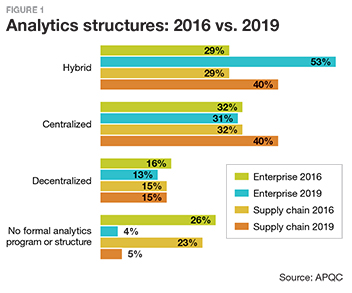 Figure 1 compares the structure of the enterprise and supply chain levels in 2016 and 2019. The data shows a clear decrease in organizations with no formal analytics program or structure at both the enterprise and supply chain levels. Although the percentage of organizations with a decentralized structure has remained relatively static over the last three years, there has been a marked increase in organizations using a hybrid structure at both the enterprise and supply chain levels.
The use of a hybrid structure at the enterprise level helps organizations combine the holistic perspective and control of centralized guidance with the flexibility and insights into business needs provided by decentralized implementation. At the supply chain level, in 2019 a nearly equal percentage of organizations use a hybrid structure as use a centralized structure. These results indicate that in the supply chain, organizations see value in both centralized guidance and the hybrid structure. It will be interesting to see whether this trend changes over the next few years.
Application of analytics
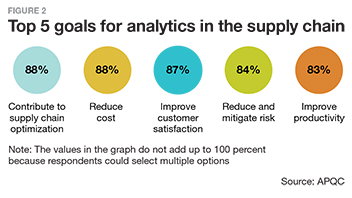
As part of its most recent research on analytics, APQC looked at how organizations apply advanced analytics. APQC asked survey respondents to indicate the goals for their supply chain analytics programs. As shown in Figure 2, organizations have a variety of purposes for using analytics in the supply chain.
The top two goals most widely named in the
survey are: contribute to supply chain optimization and reduce cost; less important are reducing risk and improving productivity. Clearly, organizations are seeing supply chain analytics as a way to increase their planning accuracy, which can result in reduced costs in running the supply chain.
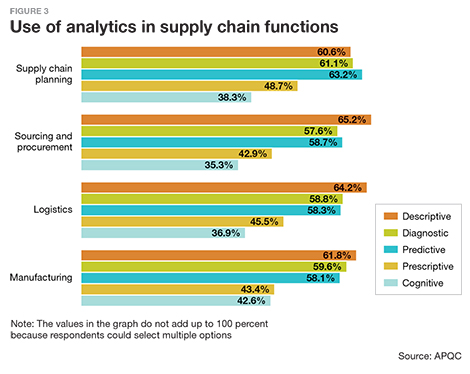
With this in mind, APQC considered the use of the five different types of analytics within the supply chain. As shown in Figure 3, a majority of organizations use descriptive analytics across the supply chain to understand events that have already occurred. To a lesser extent, organizations use diagnostic analytics and a slight majority of organizations across supply chain areas use predictive analytics to anticipate what will happen.
 Less than half of organizations across supply chain areas use prescriptive analytics to determine actions that should be taken. Even fewer use cognitive analytics, which employs machine learning to determine what organizations should or could do. Although organizations have yet to widely adopt cognitive analytics, they are using machine learning in other ways. Sixty percent of respondents indicate that their organization uses machine learning in predictive analytics. This practice allows for large amounts of structured data to be processed with seemingly disparate data, thus enabling more accurate determinations of what will happen.
Measures, enablers and barriers
With the increased investment in supply chain analytics and the greater adoption of more advanced types of analytics, organizations’ analytics programs have become more successful. In 2016, only 33% of organizations considered their analytics programs to be very effective or effective in solving strategic challenges. Compare that with 2019, when more than 66% of organizations consider their programs very effective or effective.
 This trend continues with satisfaction with access to data. In 2016, only 23% of organizations were very satisfied or satisfied with their ability to access relevant supply chain data for timely decision making. In 2019, that number jumped to 63%.
To evaluate the effectiveness of their analytics programs, organizations should consider measures of engagement and business performance. For engagement, organizations often look at the use or consumption of analytics, the number of analytics support requests and the number of employees requesting analytics training. To determine the effect of analytics on the business, organizations measure cost/benefit or return on investment, stakeholder satisfaction, revenue, customer and employee retention and cost savings.
Ultimately, organizational practices help ensure the success of a supply chain analytics program and lead to superior performance on both engagement and business measures. According to APQC’s 2019 survey, articulating the benefits of using analytics, the availability and quality of data, and the ability to interpret results are key enablers of supply chain analytics success. An analytics program will not succeed without easy access to high quality data and an organization certainly will not benefit from analytics if it is unable to interpret the results of its analysis. Most importantly, organizations will fail at analytics if they are unable to gain buy-in from employees.
APQC’s research also reveals that the top barriers supply chain analytics efforts encounter are finding the financial resources for analytics, finding people needed to carry out analytics activities, and garnering executive buy-in and approval for analytics activities. Successful analytics programs require investment, and without financial resources an organization’s efforts will not yield results. Similarly, an analytics effort cannot get off the ground if there are no individuals in the organization with the skillset to carry out analytics activities. In addition to setting the organizational attitude toward supply chain analytics, leadership that does not support analytics activities will limit financial and tactical resources, thus ensuring that the results of the analytics program will be limited.
Analytics in practice
APQC recognizes that not all organizations have achieved the success of the organizations represented in its survey. However, it is imperative that organizations effectively manage their data to streamline their work to set a solid foundation for improvement and analytics.
A large healthcare organization interviewed by APQC faced this challenge because it lacked the processes, tools and structures for managing its data. Its solution was to create a supply chain data management program to not only manage its data, but also to reduce waste and create more effective risk management and reporting.
The program consists of three core components: people, process and technology. It uses process to standardize data management and analytics tools and the data management team performs diagnostic, predictive, prescriptive and cognitive analytics. As part of the program, the organization has undertaken several key projects:
- consolidating and supporting business responsibilities to a limited number of individuals involved in data creation and maintenance;
- creating data dictionaries for various types of data (such as material, customer and vendor master data) to provide definitions and rules, as well as guidance for data fields;
- initiating a chatbot feature so that internal customers can ask questions at any time of day; and
- creating playbooks that provide a single source of truth for all master data documentation.
The organization measures its success through cycle time, data quality and stakeholder engagement. As a result of its efforts, it has significantly reduced cycle times. It is able to deliver monthly dashboards to provide full visibility into the customer and vendor master data creation process. It has also stabilized its data governance.
The organization has identified several key enablers for its program’s success. When it began the program, the organization was proactive in change management and ensured that stakeholders saw data as an asset for the company. It was also able to prioritize aspects of its analytics projects to stay within the defined budget for analytics adoption.
Consider enablers and barriers to advancement
APQC recommends that organizations consider the key enablers and barriers of supply chain analytics, whether they are just starting out in analytics or if they have already established a program. Without mature processes in place, organizations may be limiting their success.
Over the last three years companies have made much progress with analytics, as evidenced by an increase in the effectiveness of analytics programs and the availability of quality data. Within the next three years, APQC expects to see greater numbers of organizations use cognitive analytics to make more precise predictions and decisions.
About APQC
APQC helps organizations work smarter, faster and with greater confidence. It is the world’s foremost authority in benchmarking, best practices, process and performance improvement, and knowledge management. APQC’s unique structure as a member-based nonprofit makes it a differentiator in the marketplace. APQC partners with more than 500 member organizations worldwide in all industries. With more than 40 years of experience, APQC remains the world’s leader in transforming organizations. Visit us at apqc.org and learn how you can make best practices your practices.
Recent Comments