

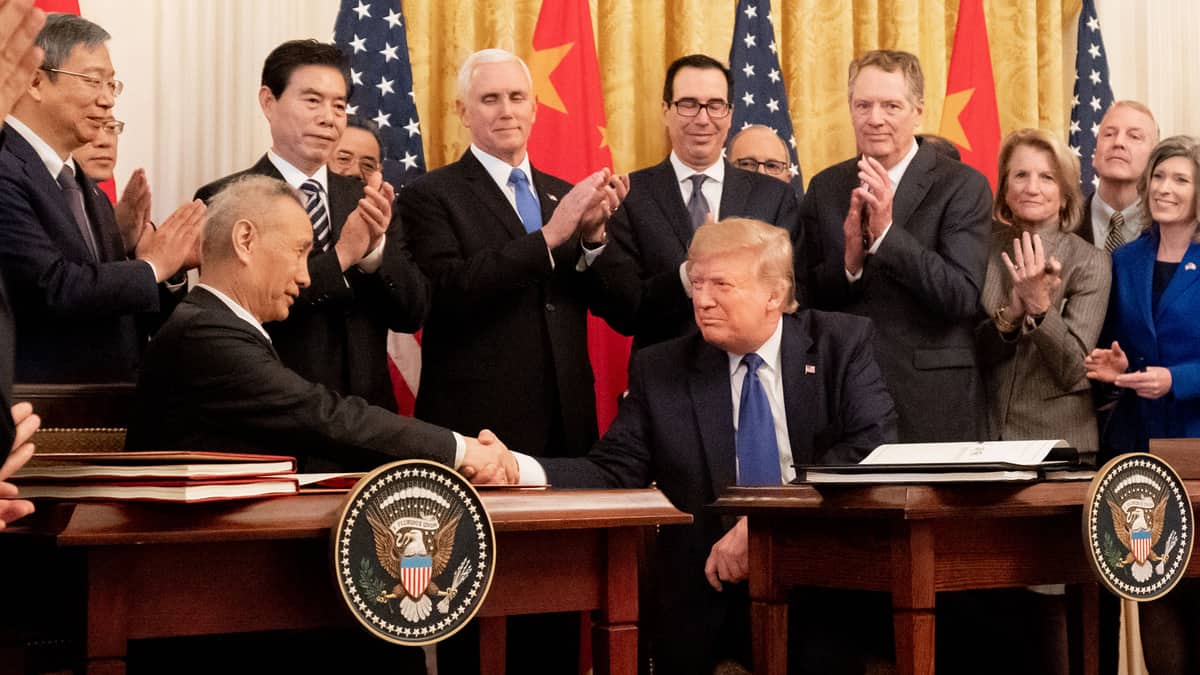

The signing of the Phase One trade pact between the U.S. and China on Wednesday is a clear positive for ocean shipping demand. But the sentiment overhang on shipping equities will likely linger. There’s still too much uncertainty on future trade relations between the two countries.
China is committed to buying $77.8 billion in U.S. manufactured products over the next two years, which is good for the container sector; $32 billion in agricultural products, a plus for dry bulk shipping; and $52.4 billion in energy exports, which should support tankers carrying crude oil, liquefied petroleum gas (LPG) and liquefied natural gas (LNG).
Frode Mørkedal, an analyst at Clarksons Platou Securities, pointed out that the U.S.-China deal would likely redirect ocean flows more so than create new volumes.
“Macro analysts estimate the trade deal could add 0.1-0.3% to Chinese GDP,” he explained. “Although China’s import demand could therefore increase, it is unlikely to expand by $200 billion [total commitments under the Phase One deal]. Increased volumes from the U.S. would likely lead to reductions from other countries. Hence, we see the main positive impact being potentially increased distances.”
Shipping demand is not measured in tons, but rather in ton-miles: volume multiplied by distance. If two ships carry the same cargo tonnage but the second one travels twice the distance, it accounts for twice as much demand as the first ship.
Tankers
One of the world’s longest-haul crude-tanker trades is between the U.S. and China. According to Amit Mehrotra, transportation analyst at Deutsche Bank, “U.S.-to-China crude shipments have been halved since 2017 and a reacceleration would have positive implications for Euronav [NYSE: EURN].” Other U.S.-listed companies with heavy exposure to the very large crude carriers (VLCCs, tankers designed to carry 2 million barrels of crude oil) are Frontline (NYSE: FRO) and DHT (NYSE: DHT).
Ben Nolan, shipping analyst at Stifel, noted that U.S. crude-oil exports to China “have fallen off a cliff in 2019 relative to the last two years. By requiring some of those cargoes to head to China, it should be marginally supportive of tanker rates. At the end of the day, [Chinese] oil consumption is unlikely to change, but average voyage lengths could increase moderately.”
U.S. crude exports to China totaled 1.8 million barrels per day (b/d) last year, down 60% from 4.5 million b/d in 2017.
Dry bulk
On the dry bulk side of the equation, Nolan said, “Similar to oil, this is unlikely to change underlying commodity consumption, but increased grain trade to China could lengthen ton-mile demand, which would be particularly good for Kamsarmax and Ultramax owners such as Star Bulk [NASDAQ: SBLK] and Scorpio Bulkers [NYSE: SALT].” A Kamsarmax bulker has a capacity of 82,000-83,000 deadweight tons (DWT), a Supramax 45,000-60,000 DWT.
There could also be an opportunity for increased U.S. coal exports, which totaled just 800,000 tons in 2019, down 75% from 3.2 million tons in 2017.
LPG
LPG is transported from the U.S. to Asia using very large gas carriers (VLGCs), which have a capacity of 84,000 cubic meters and usually transit the Panama Canal. The trade war has prompted China to switch its LPG buying to the Middle East, but U.S. export ton-miles have been maintained because export cargoes have simply diverted to Japan and Korea.
According to Nolan, “With LPG prices in the U.S. dramatically cheaper than in Asia and with LPG used as a feedstock, those companies in Asia that can use North American LPG should have a cost advantage. With tariffs going away, we would expect to see both spot and long-term exports of LPG heading from the U.S. to China.
“The biggest beneficiary should be the larger LPG vessels, followed by those with export facilities, particularly Navigator [NYSE: NVGS],” he said. The largest U.S.-listed owner of VLGCs is Dorian LPG (NYSE: LPG).
LNG
LNG exports to China totaled 2.2 million tons in 2019, down 90% from 2017 levels. “This was a big hit to demand from a ton-mile basis,” said Nolan, adding, “If tariffs go away on LNG, it would allow more exports to make the long journey, pushing up demand for LNG carriers.” He believes this could be a “modest positive” for GasLog Ltd. (NYSE: GLOG) and Golar LNG (NYSE: GLNG).
“The trade deal would serve the greatest benefit to the U.S. LNG producers [because] it should allow additional headroom for LNG export deals to be signed,” he continued, adding that Cheniere (NYSE: LNG) should be a beneficiary.
As Mehrotra put it, “We expect increased LNG purchases from China, which carries positive implications for the pre-FID [Final Investment Decision] U.S. liquefaction projects, which in turn is a positive for U.S. energy activity levels.” The more liquefaction projects that reach FID, the more LNG cargoes will someday head to sea, a plus for shipping.
Shipping stocks
Tensions between the U.S. and China since the election of President Donald Trump have created a negative overhang for U.S.-listed shipping equities.
As Jefferies shipping analyst Randy Giveans told FreightWaves during an interview in September, “When you think trade wars and slowing global trade, you think shipping companies. Shipping companies are very levered to global trade — they facilitate global trade. There’s certainly an overhang right now with the trade tensions.”
The question is: Will the signing of the Phase One trade deal have a material upside effect on shipping stocks? The early indication appears to be no, because too much uncertainty remains.
Will a future dispute between the countries cause one of them to walk away from the deal? Will China buy as much agricultural products as promised, and even if so, does that materially change dry bulk ton-mile demand (versus Chinese imports from Brazil and Argentina)?
Since the Phase One deal was announced on Dec. 13, most shipping stocks have either fallen or been flat. On Wednesday, the day the agreement was signed, most shipping stocks fell. Equities are being pressured by lower spot rates in both the tanker and dry bulk sectors.
In the container segment, the Copenhagen-listed shares of the world’s largest liner company, Maersk, are down 14% since the trade deal’s initial announcement.
A telling indicator to watch is the pricing of U.S. soybeans, which has been heavily depressed by U.S.-China trade tensions. If investors believe the trade war is finally coming to an end, soybean prices should rise, but they fell on the day the deal was signed and they’re down year to date. More FreightWaves/American Shipper articles by Greg Miller
Recent Comments