

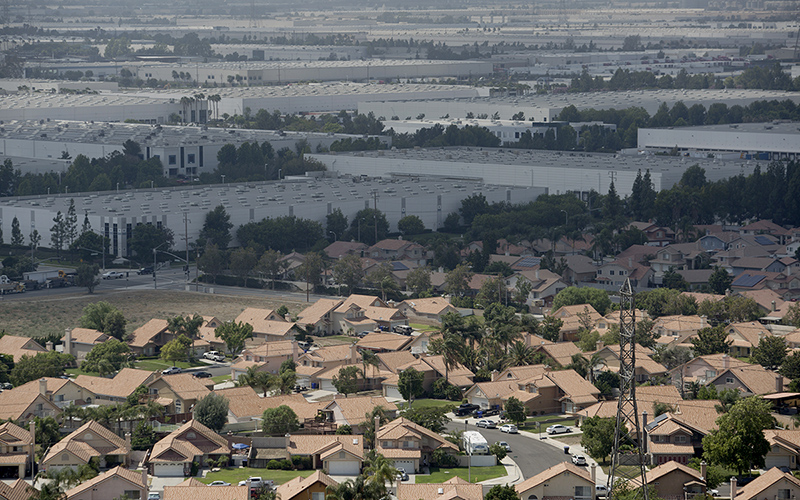

Driving down the CA-60 E through the Inland Empire, the landscape gradually becomes less urban. Jagged, rocky hills give way to patches of greenery framed by distant snow-capped mountains. Clusters of warehouses hug the freeway—hundreds of low, rectangular buildings, pressed up against residential homes. In the Inland Empire, warehouses have been proliferating seemingly overnight, residents say. For communities already struggling with some of the worst air quality in the nation, the expansion of the logistics industry—or the transportation, delivery, and storage of goods—presents a serious air quality and environmental justice challenge.
A decade ago, when Inland communities were still reeling from the economic recession and unemployment in the region topped 15 percent, the expansion of the logistics industry seemed like a lifeline to many residents. Since the heart of the recession in 2010, over 150 million square feet (about 3,300 football fields) of industrial space, mostly warehouses, has been built in the Inland Empire, according to real estate services company CBRE. The expansion of the logistics industry was sold by local governments to residents as a path to the middle class. A decade later, as poverty levels remain stubbornly high, many in the community wonder if the prosperity promised by the industry has born out. Logistics centers have provided thousands of jobs—but are they good jobs? Do the economic benefits justify the environmental degradation?
Warehouses have multiplied in the Inland Empire as a result of geography and the explosion of online shopping. The modern “miracle” of overnight delivery requires an impressive infrastructure of ships, warehouses, railroads, and delivery trucks, to shepherd goods to stores and homes. Offering abundant and inexpensive land, and situated near the Los Angeles-Long Beach port complex, the Inland Empire has attracted all of the major online shopping distributors. Amazon has erected multiple enormous distribution centers in the region, some of which top one million square feet in size.
The speed and scale of development—largely welcomed by local governments—has divided communities. Supporters of warehouse projects cite economic benefits and job opportunities. Opponents decry the industry’s low wages, the looming threat of automation, the added traffic burden, and of course, the air quality threat.
The Inland Empire’s air quality nightmare predates the explosion of the logistics industry, but the thousands of diesel trucks that come and go from warehouses are certainly adding to what has become an intractable problem. Many of the 500 million tons of goods, valued at well over 1 trillion dollars, that move through Southern California each year will spend a stint in an Inland Empire warehouse. As the number of warehouses increases, so does the amount of cancer-causing toxins spewed across neighboring communities.
Like the rest of the notoriously smoggy Greater Los Angeles area, the Inland Empire’s air quality woes originate with an unfortunate geographic coincidence: L.A. is ringed with mountains and gets a lot of sunshine. The chemical reaction that forms ozone—the dangerous air pollutant more commonly referred to as “smog”—requires energy from sunlight. L.A.’s nearly year-round blue skies create air pollution, which gets trapped near the ground by the surrounding mountains and a layer of warm air in the atmosphere called an inversion layer.
“It’s like we emit everything into this box, and the box can be really big, or it can be quite small. And the height of that box depends on the inversion layer,” Suzanne Paulson, a professor of atmospheric chemistry who directs the Center for Clean Air at UCLA, said.
Los Angeles has seen decades of impressive air quality gains since the 1970s, thanks to emissions regulations, but that progress has not been uniform. Coastal cities like Santa Monica breathe significantly healthier air than Inland communities. Geography, an uneven distribution of emission sources, and population growth all contribute to the Inland Empire’s disproportionate pollution exposure.
In recent years, air quality gains in Southern California have stalled or even declined, according to Paulson. The lack of progress is especially devastating for Inland communities, which have yet to see healthy air quality. In 2018, the city of San Bernardino experienced 102 bad air days for ozone pollution. The counties of San Bernardino and Riverside topped the American Lung Association’s State of the Air 2019 list for most ozone-polluted cities in the United States. A large body of research connects elevated ozone exposure with premature death; newer research indicates this risk is present well below current national air quality standards. Given the health risks associated with ozone exposure at even “healthy” levels, can local governments justify more warehouse development, which will only exacerbate the area’s ozone problem?
Community concern over air quality has done little to stymie local government’s voracious appetite for development. Even modest proposals to regulate warehouse projects have faced staunch opposition from local officials. Last year, a proposed 1,000-foot-buffer between large warehouse projects and residential homes in Riverside County was whittled down to 300-feet before the policy could pass. Riverside County Supervisor Kevin Jeffries, who spearheaded the effort, ultimately voted against the gutted policy in protest. “We blew it,” Jeffires told the Los Angeles Times. “The standards that were adopted are really no standards at all.”
Anthony Victoria, a spokesperson for the Riverside-County based Center for Community Action and Environmental Justice, said that developers are purposely targeting low-income communities of color for development. “It’s environmental racism taking place. [Developers] are choosing to build these industries in areas where [they] feel there isn’t any community input,” Victoria said.
The encroachment of warehouses in primarily black and brown communities in the Inland Empire is the continuation of a long history of dirty industries exploiting communities of color. Research indicates that hazardous waste sites and industrial facilities are disproportionately built in non-white communities, and people of color are exposed to higher levels of deadly air pollution.
Victoria expressed disappointment at the lack of political will to protect residents from adverse health impacts stemming from the logistics industry. “The leadership in this region is short- sighted. They are making decisions on behalf of the few, without considering the concerns, and suggestions, of the many,” Victoria said. “Developers are working hand in hand with these city officials to make these decisions. They are not listening to the community.”
This lack of community input was exemplified, according to Victoria, by the approval process for the latest controversial logistics project in the Inland Empire—a new $200-million air cargo facility in San Bernardino whose tenant is rumored to be Amazon.
The San Bernardino International Airport Authority Commission vote approving the facility took place in the midst of the holiday season, when fewer community members were able to participate, and just days before a state law took effect requiring local agencies to disclose more information about warehouse projects before holding a vote.
At community meetings leading up to the San Bernardino International Airport Authority Commission vote, activists and environmental justice advocates, including the Center for Community Action and Environmental Justice, unsuccessfully pushed for the addition of a Community Benefits Agreement to the contract for the air cargo facility, which would set guidelines around air pollution and wages. Proponents of Community Benefits Agreements argued that without the addition of legally binding riders, corporations would only continue the cycle of exploitation—automating away jobs, degrading air quality, and offering low-wages.
Robert Jimenez, a freshman at UCLA who grew up in Perris, a small city deep in the Inland Empire, has watched firsthand as the logistics industry transformed his community. “It is changing the culture of the area,” Jiminez said. “It is no longer this rural area, with animals, horses, and whatnot. It is now becoming a place that is surrounded by warehouses.”
After joining his high school track team during his freshman year of high school, Jiminez developed asthma. He subsequently became involved with environmental activism in his community. “It would be nice if these companies who are making billions of dollars could at least contribute back to the community,” Jiminez said.
The Inland Empire’s air quality problems are evident in residents’ health outcomes. People living near large sources of air pollution suffer from higher rates of respiratory diseases and cancer. One study that examined the health outcomes of children at two elementary schools, one located 500 meters directly downwind from the San Bernardino Railyard, a major source of diesel emissions, and another elementary school located seven miles west of the railyard, found that students attending school near the railyard saw a 59% increase in reduced peak expiratory flow, an indication of poor lung function.
There is one glimmer of hope for air quality in the region: the Southern California Air Quality Management District voted in May 2018 to craft rules to combat air pollution from warehouses, distribution centers, and rail yards. Implementation of the “Indirect Source Rule,” which is currently released in discussion draft form, will likely begin July 2020.
Recent Comments