


Governments are putting greater emphasis on biosecurity in order to ensure that their population can trust the food that they eat. Consumers demand to know more about the origin of food products. The focus on food traceability has intensified globally over recent years. Although the pathway to the consumer is different, the digital supply chains that are being built and technology that is being leveraged to support food-based requirements hold enormous possibilities for health care too. Taking a consistent approach also helps to ensure that we are not needing to create separate systems or infrastructure where the various supply chains overlap.
Are we alone in the challenge?
Supply chain projects were included in some of the early e-health programs but typically the supply chain has not been well integrated into the digitalisation programs that are occurring across the sector in Australia. Instead, various stakeholders have created separate, and often diverse, streams of activity. This lack of a cohesive approach makes compliance more difficult for suppliers and provides them with greater challenges in meeting customer expectations of visibility. Providing access to more data extends into consumer health and wellbeing and we continue to look at big data to support artificial intelligence (AI) and other emerging technologies as an area that will potentially need to see significant change.
A recent roundtable of key UK healthcare policymakers and practitioners discussed the use of simple technologies such as barcode scanning and use of global data standards in supporting the need for greater information across the many processes in the care provided by the NHS.1
During this discussion, Lord Philip Hunt, of Kings Health, was reported as saying that the public would be “pretty surprised” by the lack of traceability in health care. While he was referring to the UK specifically, in truth other parts of the world, including Australia, are no different. Gaps in traceability of products to patient are generally only highlighted when issues such as those involving transvaginal mesh or breast implants occur. At the time of writing this article the ability to trace products to patients within their digital records or the immediate visibility of where products are in inventory within health providers remains largely unaddressed.
Starting with some basic foundations
Barcodes and scanning technologies have been used widely in other industries for well over 30 years and GS1 data standards have been used as an integral part of supply chains for all this time around the world. Where they are used as the core foundation within supply chains, they are proven to enable the granular traceability that is required to identify and contain issues with products. The value of these technologies is widely acknowledged by peak organisations such as the International Hospital Federation (IHF) and Society of Hospital Pharmacists Australia (SHPA), not only in supporting traceability but also in supporting clinical processes and improving patient safety within care settings.2,3
Thinking beyond the supply chain
Many of the changes within the supply chain, and the need to ensure that traceability extends all the way to where a product meets a patient, are being driven globally by regulatory requirements. The value, however, of investing in implementing foundational technologies to support traceability extends far beyond compliance where organisations have taken proactive approaches. Potential safety and efficiency improvements are well documented by peak organisations4 and are already being implemented within health services including many NHS Trusts in the UK6 and ACT Health in Australia to great benefit.
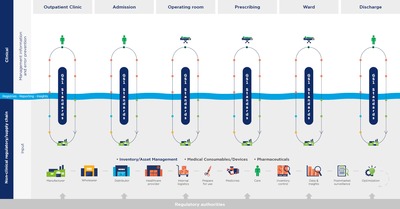
The ‘digital health’ agenda is extremely full and it is often challenging to bridge the supply chain and clinical delivery within organisations or give thought to the necessity to support traceability. The GS1 Global Clinical Advisory Committee (CAC) has recently documented how and where the supply chain and data standards interact with key clinical processes to build foundations that will take the supply chain beyond the back room to the patient.5
This group brings together leading clinicians from the global healthcare community to help support the challenging transition process facing the sector globally. Those organisations that are yet to start their journey of addressing traceability or how they can leverage scanning technology and data standards are encouraged to utilise this tool to help break down potential benefits and identify areas of focus.
Collaborating in 2020 to achieve traceability
Collaboration has become commonplace within the health sector; however, we have yet to tackle the challenge of ensuring traceability within and across the system in Australia in a collaborative way. While the Therapeutic Goods Administration (TGA) is taking a critical lead role in ensuring we develop globally aligned regulations, many of the necessary discussions that will ensure a software-agnostic, nationally (and internationally) interoperable and transparent mechanism to support traceability are yet to commence. This challenge awaits us as the new decade commences.
References
- Roundtable: the future of scanning technologies in the NHS (HSJ) https://guides.hsj.co.uk/5800.guide
- Global identifiers for enhancing efficiency and patient safety editorial (International Hospital Federation & GS1) https://www.ihf-fih.org/download_doc_file.php?doc=b9aeb66575236887f1d62eda5ede6145
- Global identifiers for enhancing efficiency and patient safety journal (International Hospital Federation & GS1) https://www.gs1.org/docs/healthcare/Publications_position-papers/GS1-IHF-09-HD-Final.pdf
- Closing the loop of medication management in hospitals to improve patient safety with barcode technology on unit dose packaging (SHPA) https://www.shpa.org.au/sites/default/files/uploaded-content/website-content/Fact-sheets-position-statements/position_statement_-_unit_dose_packaging.pdf
- Clinical Patient Pathway (GS1 Global Clinical Advisory Committee https://www.gs1.org/sites/default/files/docs/healthcare/project-imagine/Clinical-Patient-Pathway-final_InteractievePDF_GS1.pdf
- How barcodes are making hospitals in the UK Safer and more efficient (WASP) http://www.waspbarcode.co.uk/blog/how-barcodes-are-making-hospitals-and-surgical-theatres-in-the-uk-safer-and-more-efficient/?
Recent Comments