

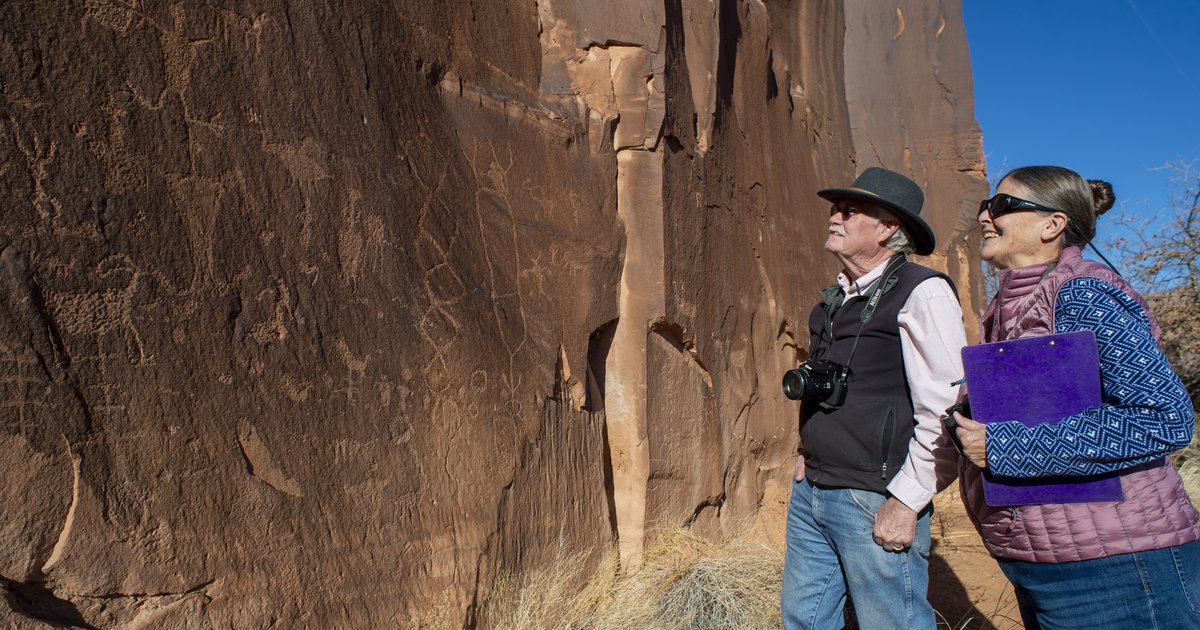

Pam and Quentin Baker were so drawn to the rock art around Moab that they built their retirement home there in the late 1990s and relocated to the southeastern Utah tourist town in 2001 after long careers as Colorado educators.
Since that time, they have led volunteer efforts to document dozens of panels carved into the sandstone walls along the Colorado River corridor, going through the painstaking process of recording numerous data points on each site and replicating hundreds of petroglyphs and pictographs left by ancient Native Americans.
The project culminated with the submission of a massive packet of material — nominating 199 sites on about 180,000 acres of public land for listing on the National Register of Historic Places — to the National Park Service last March. After initially approving the petition, which placed all the sites under a single listing, the service’s Keeper of the National Register withdrew the nomination, potentially squandering thousands of hours of hard field work by volunteers organized by the Bakers and the Bureau of Land Management.
Much of Utah can be thought of as a gallery filled with ancient art literally carved and painted into a landscape of intriguing geology. Yet this trove of rock art has yet to be fully documented — even as it is repeatedly defaced and damaged by vandals and visitors alike.
“We need to say this has national significance, and it’s what makes Moab special,” Pam Baker said. “The process is too labor intensive for the BLM to do on their own. Once we were here full time, we recruited others to help, dozens of people.”
/arc-anglerfish-arc2-prod-sltrib.s3.amazonaws.com/public/QK4MXFYX5ZCUNKISPPHO3TPAKY.JPG&Caption=(Rick Egan | The Salt Lake Tribune) Rock art along the Potash Road near Moab, Wednesday, Jan. 15, 2020.&Notes=https://arc-anglerfish-arc2-prod-sltrib.s3.amazonaws.com/public/QK4MXFYX5ZCUNKISPPHO3TPAKY.JPG&BackText=Return%20to%20the%20Article&BackURL=https://www.sltrib.com/news/environment/2020/01/19/volunteers-blm-worked/) (Rick Egan | The Salt Lake Tribune) Rock art on the Birthing Panel, near Moab, Wednesday, Jan. 15, 2020.
/arc-anglerfish-arc2-prod-sltrib.s3.amazonaws.com/public/57LY3NS5QBE7BFBQUJDGAWVYT4.JPG&Caption=(Rick Egan | The Salt Lake Tribune) Rock art on the Birthing Panel, near Moab, Wednesday, Jan. 15, 2020.&Notes=https://arc-anglerfish-arc2-prod-sltrib.s3.amazonaws.com/public/57LY3NS5QBE7BFBQUJDGAWVYT4.JPG&BackText=Return%20to%20the%20Article&BackURL=https://www.sltrib.com/news/environment/2020/01/19/volunteers-blm-worked/) (Rick Egan | The Salt Lake Tribune) Rock art along the Potash Road near Moab, Wednesday, Jan. 15, 2020.
/arc-anglerfish-arc2-prod-sltrib.s3.amazonaws.com/public/67T75Y3POBBOVKFORWY6ZIS3WY.JPG&Caption=(Rick Egan | The Salt Lake Tribune) Rock art along the Potash Road near Moab, Wednesday, Jan. 15, 2020.&Notes=https://arc-anglerfish-arc2-prod-sltrib.s3.amazonaws.com/public/67T75Y3POBBOVKFORWY6ZIS3WY.JPG&BackText=Return%20to%20the%20Article&BackURL=https://www.sltrib.com/news/environment/2020/01/19/volunteers-blm-worked/) (Rick Egan | The Salt Lake Tribune) Rock art along the Potash Road near Moab, Wednesday, Jan. 15, 2020.
/arc-anglerfish-arc2-prod-sltrib.s3.amazonaws.com/public/7DIZS7H3VZD3VP3543THIGDZHI.JPG&Caption=(Rick Egan | The Salt Lake Tribune) Rock art along the Potash Road near Moab, Wednesday, Jan. 15, 2020.&Notes=https://arc-anglerfish-arc2-prod-sltrib.s3.amazonaws.com/public/7DIZS7H3VZD3VP3543THIGDZHI.JPG&BackText=Return%20to%20the%20Article&BackURL=https://www.sltrib.com/news/environment/2020/01/19/volunteers-blm-worked/) (Rick Egan | The Salt Lake Tribune) Rock art along the Potash Road near Moab, Wednesday, Jan. 15, 2020.
/arc-anglerfish-arc2-prod-sltrib.s3.amazonaws.com/public/HV3RLMHIFZH3ZE3V5FI4OKT4II.JPG&Caption=(Rick Egan | The Salt Lake Tribune) Rock art along the Potash Road near Moab, Wednesday, Jan. 15, 2020.&Notes=https://arc-anglerfish-arc2-prod-sltrib.s3.amazonaws.com/public/HV3RLMHIFZH3ZE3V5FI4OKT4II.JPG&BackText=Return%20to%20the%20Article&BackURL=https://www.sltrib.com/news/environment/2020/01/19/volunteers-blm-worked/) (Rick Egan | The Salt Lake Tribune) Rock art along the Potash Road near Moab, Wednesday, Jan. 15, 2020.
/arc-anglerfish-arc2-prod-sltrib.s3.amazonaws.com/public/IPIKLBO3SJFTROJQUTRUCKVQUA.JPG&Caption=(Rick Egan | The Salt Lake Tribune) Rock art along the Potash Road near Moab, Wednesday, Jan. 15, 2020.&Notes=https://arc-anglerfish-arc2-prod-sltrib.s3.amazonaws.com/public/IPIKLBO3SJFTROJQUTRUCKVQUA.JPG&BackText=Return%20to%20the%20Article&BackURL=https://www.sltrib.com/news/environment/2020/01/19/volunteers-blm-worked/) (Rick Egan | The Salt Lake Tribune) Rock art on the Birthing Panel, near Moab, Wednesday, Jan. 15, 2020.
/arc-anglerfish-arc2-prod-sltrib.s3.amazonaws.com/public/J5I22IV2JVBAHJMTXYPVRXRCII.JPG&Caption=(Rick Egan | The Salt Lake Tribune) Rock art on the Birthing Panel, near Moab, Wednesday, Jan. 15, 2020.&Notes=https://arc-anglerfish-arc2-prod-sltrib.s3.amazonaws.com/public/J5I22IV2JVBAHJMTXYPVRXRCII.JPG&BackText=Return%20to%20the%20Article&BackURL=https://www.sltrib.com/news/environment/2020/01/19/volunteers-blm-worked/) (Rick Egan | The Salt Lake Tribune) Rock art on the Birthing Panel, near Moab, Wednesday, Jan. 15, 2020.
/arc-anglerfish-arc2-prod-sltrib.s3.amazonaws.com/public/L2Q7IW4HGRD67MCAV2WDYH3BOM.JPG&Caption=(Rick Egan | The Salt Lake Tribune) Rock art on the Birthing Panel, near Moab, Wednesday, Jan. 15, 2020.&Notes=https://arc-anglerfish-arc2-prod-sltrib.s3.amazonaws.com/public/L2Q7IW4HGRD67MCAV2WDYH3BOM.JPG&BackText=Return%20to%20the%20Article&BackURL=https://www.sltrib.com/news/environment/2020/01/19/volunteers-blm-worked/) (Rick Egan | The Salt Lake Tribune) Rock art on the Birthing Panel, near Moab, Wednesday, Jan. 15, 2020.
/arc-anglerfish-arc2-prod-sltrib.s3.amazonaws.com/public/LQPLYP542FEDTPAD5O5CUOTNOU.JPG&Caption=(Rick Egan | The Salt Lake Tribune) Rock art on the Birthing Panel, near Moab, Wednesday, Jan. 15, 2020.&Notes=https://arc-anglerfish-arc2-prod-sltrib.s3.amazonaws.com/public/LQPLYP542FEDTPAD5O5CUOTNOU.JPG&BackText=Return%20to%20the%20Article&BackURL=https://www.sltrib.com/news/environment/2020/01/19/volunteers-blm-worked/) (Rick Egan | The Salt Lake Tribune) Rock art on the Moonflower Panel, on the Kane Creek Road, near Moab, Wednesday, Jan…
/arc-anglerfish-arc2-prod-sltrib.s3.amazonaws.com/public/MUEGP6QM5FACTEVB3JNCFD6D6Y.JPG&Caption=(Rick Egan | The Salt Lake Tribune) Rock art on the Moonflower Panel, on the Kane Creek Road, near Moab, Wednesday, Jan. 15, 2020.&Notes=https://arc-anglerfish-arc2-prod-sltrib.s3.amazonaws.com/public/MUEGP6QM5FACTEVB3JNCFD6D6Y.JPG&BackText=Return%20to%20the%20Article&BackURL=https://www.sltrib.com/news/environment/2020/01/19/volunteers-blm-worked/) (Rick Egan | The Salt Lake Tribune) Rock art on the Birthing Panel, near Moab, Wednesday, Jan. 15, 2020.
/arc-anglerfish-arc2-prod-sltrib.s3.amazonaws.com/public/NJY6MG26GVDR7DMC3QVB7KA5YI.JPG&Caption=(Rick Egan | The Salt Lake Tribune) Rock art on the Birthing Panel, near Moab, Wednesday, Jan. 15, 2020.&Notes=https://arc-anglerfish-arc2-prod-sltrib.s3.amazonaws.com/public/NJY6MG26GVDR7DMC3QVB7KA5YI.JPG&BackText=Return%20to%20the%20Article&BackURL=https://www.sltrib.com/news/environment/2020/01/19/volunteers-blm-worked/) (Rick Egan | The Salt Lake Tribune) Rock art along the Potash Road near Moab, Wednesday, Jan. 15, 2020.
/arc-anglerfish-arc2-prod-sltrib.s3.amazonaws.com/public/NSZRH6ZOJJCVBLYIHCAZUN5FTU.JPG&Caption=(Rick Egan | The Salt Lake Tribune) Rock art along the Potash Road near Moab, Wednesday, Jan. 15, 2020.&Notes=https://arc-anglerfish-arc2-prod-sltrib.s3.amazonaws.com/public/NSZRH6ZOJJCVBLYIHCAZUN5FTU.JPG&BackText=Return%20to%20the%20Article&BackURL=https://www.sltrib.com/news/environment/2020/01/19/volunteers-blm-worked/) (Rick Egan | The Salt Lake Tribune) Rock art along the Potash Road near Moab, Wednesday, Jan. 15, 2020.
/arc-anglerfish-arc2-prod-sltrib.s3.amazonaws.com/public/O5YPEO6PMVDJRKMNJI6JG4WGUE.JPG&Caption=(Rick Egan | The Salt Lake Tribune) Rock art along the Potash Road near Moab, Wednesday, Jan. 15, 2020.&Notes=https://arc-anglerfish-arc2-prod-sltrib.s3.amazonaws.com/public/O5YPEO6PMVDJRKMNJI6JG4WGUE.JPG&BackText=Return%20to%20the%20Article&BackURL=https://www.sltrib.com/news/environment/2020/01/19/volunteers-blm-worked/) (Rick Egan | The Salt Lake Tribune) Volunteers Pam and Quent Baker observe some rock art along the Potash Road near M…
/arc-anglerfish-arc2-prod-sltrib.s3.amazonaws.com/public/OHEO4O3YIBASTDF4P3IV2KINPI.JPG&Caption=(Rick Egan | The Salt Lake Tribune) Volunteers Pam and Quent Baker observe some rock art along the Potash Road near Moab. The Bakers are leading a 20-year effort to document 199 rock art sites. Wednesday, Jan. 15, 2020.&Notes=https://arc-anglerfish-arc2-prod-sltrib.s3.amazonaws.com/public/OHEO4O3YIBASTDF4P3IV2KINPI.JPG&BackText=Return%20to%20the%20Article&BackURL=https://www.sltrib.com/news/environment/2020/01/19/volunteers-blm-worked/) (Rick Egan | The Salt Lake Tribune) Volunteer Pam Baker observe some rock art along the Potash Road near Moab, Wednes…
/arc-anglerfish-arc2-prod-sltrib.s3.amazonaws.com/public/OMT4B4LLHVD2TH4WOF3NRY4RWM.JPG&Caption=(Rick Egan | The Salt Lake Tribune) Volunteer Pam Baker observe some rock art along the Potash Road near Moab, Wednesday, Jan. 15, 2020.&Notes=https://arc-anglerfish-arc2-prod-sltrib.s3.amazonaws.com/public/OMT4B4LLHVD2TH4WOF3NRY4RWM.JPG&BackText=Return%20to%20the%20Article&BackURL=https://www.sltrib.com/news/environment/2020/01/19/volunteers-blm-worked/) (Rick Egan | The Salt Lake Tribune) Rock art along the Potash Road near Moab, Wednesday, Jan. 15, 2020.
/arc-anglerfish-arc2-prod-sltrib.s3.amazonaws.com/public/RYFG3LYVFZBSBLVDR4FRCZ2OGQ.JPG&Caption=(Rick Egan | The Salt Lake Tribune) Rock art along the Potash Road near Moab, Wednesday, Jan. 15, 2020.&Notes=https://arc-anglerfish-arc2-prod-sltrib.s3.amazonaws.com/public/RYFG3LYVFZBSBLVDR4FRCZ2OGQ.JPG&BackText=Return%20to%20the%20Article&BackURL=https://www.sltrib.com/news/environment/2020/01/19/volunteers-blm-worked/) (Rick Egan | The Salt Lake Tribune) Volunteers Pam and Quent Baker observe some rock art along the Potash Road near M…
/arc-anglerfish-arc2-prod-sltrib.s3.amazonaws.com/public/SOAOJ52KPNHZPJBNOMSN5PINCY.JPG&Caption=(Rick Egan | The Salt Lake Tribune) Volunteers Pam and Quent Baker observe some rock art along the Potash Road near Moab. The Bakers are leading a 20-year effort to document 199 rock art sites. Wednesday, Jan. 15, 2020.&Notes=https://arc-anglerfish-arc2-prod-sltrib.s3.amazonaws.com/public/SOAOJ52KPNHZPJBNOMSN5PINCY.JPG&BackText=Return%20to%20the%20Article&BackURL=https://www.sltrib.com/news/environment/2020/01/19/volunteers-blm-worked/) (Rick Egan | The Salt Lake Tribune) Volunteers Pam and Quent Baker observe some rock art along the Potash Road near M…
/arc-anglerfish-arc2-prod-sltrib.s3.amazonaws.com/public/SRF5U3EUB5EQ5MP7PHPXZCC4NA.JPG&Caption=(Rick Egan | The Salt Lake Tribune) Volunteers Pam and Quent Baker observe some rock art along the Potash Road near Moab. The Bakers are leading a 20-year effort to document 199 rock art sites. Wednesday, Jan. 15, 2020.&Notes=https://arc-anglerfish-arc2-prod-sltrib.s3.amazonaws.com/public/SRF5U3EUB5EQ5MP7PHPXZCC4NA.JPG&BackText=Return%20to%20the%20Article&BackURL=https://www.sltrib.com/news/environment/2020/01/19/volunteers-blm-worked/) (Rick Egan | The Salt Lake Tribune) Rock art along the Potash Road near Moab, Wednesday, Jan. 15, 2020.
/arc-anglerfish-arc2-prod-sltrib.s3.amazonaws.com/public/UGDE45GQZVEG5PRB4HW253HW54.JPG&Caption=(Rick Egan | The Salt Lake Tribune) Rock art along the Potash Road near Moab, Wednesday, Jan. 15, 2020.&Notes=https://arc-anglerfish-arc2-prod-sltrib.s3.amazonaws.com/public/UGDE45GQZVEG5PRB4HW253HW54.JPG&BackText=Return%20to%20the%20Article&BackURL=https://www.sltrib.com/news/environment/2020/01/19/volunteers-blm-worked/) (Rick Egan | The Salt Lake Tribune) Volunteers Pam and Quent Baker observe some rock art along the Potash Road near M…
/arc-anglerfish-arc2-prod-sltrib.s3.amazonaws.com/public/VGULLLZNFFEIBHEGXTUOB2X3EY.JPG&Caption=(Rick Egan | The Salt Lake Tribune) Volunteers Pam and Quent Baker observe some rock art along the Potash Road near Moab. The Bakers are leading a 20-year effort to document 199 rock art sites. Wednesday, Jan. 15, 2020.&Notes=https://arc-anglerfish-arc2-prod-sltrib.s3.amazonaws.com/public/VGULLLZNFFEIBHEGXTUOB2X3EY.JPG&BackText=Return%20to%20the%20Article&BackURL=https://www.sltrib.com/news/environment/2020/01/19/volunteers-blm-worked/) (Rick Egan | The Salt Lake Tribune) Rock art along the Potash Road near Moab, Wednesday, Jan. 15, 2020.
/arc-anglerfish-arc2-prod-sltrib.s3.amazonaws.com/public/XD3DSMTWCFFS7K7QIEHOTHG2MI.JPG&Caption=(Rick Egan | The Salt Lake Tribune) Rock art along the Potash Road near Moab, Wednesday, Jan. 15, 2020.&Notes=https://arc-anglerfish-arc2-prod-sltrib.s3.amazonaws.com/public/XD3DSMTWCFFS7K7QIEHOTHG2MI.JPG&BackText=Return%20to%20the%20Article&BackURL=https://www.sltrib.com/news/environment/2020/01/19/volunteers-blm-worked/) (Rick Egan | The Salt Lake Tribune) Volunteers Pam and Quent Baker observe some rock art along the Potash Road near M…
/arc-anglerfish-arc2-prod-sltrib.s3.amazonaws.com/public/YCO4EE7FMVFATCPYTKCFL4OLCA.JPG&Caption=(Rick Egan | The Salt Lake Tribune) Volunteers Pam and Quent Baker observe some rock art along the Potash Road near Moab. The Bakers are leading a 20-year effort to document 199 rock art sites. Wednesday, Jan. 15, 2020.&Notes=https://arc-anglerfish-arc2-prod-sltrib.s3.amazonaws.com/public/YCO4EE7FMVFATCPYTKCFL4OLCA.JPG&BackText=Return%20to%20the%20Article&BackURL=https://www.sltrib.com/news/environment/2020/01/19/volunteers-blm-worked/)
 (Rick Egan | The Salt Lake Tribune) Rock art on the Birthing Panel, near Moab, Wednesday, Jan. 15, 2020. (Rick Egan | The Salt Lake Tribune) Rock art along the Potash Road near Moab, Wednesday, Jan. 15, 2020. (Rick Egan | The Salt Lake Tribune) Rock art along the Potash Road near Moab, Wednesday, Jan. 15, 2020. (Rick Egan | The Salt Lake Tribune) Rock art along the Potash Road near Moab, Wednesday, Jan. 15, 2020. (Rick Egan | The Salt Lake Tribune) Rock art along the Potash Road near Moab, Wednesday, Jan. 15, 2020. (Rick Egan | The Salt Lake Tribune) Rock art on the Birthing Panel, near Moab, Wednesday, Jan. 15, 2020. (Rick Egan | The Salt Lake Tribune) Rock art on the Birthing Panel, near Moab, Wednesday, Jan. 15, 2020. (Rick Egan | The Salt Lake Tribune) Rock art on the Birthing Panel, near Moab, Wednesday, Jan. 15, 2020. (Rick Egan | The Salt Lake Tribune) Rock art on the Moonflower Panel, on the Kane Creek Road, near Moab, Wednesday, Jan. 15, 2020. (Rick Egan | The Salt Lake Tribune) Rock art on the Birthing Panel, near Moab, Wednesday, Jan. 15, 2020. (Rick Egan | The Salt Lake Tribune) Rock art along the Potash Road near Moab, Wednesday, Jan. 15, 2020. (Rick Egan | The Salt Lake Tribune) Rock art along the Potash Road near Moab, Wednesday, Jan. 15, 2020. (Rick Egan | The Salt Lake Tribune) Volunteers Pam and Quent Baker observe some rock art along the Potash Road near Moab. The Bakers are leading a 20-year effort to document 199 rock art sites. Wednesday, Jan. 15, 2020. (Rick Egan | The Salt Lake Tribune) Volunteer Pam Baker observe some rock art along the Potash Road near Moab, Wednesday, Jan. 15, 2020. (Rick Egan | The Salt Lake Tribune) Rock art along the Potash Road near Moab, Wednesday, Jan. 15, 2020. (Rick Egan | The Salt Lake Tribune) Volunteers Pam and Quent Baker observe some rock art along the Potash Road near Moab. The Bakers are leading a 20-year effort to document 199 rock art sites. Wednesday, Jan. 15, 2020. (Rick Egan | The Salt Lake Tribune) Volunteers Pam and Quent Baker observe some rock art along the Potash Road near Moab. The Bakers are leading a 20-year effort to document 199 rock art sites. Wednesday, Jan. 15, 2020. (Rick Egan | The Salt Lake Tribune) Rock art along the Potash Road near Moab, Wednesday, Jan. 15, 2020. (Rick Egan | The Salt Lake Tribune) Volunteers Pam and Quent Baker observe some rock art along the Potash Road near Moab. The Bakers are leading a 20-year effort to document 199 rock art sites. Wednesday, Jan. 15, 2020. (Rick Egan | The Salt Lake Tribune) Rock art along the Potash Road near Moab, Wednesday, Jan. 15, 2020. (Rick Egan | The Salt Lake Tribune) Volunteers Pam and Quent Baker observe some rock art along the Potash Road near Moab. The Bakers are leading a 20-year effort to document 199 rock art sites. Wednesday, Jan. 15, 2020.
Armed with rulers, notebooks, pencils and standard documentation forms, volunteers gathered the required data, recording many aspects of the rock panels found at each site. It took years and much of the work was completed a decade ago.
To organize the nomination, the BLM relied on a streamlined “multiple property” process that it had successfully used to put hundreds of sites along Utah’s famed Nine Mile Canyon in Carbon and Duchesne counties under group listings in 2012 and 2014, according to Josh Loftin, spokesman for the Utah Department of Heritage and Arts.
“It followed what was accepted before,” he said.
But with recent changes in leadership, the park service wants the sites documented differently in a kind of bureaucratic bait and switch that could delay the sites’ listing for years.
“They said they had to do a single nomination for every site,” Loftin said. “For them [BLM archaeologists] to go back and do this for each site would be a huge chunk of work they don’t have the time for.”
‘Committed to protecting’
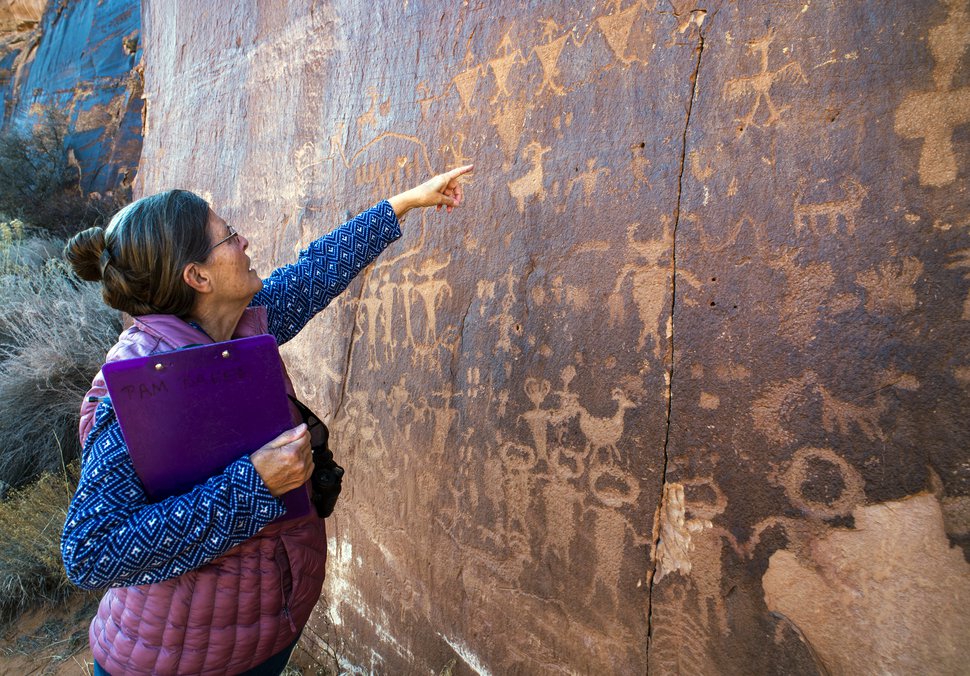
 Volunteer Pam Baker observes some rock art along Potash Road near Moab, Wednesday, Jan. 15, 2020. &Notes=https://arc-anglerfish-arc2-prod-sltrib.s3.amazonaws.com/public/OMT4B4LLHVD2TH4WOF3NRY4RWM.JPG&BackText=Return%20to%20the%20Article&BackURL=https://www.sltrib.com/news/environment/2020/01/19/volunteers-blm-worked/)
While southern Utah’s public lands are blanketed with hidden rock art and other artifacts left by ancient cultures, little has been surveyed for cultural resources. Hardly 15% of the Moab region has been canvassed, yet hundreds of sites have been documented. The surveys supporting the rock art petition came from 250 archaeological investigations spread over 60 years, according to the nomination’s cover document.
“This varied work was undertaken over such a long period of time, by so many different individuals and organizations, and for so many different purposes,” states a draft of this document. “As a result, there has been no standard method for survey, recording, collection, testing, or excavation. Further, as technology and professional standards have improved with time, so too has the quality of data, and arguably the way archaeologists relate to sites.”
The nomination had been closely vetted by the BLM’s state and national offices — as well as the Utah State Historic Preservation Office — before submission, and the Keeper of the National Register had posted the nomination on the Federal Register last March.
At that point, the sites’ listing on the National Register had cleared all the key steps, according to Leigh Grench, the now-retired BLM archaeologist who supervised the nomination. New reviewers with the park service’s National Register program, however, insisted on greater uniformity in the sites’ documentation and a more robust explanation of their historic significance.
BLM officials said they plan to resubmit the nominating materials after addressing the questions the Keeper’s office raised.
“They also asked us to resubmit using a different format,” BLM spokeswoman Kim Finch said. “The BLM is committed to protecting archaeological sites, and we are proud to manage a variety of nationally important cultural sites.”
For its part, the National Park Service agrees the Moab rock art sites hold historic significance.
“It is not an uncommon occurrence that nominations are returned for revision, particularly when it is a very large and complex submission such as this in which the cover document needs to outline the historical context, significance and integrity discussion for all individual nominations to be submitted under its auspices,” said spokeswoman Cynthia Hernandez. “The National Register program, administered by the National Park Service, is in wholehearted agreement that these are important sites, and we very much appreciate the effort that went into preparing the documentation.”
Ancient transportation corridors
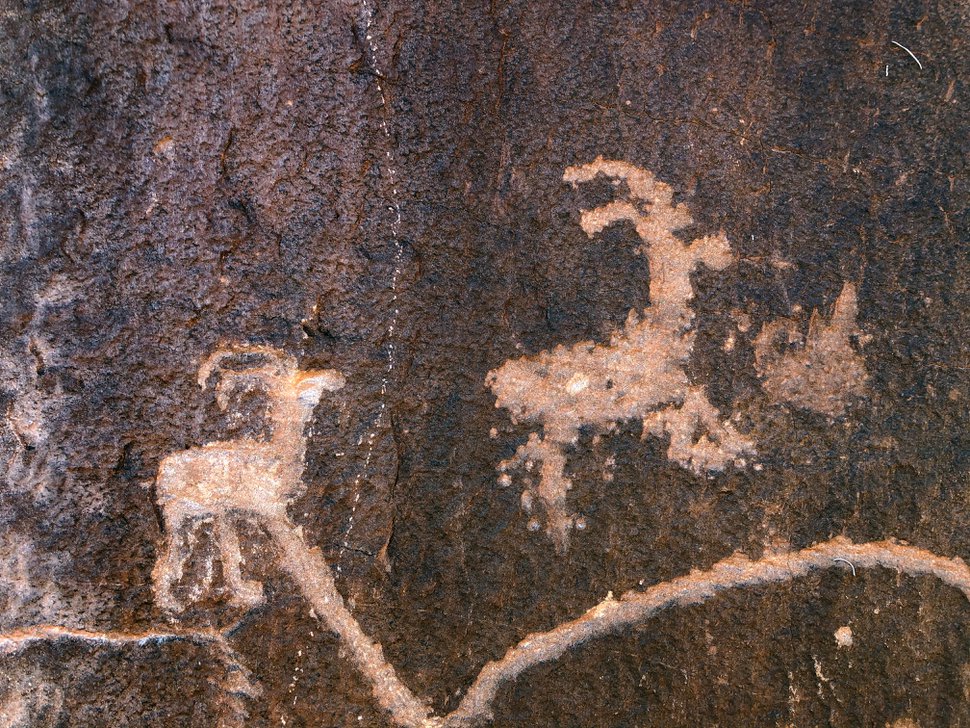
 Rock art along Potash Road near Moab, Wednesday, Jan. 15, 2020. &Notes=https://arc-anglerfish-arc2-prod-sltrib.s3.amazonaws.com/public/RYFG3LYVFZBSBLVDR4FRCZ2OGQ.JPG&BackText=Return%20to%20the%20Article&BackURL=https://www.sltrib.com/news/environment/2020/01/19/volunteers-blm-worked/)
The first sites the Bakers tackled were strung along the Colorado River’s right bank, beside Potash Road, or Utah Scenic Byway 279, in an area known as The Portal. These sites have seen heavy visitation. Many have since been defaced.
According to interpretive signs the BLM installed, these images are expressions of the Archaic cultures, dating between 3,000 and 8,000 years ago, as well as the more recent Fremont, dating back 700 to 1,550 years.
“We recorded the sites that are most commonly visited and ones that people are aware off,” Pam Baker said. “We do it for the baseline data so site stewards can monitor sites to see if we are having problems with vandalism and graffiti.”
These rock art sites are typically found along water courses, traveled by both the Anasazi, or Ancestral Puebloans, and the Fremont, two distinct cultural groups whose civilizations appeared to peak in Utah about 800 years ago before mysteriously disappearing.
“It was the edge of things where the Fremont and Ancestral Pueblo cultures may have overlapped,” Baker said. “You have rock art along the rivers because those are the travel corridors. There is a lot of research potential here.”
The sites are concentrated in seven areas, mostly Mill Creek, The Portal along Potash Road, Behind the Rocks and Hell Roaring Canyon.
“This represents 5,000 years of cultural history, everything from Archaic to Ute,” said Grench, now a board member with the Utah Rock Art Research Association. “Part of the problem with the process [for listing historic properties] is it was developed for historic buildings, not prehistoric sites.”
To get such sites listed, Utah archaeologists sometimes petitioned for their inclusion in “multiple property” nominations.
“The combination of sites under one listing pulls together known research and recording efforts for future studies in precontact iconography, travel, and communication,” states the nomination’s cover document, referencing the Native American cultures before the arrival of Europeans in what became the southwestern United States. “Most of the nomination area has not been inventoried, so one of the management benefits of the multiple property listing is that sites that will be recorded or updated in the future can be assessed for contributing value and added to the listing.”
Grench worked on the rock art nomination during her entire 11-year tenure in Moab before her retirement last year.
“My supervisors changed a lot,” she said, “but they were always on board.”
‘We thought it was done’
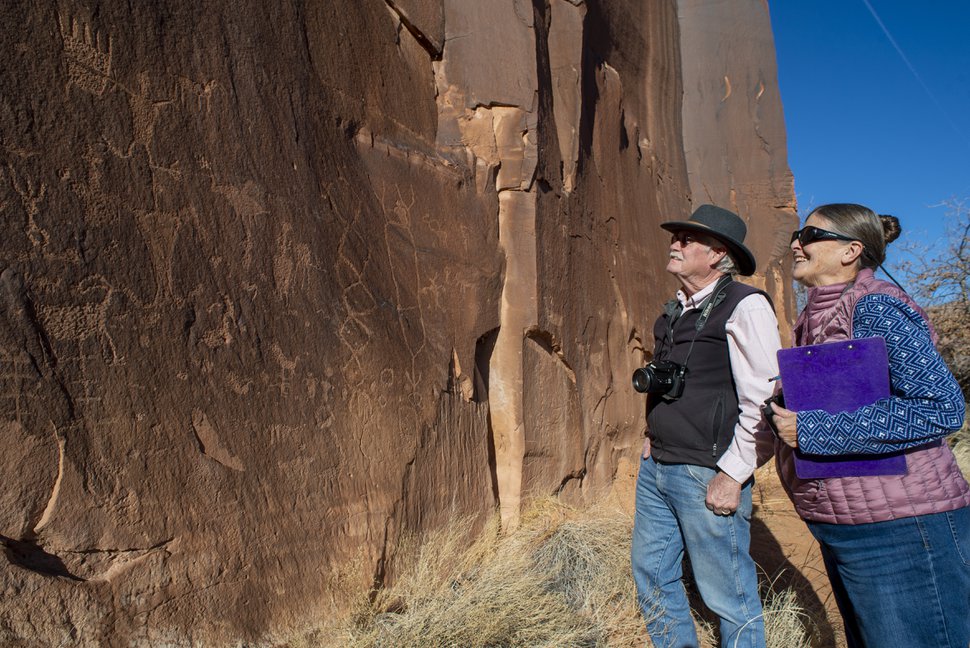
 Volunteers Pam and Quentin Baker observe some rock art along Potash Road near Moab. The Bakers are leading a 20-year effort to document 199 rock art sites. Wednesday, Jan. 15, 2020. &Notes=https://arc-anglerfish-arc2-prod-sltrib.s3.amazonaws.com/public/VGULLLZNFFEIBHEGXTUOB2X3EY.JPG&BackText=Return%20to%20the%20Article&BackURL=https://www.sltrib.com/news/environment/2020/01/19/volunteers-blm-worked/)
Grench shepherded the proposed listing through various approvals, including the Grand County Council, various native tribes, state preservation officials and BLM higher-ups in Washington. Along the way, she said, the BLM received guidance from reviewers in the Keeper’s office.
“They told us the way we were doing it was correct,” Grench said, “and they would accept it.”
The BLM stitched the materials together and submitted them to the park service shortly after last year’s federal government shutdown, which further complicated the nomination. By then, the BLM was working with a new set of reviewers, who were likely operating with a different set of standards.
Still, the Keeper of the National Register, Joy Beasley, formally proposed listing the 199 sites when that office posted the nominations on the Federal Register in March. That posting invited public comment through April 22.
“We thought it was done because that’s the last step,” said Grench, who was stunned to learn a month later the nomination had been withdrawn.
The Keeper’s office sent it back to the BLM, citing a “number of technical and substantive errors.”
“Neither the cover document nor the individual nominations justify the national level of significance selected for each of the sites with a national context for each criteria of significance,” the Keeper’s memo states to the BLM. The nomination’s problems, as outlined by the Keeper, were the result of outdated, uneven and improper data-recording techniques used to specify each sites’ significance, integrity and context.
These problems perhaps reflect the changes that occurred in data-gathering standards used by many different volunteers through the years. Documentation that passed muster a few years ago, Grench noted, apparently does not cut it now.
Given that a lack of consistency is inevitable in a volunteer-driven, multiyear effort, it is unclear when or how the BLM will salvage the nomination. But thanks to the unpaid labor of Utahns like the Bakers, at least the agency holds detailed records of thousands of images written into Utah’s public lands before they are erased or obliterated.
Recent Comments