

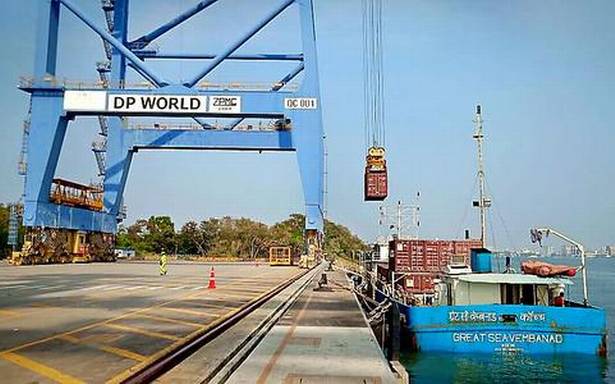

The Centre has allowed direct port delivery (DPD) clients and authorised economic operators (AEO) to pay terminal handling charges (THC) directly to the port terminals in a move that drastically alters the way the levy is collected.
The move is expected to end years of tussle between shipping lines and importers/exporters over the issue.
The decision, according to the Central Board of Indirect Taxes & Customs (CBIC), will improve the ease of doing business and save thousands of crores to the trade and industry.
Bill of Lading
In container trade, THC is currently levied by the port terminals on the shipping lines for services such as unloading cargo containers from the ship and carting them to the storage yard in case of imports and vice versa for exports. Lines, in turn, recover this amount from the importers/exporters as an extra charge over and above the ocean freight. The Bill of Lading — a contract between the line and a customer — demarcates the ocean freight and local charges such as THC and for delivering the container at the container freight station or inland container depot.
The trade (importers/exporters) have been accusing the lines of recovering THC charges higher than what the lines pay to the terminals to clear the containers. In short, they claim the recovery is not on an exact back-to-back basis, but with a mark-up.
In early 2000, the Tariff Authority for Major Ports (TAMP), tried to regulate the THC levied by the shipping lines from the trade, against which the lines went to court arguing that the rate regulator had no jurisdiction over the rates collected by the lines outside the port area.
“It appears that shipping lines are charging excessive charges as terminal handling charges than what the terminals are charging for clearance of containers. This should immediately be changed to facilitate ease of doing business,” John Joseph, Chairman, CBIC, wrote in a January 13 communication to all principal chief commissioners/chief commissioners of Customs.
Direct payment
“As an immediate measure, trade notice/public notice may be issued in all Custom Houses under your charge to see that DPD clients and AEO clients are permitted to pay terminal charges directly to the terminals and this should be followed in letter and spirit,” Joseph wrote in the letter, a copy of which has been reviewed by BusinessLine.
“This will actually save almost Rs 5,000 to Rs 10,000 per container as can be seen from the complaints received in my office. Since India is having a traffic of almost one crore containers, this will be a substantial gain to the industry and trade,” Joseph, who was instrumental in introducing the DPD programme during his tenure as chief commissioner of Customs, Mumbai Zone II, added.
“The total freight from where the shipping line work starts to where it ends should be one cost, including the THC, but what they were doing is having separate heads while quoting to the exporters and importers; there was no transparency,” said TS Ahluwalia, President, Northern India Shippers Association.
Shipping industry sources said that the new initiative will require changes to the Bill of Lading to make it “free-in, free-out” of containers, excluding THC, for smooth enforcement.
Lines’ reaction
Shipping lines say they have been made the fall guy in the government’s bid to reduce logistics costs.
“For a shipping line coming to Jawaharlal Nehru Port Trust (JNPT), we are paying $160,000 as vessel-related charges per call. It is very high compared with other parts of the world. Nobody is questioning that. For customers, the criminal is the shipping line and the terminals are like saints. Somebody should question why they are charging so much. If the government is trying to reduce the costs, then why are these charges not reduced, why only the shipping line is blamed every time,” said an executive with a Europe-based container line.
Trade sources said that the new arrangement should be extended to all and not just to some 2,000 DPD and AEO clients, who form only 10 per cent of the total trade, particularly at JNPT, India’s busiest container gateway, to be effective.
“You cannot do it on a piecemeal basis for 10 per cent of customers and exclude the balance 90 per cent. If you want to make a policy, do it for everybody,” a trade source said.
Recent Comments