


Ocean container carriers certainly have themselves to blame in part for generally weak rates and lousy financial results over the past several years, including bankruptcy for some,.
That’s because in general the carriers as a group have added capacity – often recently in the form of ultra large container vessels (ULCVs) of 18,000 TEU capacity or more – at a rate faster than the grown in demand for moving boxes, as global trade growth has slowed significantly since the Great Recession in 2008-09.
|


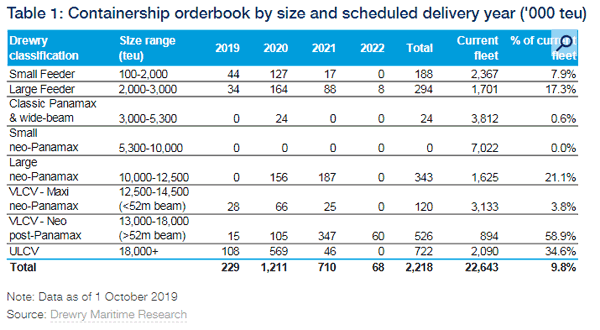
However, things were much different in 2019, when just 229,000 TEU capacity was brought on-line across all size ships in a sector with about 22 million TEU – meaning capacity basically flat. (See chart below).
But things will be different in 2020, say the container industry analysts at Drewry, who note in a recent blog post that “This year will be yet another challenging one for the container industry in terms of capacity management.”
Drewry estimates that container carriers will had about 1.2 million in TEU capacity this year, increasing total capacity 5.3%, versus an expected increase in global trade in 2020 of just 2% or so – though the reality is that number will depend in part on what happens with the various trade wars.
Drewry said there will be 23 ULCVs delivered in 2020, all to either HMM, CMA CGM, and MSC. Maersk Line, the sector’s largest carrier by capacity, has said it is done ordering megaships for a while.
Drewry notes that the 2020 delivery schedules for the new ULCVs are spread evenly through 2020, which should reduce their impact on the supply-demand balance versus if they arrived en masse.
Drewry also expects some of the ULCVs scheduled for an end-year delivery to slip into 2021 delivery slots. But even if some of the big new builds don’t arrive this year there will be a significant amount of new capacity entering the market.
However, Drewry says that “the reality is that lines are very adept at switching capacity around and hiding it when necessary,” meaning the relative impact on rates is likely to be modest.
For example, a tried and tested method of removing unwanted capacity is voiding scheduled sailings. Drewry calculates there were 253 voided sailings in the East-West lanes alone during 2019 (December’s tally being a preliminary estimate) – a significant increase on the 145 voids in 2018.
(See More Below)
|
|||


The need to retrofit many ships with special scrubbers to meet new, now live requirements for reducing sulfur emissions will also reduce effective capacity
As of late December 2019, there were still some 260 ships with an aggregated capacity of nearly 2.4 million TEU awaiting retrofits, so the size of the idle fleet will remain high for a few more months at minimum, while reported yard delays in the retrofits will keep many ships out of service for longer than expected.
All told, Drewry says its global supply-demand index (adjusted for idle fleet), calls for a tiny decrease of 0.4 points to 90.6 in 2020, with any index reading below 100 indicating overcapacity.
“The the forecast highlights just how far carriers have to go to compensate for the industry’s structural overcapacity and reach a comfortable balance that will promote sustainable freight rate gains,” Drewry says.
Looking beyond 2020, Drewry says that carriers’ best hope to reverse its financial path is for them to be much more ruthless on demolitions and to show even more restraint when it comes to ordering new tonnage. But that has proven tough historically, especially as “there is significant government influence within some Asia-based carriers that could force politically-driven rather than commercially-driven investment decisions,” in actions designed to keep ship builders busy.
In the end, Drewry expects the market to continue in much the same manner as it did last year, with the carriers lines remaining price-takers as the supply-demand fundamentals will work against them.
It adds that carriers will be able to remain profitable so long as operating costs are kept in check, but it will be a tightrope act, with the capacity levers of idling and void sailings pulled frequently.
In other words, it will be yet another year of low rates for shippers again in 2020.
Will the container carrriers ever keep capacity discipline? What do you expect rates to do in 2020? Let us know your thoughts at the Feedback section below.
Recent Comments