


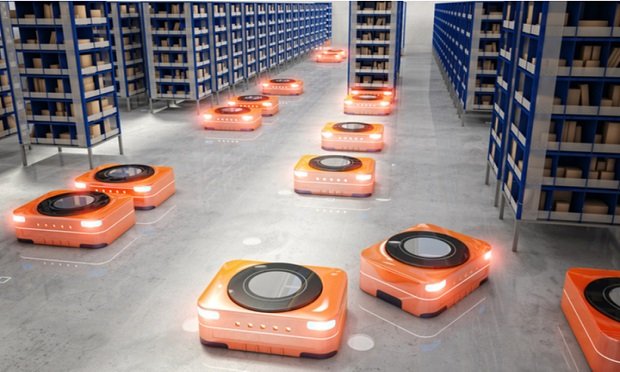
 The rapid advancements in AI, machine learning, and automation are bound to improve the current situation of warehouse robotics. (Photo: Allied Market Research)
Editor’s Note: Emerging technology in the workplace is not a new phenomenon — consider how many companies use wearables to improve worker safety. But robotics has emerged as a possible game-changer to warehouse operations in industries across the globe. While only time will tell how it will impact worker safety, workers’ compensation and commercial insurance coverage, understanding where the market is — and where it is heading — will be key for insurance professionals as they prepare clients for the next-gen of technology.
Take a glance around you, and you will see automation everywhere. The technology showcased in science-fiction movies such as Wall-E has come to life. Since the invention of wheels, we have come a long way. We now have driverless cars that can pick us up and drop us at our destination, and we can shop online by just reading out the grocery list using speech-recognition technology such as Alexa. Automated technology has transformed and reshaped our lives, and the warehouse industry has also received the Midas touch of automation.
The dire need to reduce costs, streamline operations, and improve efficiency drive robotic innovations. Furthermore, the economy is getting stronger, and the demand for automation owing to prevailing competition in e-commerce has boosted the growth of the warehouse robotics market.
According to Allied Market Research, the global warehouse robotics market is projected to reach $5.19 billion by 2023, registering a CAGR of 11.6% from 2017 to 2023. In addition, when it comes to adopting automation in the warehouse industry, the surface has barely been scratched, and there are an array of innovations on its way.
Warehouses get upgraded, but not so simply
The adoption of automation is not as easy as it sounds. The biggest challenge is the lack of awareness and a clear strategy and the dearth of data needed for main artificial intelligence (AI) and machine learning technology to work at their full potential.
Systems that use AI need accurate data, or they could run into problems. Apart from this, if the technology is not backed by a proper, supporting business strategy, it could be a costly endeavor. Thus, everyone from the top-down in a company’s hierarchy must know about the technology. Moreover, senior members and employees who would interact with such innovative technology must be committed.
Prominent types of warehouse robotics
Supply chain drones are the next big thing in warehouse robotics. People were thrilled to develop Jeff Bezos’ brainchild, Octocopter, as drones are the most efficient solution to inventory management, especially in hard-to-reach locations.
Drones that are equipped with RFID, OCR, and GPS, coupled with barcode scanners, can reach remote places and easily outperform humans. For now, drone technology is limited inside warehouses or distributing centers. However, the adoption of drones in warehouses is increasing with each day with their ability to reach areas where slow-moving equipment struggle.
Warehouse order pickups are the most time-consuming part of the supply chain, and robots can shorten it. Automated-guided vehicles can shorten the number of hours workers spend moving around the warehouse. Moreover, compared to drones, the cost of adopting automated vehicles is less, which allows the adoption of automation in almost every warehouse.
The following are the major types of automated robots:
Driverless forklifts
Fully-and semi-automated forklifts are making headway in warehouses where human workers are a scarcity. A forklift is an integral part of warehouse operations. Driverless forklifts save workers from heavy lifting, help move pallets and deposit in them in the desired location without human assistance. It is unclear how many driverless forklifts have made into warehouses, but the companies that offer such devices are growing rapidly.
Goods-to-person robots
These robots are equipped with machine learning abilities and with sensors that can carry bins or carts from the inventory warehouse to an individual. Thus, companies in the warehouse robotics industry have been investing big bucks in developing goods-to-person robots that can traverse inventory heights. Moreover, these robots help optimize warehouse space by working in narrow aisles.
Inventory robots
The use of inventory robots is the norm now with counting robots that can scan inventory with the help of RFID sensors and scanners. Instead of counting inventory every other day, these warehouse robots can monitor them daily and send notifications regarding emergencies, such as inventory theft.
Future of warehouse robotics
It does not take a genius to figure out that automation could make the routine, mundane process more efficient, quicker, and reliable. Owing to these abilities, adopting robotics is an important competitive advantage for market players.
It is expected that in the future, customers will demand more traceability and transparency. They will want to know the whereabouts of their products as soon as they purchase it. And this will be the next challenge for market players: To fulfill the demands of tech-savvy customers. Integrating RFID tags and robots that can quickly scan will become the must-have for warehousing.
The rapid advancements in AI, machine learning, and automation are bound to improve the current situation of warehouse robotics. In addition, the advent of 5G and innovations in big data and cloud computing will disrupt the warehouse robotics industry, making it more effective, customer-oriented, and accurate than ever.
Swamini Kulkarni holds a bachelor’s degree in instrumentation and control engineering from Pune University and works as a content writer for Allied Market Research.
Related:
Recent Comments