
Tech News, Magazine & Review WordPress Theme 2017
  • Home
  • Supply Chain Updates
  • Global News
  • Contact Us
  • Home
  • Supply Chain Updates
  • Global News
  • Contact Us
No Result
View All Result
No Result
View All Result
Home Supply Chain Updates

Trans-Pacific box volumes contract first time in decade

usscmc by usscmc
January 24, 2020
Trans-Pacific box volumes contract first time in decade
Share on FacebookShare on Twitter

Container research firm Alphaliner said trade on the trans-Pacific dropped in 2019 for the first time in a decade, the victim of the ongoing U.S.-China trade war and shippers deciding not to move boxes ahead of implementation of the new marine fuel standards in 2020.

The Paris-based researcher also offered a muted outlook on the container trade as major ocean carriers do not plan to expand services this year on one of the world’s busiest trade lanes. 

Alphaliner said in a recent report that total container volumes on the eastbound trans-Pacific fell 2.5% last year, the first such decline since the end of the Great Recession in 2009, when container volumes sank 15.3% from the year earlier.

The National Retail Federation noted that container import volumes to the U.S. are also likely to drop for the first time in 10 years.

The slowdown in container volumes will be a big theme for transportation and logistics companies as they report fourth-quarter earnings. Expeditors International (Nasdaq: EXPD), the largest forwarder in the trans-Pacific, warned last week that fourth-quarter operating income will range between $177 million and $183 million, down from $217 million in operating income reported in the fourth quarter of 2018.

Jeffrey S. Musser, president and CEO of Expeditors, said in a statement the results “include slowing of various global economies, trade disputes, and a customer base that is taking advantage of a market that appears to be changing from a supply and demand standpoint.”

Data from the six major North American west coast ports show import container volumes of 13.2 million twenty-foot equivalent units (TEUs) in 2019, compared to 13.7 million in 2018.

Of course, the ports have a high hurdle due to front-loading ahead of tariffs in 2018. That year saw the second highest growth in a decade with trans-Pacific volume growth of 8.3%, Alphaliner noted.

As for 2019’s front-loading, it was largely non-existent. Alphaliner noted the fourth quarter of 2019 saw a steep 10% drop in container volumes, compared to slight growth in volumes in the first three quarters of the year.
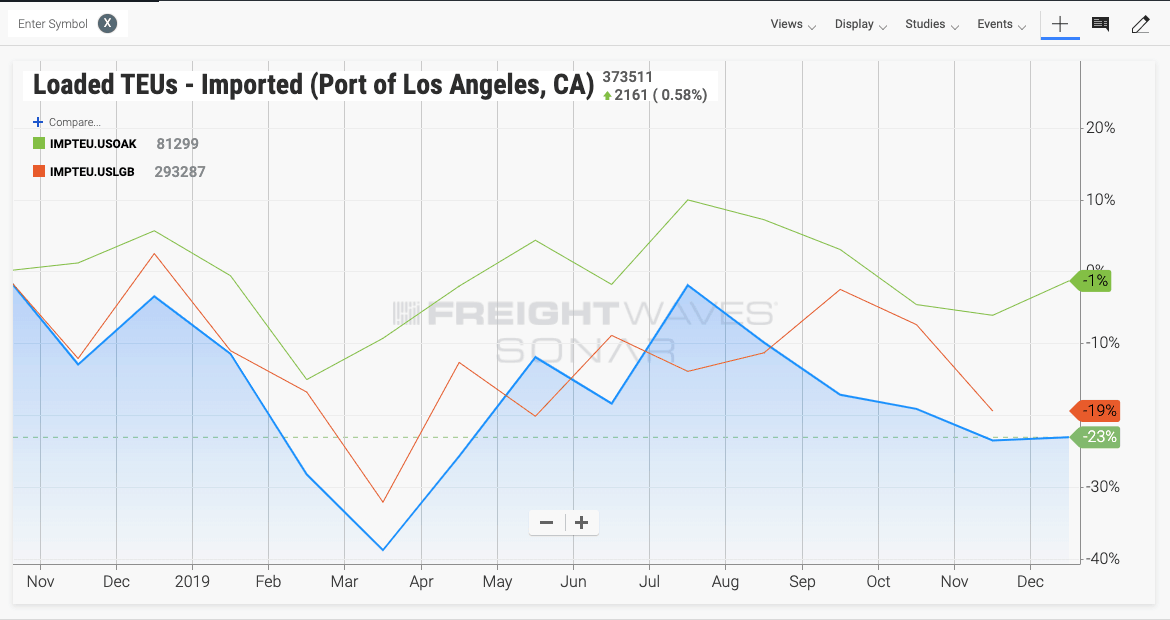
Import TEUs into California’s three largest ports. (SONAR: IMPTEU.USLAX, USLGB, USOAK)

“There was no repeat of the cargo front-loading that took place in the last quarter of 2018 to avoid the punitive import tariffs that were to be imposed on Chinese imports to the U.S.,” Alphaliner said.

Expeditors’ Musser held a similar view that the pace at which these changes occurred accelerated dramatically in the fourth quarter.

Likewise, shippers bided their time with respect to the International Maritime Organization’s rule that ocean carriers use more expensive low-sulfur fuel in 2020 as there “was also no evidence of any significant front-loading to avoid the [low-sulfur] surcharge which was implemented from late December last year.”

China, which accounts for three-quarters of the volume coming on the trans-Pacific eastbound lane, saw its TEU volume to the U.S. drop 10% last year, thanks to President Donald Trump’s push to extract more concessions from the U.S.’s largest overseas trading partner. 

Despite the implementation of the Phase One trade deal, “the new deal is not expected to reverse the decline of Chinese exports to the U.S. in the near term,” it added.

Maersk Chief Executive Officer Soren Skou said in an interview with CNBC the Phase One trade does reduce uncertainty in the trans-Pacific trade. But it is unclear whether it will result in a return of container volumes lost over the last year.

The result is that ocean carriers are not likely to introduce much, if any, new capacity in the trans-Pacific.

THE Alliance has revamped its network to incorporate ships from Hyundai Merchant Marine and offer additional service from faster-growing exporters in Southeast Asia. But Alphaliner said the service changes mean “capacity will increase marginally despite the reduction in total number of services.”

usscmc

usscmc

No Result
View All Result

Recent Posts

  • How Hapag Lloyd captured a major market share in the Container Shipping Industry in USA
  • Why USA’s East Coast is the Favorite Destination for Manufacturing Companies
  • How Trade Relations Between the USA and UK Improved After Keir Starmer Became Prime Minister
  • Tips and Tricks for Procurement Managers to Handle Their Supplier Woes
  • The Crazy Supply Chain of Walmart Spanning Across the Globe

Recent Comments

  • Top 5 Supply Chain Certifications that are in high demand | Top 5 Certifications on Top 5 Globally Recognized Supply Chain Certifications
  • 3 Best Procurement Certifications that are most valuable | Procurement Newz on Top 5 Globally Recognized Supply Chain Certifications

Archives

  • July 2024
  • June 2024
  • May 2024
  • April 2024
  • March 2024
  • February 2024
  • January 2024
  • December 2023
  • November 2023
  • October 2023
  • September 2023
  • August 2023
  • July 2023
  • June 2023
  • May 2023
  • April 2023
  • March 2023
  • February 2023
  • January 2023
  • December 2022
  • November 2022
  • October 2022
  • September 2022
  • August 2022
  • July 2022
  • June 2022
  • May 2022
  • April 2022
  • March 2022
  • February 2022
  • January 2022
  • December 2021
  • November 2021
  • October 2021
  • September 2021
  • August 2021
  • July 2021
  • June 2021
  • May 2021
  • April 2021
  • March 2021
  • February 2021
  • January 2021
  • December 2020
  • November 2020
  • October 2020
  • September 2020
  • August 2020
  • July 2020
  • June 2020
  • May 2020
  • April 2020
  • March 2020
  • February 2020
  • January 2020
  • December 2019
  • November 2019
  • September 2019

Categories

  • Global News
  • Supply Chain Updates

Meta

  • Log in
  • Entries feed
  • Comments feed
  • WordPress.org
  • Antispam
  • Contact Us
  • Disclaimer
  • Home
  • Privacy Policy
  • Terms of Use

© 2025 www.usscmc.com

This website uses cookies to improve your experience. We'll assume you're ok with this, but you can opt-out if you wish. Cookie settingsACCEPT
Privacy & Cookies Policy

Privacy Overview

This website uses cookies to improve your experience while you navigate through the website. Out of these cookies, the cookies that are categorized as necessary are stored on your browser as they are essential for the working of basic functionalities of the website. We also use third-party cookies that help us analyze and understand how you use this website. These cookies will be stored in your browser only with your consent. You also have the option to opt-out of these cookies. But opting out of some of these cookies may have an effect on your browsing experience.
Necessary
Always Enabled
Necessary cookies are absolutely essential for the website to function properly. This category only includes cookies that ensures basic functionalities and security features of the website. These cookies do not store any personal information.
Non-necessary
Any cookies that may not be particularly necessary for the website to function and is used specifically to collect user personal data via analytics, ads, other embedded contents are termed as non-necessary cookies. It is mandatory to procure user consent prior to running these cookies on your website.
SAVE & ACCEPT
No Result
View All Result
  • Home
  • Supply Chain Updates
  • Global News
  • Contact Us

© 2025 www.usscmc.com