



As technology pours into the logistics industry and illuminates supply chain blind spots, opportunities for efficiency and profit abound.
The pharmaceutical industry, for instance, loses at least $15 billion of product each year to temperature deviations that force cargo disposal. When taking additional costs into consideration, such as labor expenses for damage analysis and product replacement, the annual cost spikes to over $35 billion.
When coupled with natural disasters like hurricanes, maintaining sanctity of shipped food, blood and pharmaceutical goods becomes extra precarious. However, the technology is available to interrogate cargo with a Bluetooth-connected cellphone to make sure each pallet is in range and safe. This technology also can help identify the causes of each temperature excursion.
But let’s step back for more context. A recent report by ChainLink Research shows that 80 million to 130 million climate-sensitive shipments happen worldwide each year. In 2018, logistics spending for temperature-controlled pharmaceuticals was $15 billion, and it’s projected to outpace overall pharmaceutical spending at a rate of 8%, as opposed to the 2% rate for non-cold-chain products.
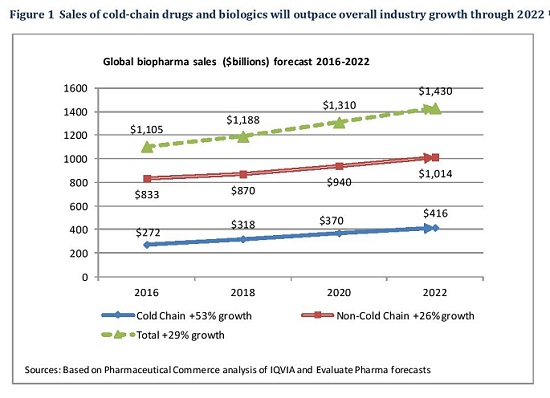
The graph below shows temperature-controlled product sales growing twice as fast as pharmaceuticals as a whole. Projections for 2020 show that of the $1.31 trillion of total pharmaceutical sales, 28% of those sales ($370 billion) are cold chain.
The amount of damaged pharmaceuticals also will inevitably rise, unless the industry agrees on a set of standard operating procedures (SOP) and embraces the right technology to protect the food and pharma supply chains.
How and why is pharmaceutical cargo so frequently damaged? Damaged pharmaceuticals occur due to temperature excursions, but also when a pallet is dropped by a forklift operator or bounces down bumpy roads. Statistics from the World Health Organization (WHO) and the Parenteral Drug Association (PDA) reveal that:
- 25% of vaccines are shipped incorrectly and reach their destination damaged.
- 20% of temperature-sensitive products are damaged during shipment due to temperature excursions.
- Average labor cost to analyze root causes of damaged goods ranges from $3,000 to $10,000.
- Pharmaceutical organizations spend an average 6% of revenue on logistics.
Currently, various governmental bodies enforce regulation and compliance within the pharmaceutical supply chain, which makes it difficult to address inefficiencies and implement change. For instance, the European Union’s Good Distribution Practice (GDP) places responsibility for compliance on the wholesale distributor. In the U.S., the Food and Drug Administration (FDA), through federal code FDA 21 CFR 11, requires drugmakers, medical device manufacturers and biotech companies to upload their data into a secure data logging service. Additionally, the United States Drug Supply Chain Security Act (DSCSA) requires wholesalers, manufacturers and repackagers to share data on all shipments, whether by electronic or paper-based means. Compliance gained through paper-based systems is a shaky endeavor.
Only until recently, the primary source to monitor temperature excursions was a simple USB temperature logger, which couldn’t define the root causes of damage and was only used when damage was detected. This severely limited a data set that could provide context and insight into supply chain performance.
An integrated data platform that can drop down to the pallet level and take high-resolution images for cargo visibility would have been a herculean effort five to seven years ago, said Craig Montgomery, senior vice president of global marketing and strategic business development at PowerFleet Inc. But the technology is here and the cost is minimal when you consider the savings from a risks and claims perspective.
“Because the tracking devices are Bluetooth enabled, you have the ability to understand the status of the cargo at any stage of its journey,” said Montgomery. “Is it stable or starting to perish? Has it expired or become degraded in some way? When did this occur? How long was it over the temperature threshold? What asset was it with?”
PowerFleet, previously I.D. Systems, offers advanced Bluetooth technology to track the status of the cargo within a trailer. Subscribers have the ability to track shifting cargo at predetermined times but also the cargo’s environment, including temperature, light, humidity, and shock. This environmental data is combined with high resolution images of the cargo during its trip. Because each Bluetooth device has its own tiny database, you can use them to store key data, such as the manufacturer, production date, temperature requirements, and more importantly, the history of its temperature environment and if it has ever exceeded its thresholds.
“Rather than be reactive, we’re trying to provide data so our customers can make a smarter decision faster,” said Norm Thomas, general manager at PowerFleet.
Recent Comments