


By Will Sumner, Hemp Content Manager, and Beau Whitney, Senior Economist, New Frontier Data
Were the past harvest season not turbulent enough for American hemp farmers, a new obstacle to success looms in the pursuit of standards and testing: A general and widespread lack of DEA-approved testing capacity is predicted not only to limit farmers’ ability to bring their products to market, but may also force them to break the law by transporting hemp with prohibitively high levels of THC (0.3% by weight) across state lines.
Since the release of the federal U.S. Department of Agriculture (USDA)’s rules for the federal domestic hemp program, the industry has been coming to grips with the latest regulatory realities. In addition to new testing standards which require hemp crops to be checked for total THC content, the USDA’s rules further require that testing be done by labs registered with the Drug Enforcement Administration (DEA). Therein lies a problem.
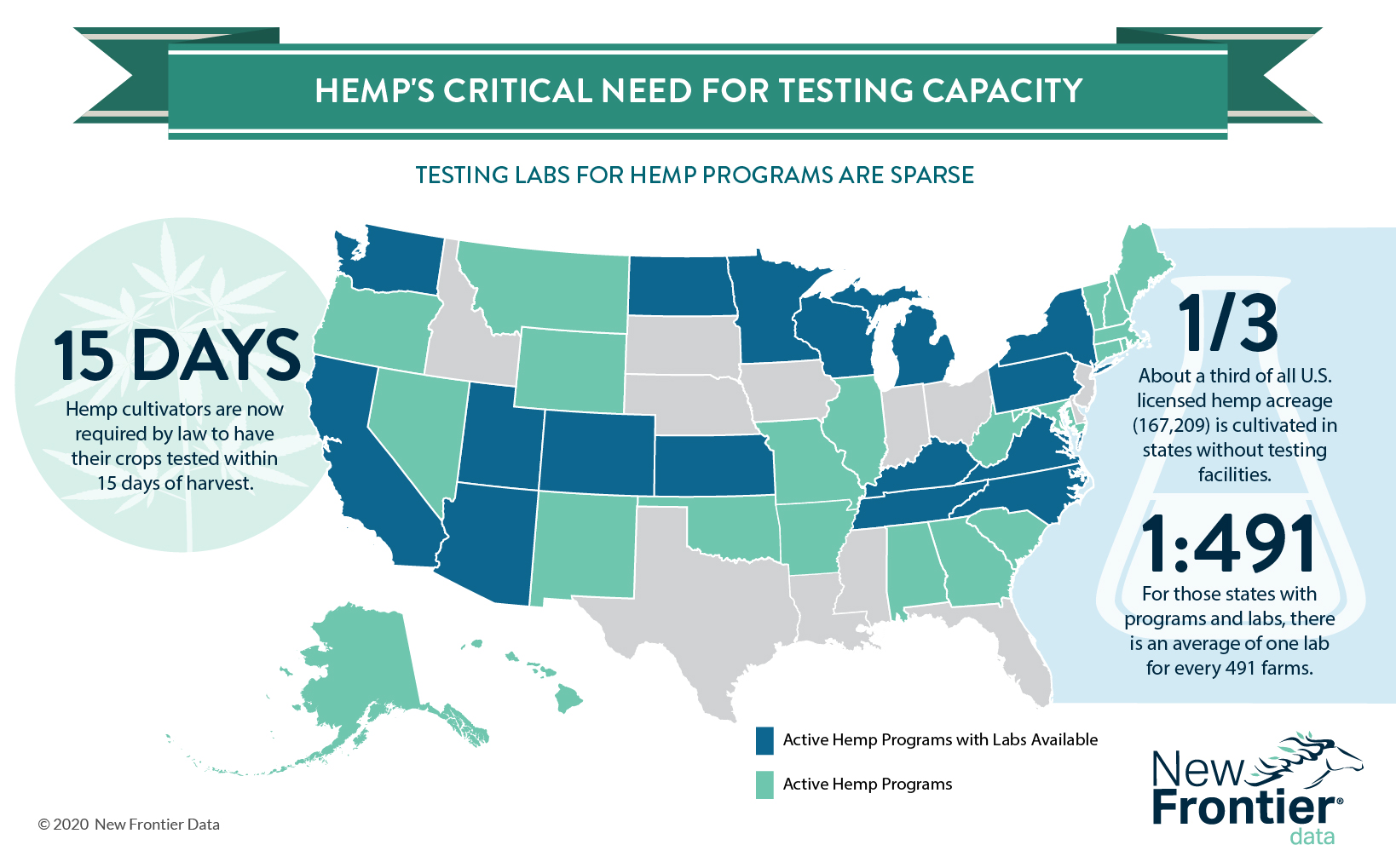
According to the USDA’s website, there are 44 labs nationwide which are registered by the DEA to handle controlled substances. Conversely, there are more than 16,000 licensed hemp cultivators in the United States. Thus, the nationwide average of farms per DEA-registered lab breaks down to approximately 380 cultivators and roughly 11,078 acres of hemp.
The numbers get even worse when one considers simple factors like geography. The operating DEA-registered labs are limited to 22 states, six of which did not have an active hemp program in 2019 (meaning that those labs are likely unprepared for the influx and scale of hemp biomass requiring verification). Additionally, three of the top 10 hemp-producing states (i.e., Oregon, Illinois, and Montana) have no testing labs; two others (New York and Tennessee) each have one. Among the 38 states having active hemp programs, less than half (16) have any DEA-registered testing lab.
Further complicating the capacity crisis is the requirement upon hemp cultivators to have their crops tested within 15 days of harvest. Even in those states combining an active hemp program with access to a testing lab, a quick wedding will be a tall order given an average ratio of 491 cultivators per lab: Simply put, it will be impossible for available labs to meet the demand.
Hoping to head off the testing bottleneck, some state lawmakers are moving to lobby the USDA. In Colorado, the state Senate has unanimously approved a resolution calling on the USDA to revise its rules for the domestic hemp program, including removing the requirement that DEA-registered labs handle testing.
“With respect to the interim rule’s requirement that a laboratory registered with the federal drug enforcement agency (DEA) must conduct testing on hemp,” reads the resolution, “the State’s written comments suggest that the USDA should instead allow for the use of state- or tribal-certified labs.”
[Editor’s note: Though a decision had been expected from lawmakers on Capitol Hill this week, no result had been passed by time of publication.]
Barring significant increase in the number and capacity of certified labs, farmers run the risk of major economic losses. Many stand to fail if they cannot get their harvest to market. Based on a study last year, the average U.S. hemp farm includes roughly 27 acres, many of them operating on razor-thin margins, and thus jeopardized by further delays.
The USDA was due on Wednesday to close public comment about its interim hemp rules. Regardless of the agency’s resolution, the hemp industry at large seems unavoidably at risk of being choked in the bottleneck of the nascent industry’s immature supply chain.
The post Choked by the Supply Chain: USDA Reqs, Lack of Testing Labs Render Most Hemp Farmers Helpless appeared first on New Frontier Data.
The preceding article is from one of our external contributors. It does not represent the opinion of Benzinga and has not been edited.
Image by Rex Medlen from Pixabay
Recent Comments