


THE Dr Keith Rowley Government’s vision for the Toco port can now be seen on YouTube.
The five-minute fantasy animation sweeps us along broad avenues with coconut palms and shady trees, past grand buildings several stories high.
Neatly ordered cars are parked in rows beneath leafy trees, others lined up like columns of tanks waiting to invade Tobago.
The Government hopes this phalanx of vehicles will be regularly carried by the ferry T&T Spirit shown docked on one of many piers; the daily invasion force booked ot by overwhelming popular demand.
Gun-metal grey vessels with mounted machine guns on the bow are tied up on another dock waiting, as though to repel some foreign force; perhaps to hold back any more yachts and pleasure craft like those already moored in the smart marina.
Doubtless their skippers were drawn by the attraction of navigating the treacherous waters surrounding Toco, where the Atlantic Ocean and Caribbean Sea collide, so they can reach this haven on the wild north coast just for the thrill of it.
Enclosing this vast structure and platoon of fat, squat fuel tanks and endless acres of concrete is a massive sea wall closing around the port.
Moored to it are large oil industry service vessels.
Looking at the Ministry of Works and Transport’s movie it is unclear whether to class it under the genre of science fiction, horror, or both: The Creature that ate the blue lagoon.
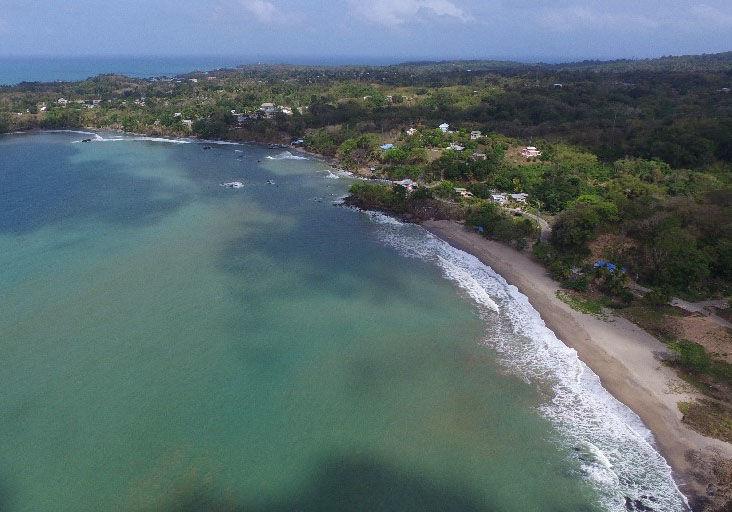
If you are a Toco resident who has grown up with a view of lovely Grande L’Anse Bay, of the surf rolling in from the pale blue ocean on a freshening morning breeze, or perhaps enjoyed its beaches for weekend limes or for your daily constitutional, this is a horror film beyond imagination.
Life as you have known it in Toco will be over when this mammoth structure – as foreign to the charms of Toco as a human settlement is to the surface of Mars – begins its lengthy, noisy, dirty and obtrusive construction.
The National Infrastructure Development Company (NIDCO) and its UK-based consultants, ERM, who describe themselves as “the world’s leading sustainability consultancy”, produced a slide presentation of the “Toco Multi-purpose Environmental Impact Assessment” (EIA) at a “Public Disclosure Meeting” a week before Christmas
(The official EIA document is yet to be published).
It explains how Toco as we know it will vanish.
They did not hold the meeting on a weekend, in the daytime, when so many interested parties would like to have attended.
Instead they held it at night on the Monday before Christmas when the majority of citizens may well have had other matters on their mind, and understandably did not want to travel the tortuous Toco road in the dark.
One man who did, Reginald Mac Lean, owner/manager of Res-Com Construction Ltd, complained it took him nine-and-a-half hours to attend the Toco consultation and get back to Port of Spain.
Is it any wonder the meeting was poorly attended?
It begs the crucial question about who would want to travel the very long, twisting route to Toco to queue to catch a ferry to Tobago? Or from Scarborough to Toco all the way to Port of Spain?
Mac Lean, who is scathing about the project, is quick to dissuade people of the idea the “highway” the Government is building from Valencia to Toco is actually a highway.
It isn’t, he says.
Instead it is a “widened two-lane, extremely winding roadway. There will be many traffic lights along the way going through the various villages, etc. It’s going to be an extra long drive. The elderly are not going to be able to endure that drive.”
The Government’s optimistic ferry forecasts smack of delusion, as zero data has been produced to show people will undertake this marathon journey.
ERM even say, “Recent trends show declining ferry passenger and freight volume to Tobago”.
Mac Lean points out that “everything that has to be trucked to Toco to be loaded onto the ferry and then transported to Tobago is going to cost more”.
ERM say that the dredge and fill material for the port reclamation (98,000 m2) will be sourced from the road upgrade. The trouble with that is ERM say it is “unclear if the Valencia Main Road upgrade will be ready for port construction.”
That suggests the cart is being put way before the horse. There is confusion about the length of time the road will take to be finished.
Mac Lean said five years for the road was the figure given by ERM at the meeting, but we’ve been told of an even longer period. ERM say three to five years is the timescale for the port.
We asked NIDCO for clarification, as well as Works and Transport Minister Rohan Sinanan. There was no response.
Logic dictates that if the fill – several thousand truckloads – is not available from the road it will have to come from somewhere else.
That somewhere else is likely to be the seabed of Grand L’Asne Bay which is already losing 100,000 cubic metres (including corals) to dredging, according to ERM.
The rock-fill for the port’s huge claw, the breakwater, will be sourced from Studley Park Quarry in Tobago, brought in piecemeal by boat.
Something else which will be brought in by barge on the “extremely rough” north coast is diesel, 750,000 gallons of it.
Mac Lean said: “It’ll be an environmental nightmare when the barge sinks.”
ERM warns of maritime accident risks near Toco and Scarborough.
ERM describes the present road route “as narrow, with sharp turns, minimal clearance, frequent obstructions, and low traffic volumes”.
There will be “increased traffic congestion and safety risks on routes to Toco…road infrastructure deterioration especially on Toco and Paria roads due to heavy truck traffic”.
While the new road is being built the poor, existing route will be pounded into submission by heavy trucks, and the people of Toco and visitors to north east Trinidad will be stuck behind them. For years.
Not to worry: ERM recommend providing “regular road and port maintenance”, where in Trinidad, of course, road maintenance is second to none.
As one exasperated hotelier argued, “The road is literally falling apart and they can’t fix it, but they can spend (millions) on advertising in the local elections.”
The trouble with employing a foreign consultancy firm, apart from the cost, is that they do not understand Trinidad and the way it works, or doesn’t.
ERM’s suggestion to “Implement a community grievance mechanism” is proof of that.
For ERM to live up to their self-proclaimed billing of “the world’s leading sustainability consultancy” one does have to wonder what they are doing involved in such a project in the first place.
By taking on this EIA they find themselves complicit in the unsustainable destruction of Toco’s present state — peaceful, calm, clean, green, serene, natural.
The so-called “sustainability” specialists have produced a document detailing a catalogue of unsustainable, adverse impacts on almost every aspect of life in Toco today – because you cannot disconnect what is planned in the bay from real life in the rest of the village.
The only positive aspects mentioned by ERM are based on completely hypothetical forecasts of visitor influxes and economic growth devoid of any supporting data.
Some of the many adverse impacts ERM found are: hydrodynamic changes, wave regime changes, water quality impacts from dredging, flushing changes from port construction, water quality impacts from accidental spills, shoreline erosion and beach profiles from port construction.
Between shore and port a deep channel will be dug, a moat, filled with water which will not be nice. There will be “observable stagnation” within the port, but mysteriously not sufficient to result in worse water quality, claims ERM. They describe the “drainage channel” as a “high hazard”.
Water quality impacts from erosion, pollution, and reduced circulation range from moderate to minor, says ERM.
Water quality outside the port, they say, won’t be “influenced by port construction” – but it will be from spills and pollution during port operations. The Environmental Management Authority reports 377 oil spills in the last four years.
ERM vaguely sees “erosion potential in some regions outside the port”.
Marine scientists the Sunday Express spoke to last May are especially worried about erosion at Mission Beach.
But ERM curiously claims “Mission Beach and Toco Beach will be protected by the port” – but certainly not from visual and water pollution the port will provide.
Mission beach is an endangered green turtle nesting habitat in the wet and dry seasons, says ERM, who reported finding 18 nests along it.
If the beach erodes what happens then? Will the turtles even be able to find what’s left of it when their route is blocked by a mammoth sea wall, the port and disorientating lights?
It will be noisy for people and turtles: “Pile driving exceeds T&T standards by ten decibels”; that’s 83 dBA in total.
That noise can travel underwater as far as Maracas, the meeting was told.
After construction operational noise from ferries and other vessels can be deemed “negligible”, claims ERM.
No mention is made of noise along Toco’s (and nearby villages) residential roads from increased traffic and thousands of thundering truckloads of fill and other materials during five years of construction.
Nor from freight being transported to Toco to Tobago with supposed regiments of cars when the port is operational.
ERM warns of increased demands on an already strained water supply on health and emergency services, and on housing availability and education shortages from the demands of a migratory construction workforce.
Expect adverse “moderate” impacts on reef ecology, turtles, tourism, displacement of marine resources, shellfish, sea moss, fishing, and loss of habitat, they say – in fact the corals will be destroyed which is why they suggest “installing” an artificial reef.
ERM admits there will be, “changes in coastal dynamics to changes in sea turtle nesting patterns, with adverse impacts on tourism.”
But in the next breath they say, “tourism and marine impacts are minor” and there will be an “influx of tourists, visitors, and economic migrants”.
That is like the YouTube description of the Government project where, it is claimed, without a shred of evidence: “The socio-economic benefits of a fast ferry port are varied and significant…this project will aid Government towards diversification…the marina and hotel facilities will encourage development of the tourism sector in north east Trinidad.”
The idea that the evisceration of a seaside village’s lovely coastline, with threats to leatherback turtles, the region’s drawcard, is going to entice tourists to Toco puts the Government’s movie into yet another genre – fantasy.
NIDCO and ERM can dress up the ruination of Toco’s natural environment and the obliteration of its beaches, corals, special ambience and way of life any way they like, but a monkey in silk is a monkey no less.
And this is one seriously ugly ape.
In the sequel to “Creature that ate the blue lagoon”, Mark Meredith looks at the impacts of the port on tourism, turtle tourism, and on threatened leatherback turtles.
Recent Comments