

Finding all-cargo aircraft with room to move goods from China to international customers could be difficult for manufacturers and retailers once factories there start reopening this week. With most airlines shelving passenger flights because of the coronavirus epidemic, analysts expect airfreight rates to spike.
No one knows exactly when the capacity shortage will materialize. Economic activity and logistics operations are constrained across many cities sealed off from travel in what is believed to be the largest mass quarantine the world has ever seen.
How supply chains react to the transportation disruptions will shape the near-term financial performance of exporters and importers, but experts say shippers can take a number of steps to minimize potential delays and unexpected costs.
“We don’t know from a production standpoint exactly how much product is going to be able to be produced in the coming few weeks. That’s the real wild card,” Neel Jones Shah, executive vice president and global head of airfreight at ultra-digital freight forwarder Flexport, said on a company webinar. From an airfreight standpoint, “we are anticipating that costs are going to go up. They could up rather severely in the short term as demand outstrips capacity.”
Some logistics providers say they are seeing higher rates on airfreight moving out of China and Hong Kong, while inbound rates on certain routes are also up due to the surge in medical supplies being sent to the outbreak zone. Charters have largely dominated the inbound traffic.
But in a new report, London-based Freight Investor Services says cargo throughput has been so thin the past two weeks that it is premature to make any clear assumptions about pricing trends, with a diversity of price increases and declines depending on routes and other factors.
Outbreak fallout
Chinese authorities have confirmed more than 40,000 cases of novel coronavirus, a more virulent but less deadly virus than the severe acute respiratory syndrome (SARS) outbreak in 2002-03, and 908 deaths.
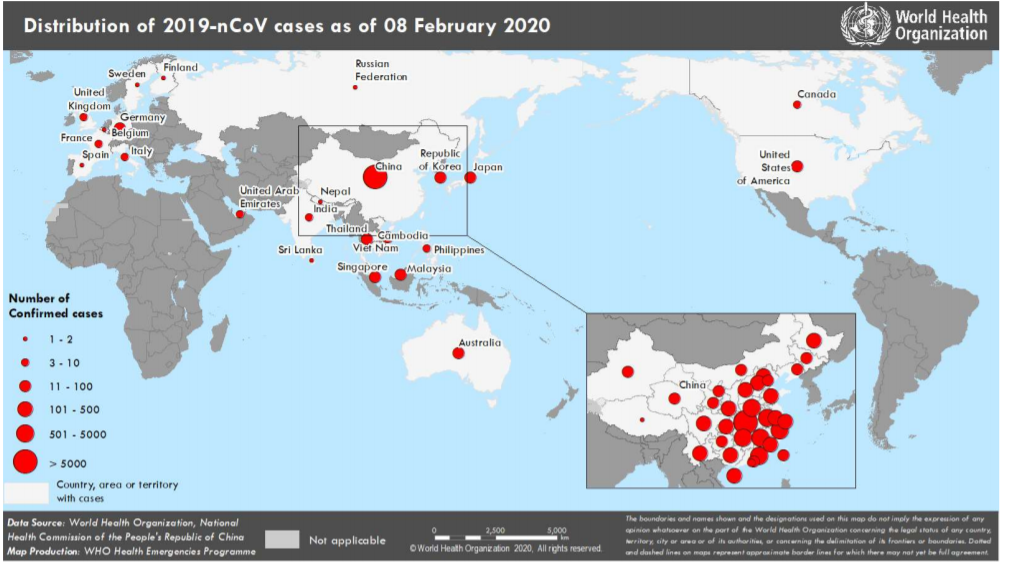

The containment strategy has centered around quarantining about 60 million people in approximately 20 cities. In cities such as Wuhan, public transportation is shut down and movement severely restricted, while all ground transportation has been banned in some provinces. Officials also extended the Lunar New Year break another week to minimize travel and keep factories closed.
More than 40 airlines have suspended passenger operations to and from mainland China, eliminating about 25,000 flights per week, according to data aggregator OAG Aviation Worldwide. Flight suspensions, many of which are scheduled to last through March, are now creeping into Hong Kong too.
The passenger pull-down means 40-45% of air cargo capacity on major east-west trade lanes has disappeared in a market in which outbound load factors often are 100%. Shippers like the daily frequency and reliability of passenger flights to move perishables and high-value goods. DB Schenker, the global logistics arm of German railroad operator Deutsche Bahn AG, says on its website the lost capacity amounts to about 4,000 tons of capacity per day.
Seattle-based forwarder Expeditors said in a blog post that the suspension of passenger flights will impact intra-Asia and Asia-Europe trade lanes more than the trans-Pacific route, where freighters are a little more common.
The question for shippers and their logistics providers is whether freighter operators will be willing and able to fill the breach.
Freighter operators typically take a 10- to 14-day hiatus for scheduled services during a normal Lunar New Year schedule, when there is no factory output. They ramp up flights about four days after factories open, which means the number of available aircraft will increase Thursday and into the weekend.
All-cargo carriers will probably take a wait-and-see approach toward adding extra flights — or sections in aviation parlance, Jones Shah predicted.
Many factories were scheduled to reopen Monday, but local restrictions could affect when businesses reopen, staggering the return of workers throughout the month. The national holiday has been extended until Feb. 17 in Qingdao, and officials in Foshan, in central Guangdong province, recently announced that companies and markets won’t be allowed to reopen until March 1.
Logistics companies are also trying to reboot operations.
SEKO Logistics said facilities in Shenzhen, Xiamen, Shanghai, Hangzhou and Ningbo were scheduled to reopen Monday, pending government approval. The Qingdao office will open Feb. 17.
Facilities will need to demonstrate they have hand sanitizer, gloves, face masks, thermometers and necessary documentation to secure certification. SEKO’s Hong Kong facilities have remained open, with office and warehouse staff wearing masks and having their temperatures checked daily. All drivers and couriers must also don masks before entering the buildings for deliveries, the Chicago-based company said.
Even with staff working from home, SEKO said it was able to arrange delivery of a 40-ton air shipment from Zhangzhou via Shanghai to Indianapolis.
DB Schenker said freight management offices in China would resume work Monday, with the exception of offices in Tianjin, Wuhan and Zhengzhou, where work restrictions remain in place. Contract logistics warehouses will have about three-quarters of their normal workforce due to local restrictions and strict quarantine procedures imposed by local authorities.
Factory and warehouse workers also might opt not to return to their jobs in the city because they feel safer for the moment in rural hometowns they visited during the Chinese New Year holiday, Jones Shah said. That’s on top of the 10-15% of workers who don’t come back each year because they are homesick.
Although many airports, seaport terminals and warehouses are technically open, the severe shortage of truck drivers and transportation restrictions due to the outbreak means freight will pile up because it can’t move in or out of those facilities, logistics experts say.
Coping strategies for shippers
International freight managers say forecasting, preplanning, flexibility and hyper communication are critical for shippers to ensure the crisis doesn’t severely compromise supply chains.
DB Schenker is advising customers to provide details, such as the readiness of cargo for pickup, shipment details, the destination and required time of arrival, as early as possible.
Freight forwarders can more easily find suitable, cost-effective transportation if they have a good handle on production forecasts, Jones Shah said on the Flexport webinar.
“The better we are informed as your supply chain partner, the better we can manage your expectations through what is going to be an incredibly volatile period. So if you used to talk to us weekly and are used to sending us forecasts that are 80% accurate, talk to us daily and really try and get that honed down to what actually needs to move because that will help us design the capacity offering more tailored to your needs,” the former cargo chief at Delta Air Lines said.
Shippers also should be open to creative arrangements to keep freight moving, such as new routings and gateways or air transport combined with a long-haul truck move.
“Unfortunately, all the origins and destinations we’re used to serving may not have the same level of capacity,” Jones Shah said. “Some of them were heavily dependent on passenger lift, and now that we don’t have that we’re having to rely on freighters that fly out of different airports at times.” Transit times will be longer and prices probably higher, but that is better than the alternative of retail stock depletions and manufacturing shutdowns because supplies can’t be delivered as scheduled, he added.
He recommended that cargo owners focus on keeping end customers happy rather than optimizing short-term costs, which might mean taking advantage of block space agreements in which large forwarders commit to pay for a certain amount of guaranteed capacity whether or not it is completely filled.
There are also financial measures companies should take to facilitate exports from China, said Dan Glazer, Flexport’s vice president of capital, customs and insurance.
Sharing logistics information internally is just as important as sharing production information externally. Doing so helps the sales organization keep customers informed of any shipping delays to stores, and it allows the finance group to better plan working capital loans, in which inventory is often pledged as collateral, to keep cash flowing through the business, he said.
If a company is running out of a critical product, it should consider using airfreight to get some of it delivered quickly and think strategically about how much should move by air versus ocean to optimize sales and margins, since airfreight is more expensive on a per-unit basis, Glazer recommended.
“One strategy we’ve seen many customers employ is taking a portion of that purchase order, maybe 20%, and budgeting it to airfreight so that as soon as those factories come on line and those goods are produced you can replenish levels,” he said.
Extra transportation expenditures during the coronavirus crisis can blow up budgets, and impact cash flow and margins, so having multiple finance options can be valuable. Flexport offers financing for air shipments to help customers spread the cost and payments over months rather than up front, Glazer added.
Recent Comments