


➤ Russian gold-silver producer Polymetal International PLC looks for greater exposure to “the green economy” through platinum group metals and rare earths projects as it moves toward reporting Scope 3 greenhouse gas emissions.
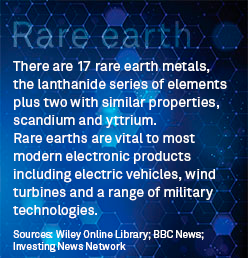
➤ CFO Maxim Nazimok believes that Russia could diversify rare earth metals supply away from China. The group of 17 metals is crucial to the permanent magnets of electric vehicles and used in military systems and renewable power generation.
➤ An investment decision on the Tomtor rare earths project is expected in the first quarter of 2020.
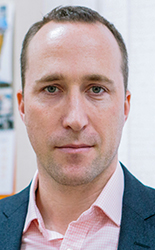 |
| Polymetal CFO Maxim Nazimok. Source: Polymetal International PLC |
Polymetal International is Russia’s second-largest gold producer and operates nine producing mines across Russia and Kazakhstan. It plans to raise gold-equivalent production by 18% over the next three years compared to 2018 through a series of expansion projects, including a second, more advanced pressure oxidation plant at its Amursk hub in Russia’s Far East. The company will report Scope 3 emissions in its 2019 annual report to be published in March to address emissions from its roasting operations. The following is an edited transcript of an interview with CFO Maxim Nazimok.
S&P Global Market Intelligence: Polymetal is looking at projects in the platinum group metals and rare earths space. Could you explain how you are going to take the company forward with these other metals?
Maxim Nazimok: I don’t think we are considering a strategic pilot into other metals in a sizable way. So both the rare earths and the PGM are effectively single projects where we want to get exposure to promising sets of commodities. There is no intention whatsoever to completely overturn the character or the DNA of the company as a precious metals producer. We are more looking to capitalize on the accumulated technological expertise, especially in the so-called hydrometallurgy — the [pressure oxidation, or POX] technology, in essence — which could also be efficient in other sets of commodities.
We see [PGM and rare earth metals] as promising commodities from the angle of the overall green economy, especially rare earths, which are actively used in magnet [production] and in electric vehicles. So this is why we see those commodities as attractive; we see how Polymetal’s expertise may be applied within those commodities; and also, we see two pretty much specific, large-scale assets in Russia, in our home market, where we could apply those competencies. So that’s the logic behind those investments. Viksha has been in our portfolio for some time already. Tomtor, the rare earths asset, is new. We are awaiting board approval for an initial stage investment, and we’ll take a very cautious, staged approach going forwards. So we will need to see both the projects progressing well and the commodities performing nicely before stepping up our investment there.
The [Tomtor investment] decision is now expected in the first quarter. More due diligence and research is being undertaken as part of board approval.
 |
You mentioned electric vehicles. Is that a trend that you are specifically looking for more exposure to? Are you looking for long-term exposure to PGM and rare earths, or is it more about trying to catch that wave in the shorter term?
It’s kind of both, in a way. In Russia, the kind of more classical EV materials such as lithium or cobalt are scarce, but rare earths aren’t. Rare earths is an interesting market in a way. Right now, it’s very concentrated, it’s effectively monopolized by China. So I think, even on a global perspective, the EV producers would be interested basically, especially the ones from the United States would be very interested, to diversify their sources of rare earths for producing various vehicles.
As you say, China controls most of the rare earths market, and that is a concern to the U.S., but would sourcing rare earths from Russia allay those concerns?
Well, I think, generally, diversification would be good. Looking at flows of other commodities, other metals, outside Russia into the developed world, they are quite abundant. So I don’t see the reason why the U.S. or the European producers wouldn’t be considering sourcing rare earths from Russia.
With rare earths, technology is key in terms of extracting, processing and refining them, but that industry in Russia has effectively collapsed since the fall of the Soviet Union. How applicable is your expertise from building the POX facility to rare earths?
So I’d say very applicable. The project we are talking about is envisaging mining rare earths in the remote site in Yakutia and then using roughly the same technology, i.e., hydrometallurgy, in the city of Krasnokamensk to extract the rare earths. So there is a very good overlap in technology. Even before we started considering the investment in [the] asset per se, our in-house engineering company, Polymetal Engineering, was already involved in technological studies for this project, so we are pretty comfortable on the technological side.
Have you actually run any tests and extracted any rare earth oxides yourself yet, even in small batches?
Pilot tests were done with the help of the company you might have heard about, Hatch [Inc.] This is pretty much a Canadian engineering company, the leader in the pressure oxidation technology globally. The current project scope involves production of ferroniobium and [rare earth] concentrate.
I also wanted to speak about the second POX plant. At the moment, a lot of your concentrate goes to third parties in China for roasting. When POX-2 is ready, you’ll have capacity to process that concentrate yourself?
Yes, that’s absolutely correct.
So would that remove the need to send any concentrate for roasting in China?
Yes. So to cut the long story short, we have now two operating assets [that will feed refractory ore to POX-2], Mayskoye and Kyzyl; and three development-stage assets, including Nezhda, which is another growth project; Veduga, which is considered for development as a stand-alone operation; and then Pescherniy, which is a satellite mine for Voro. All of the concentrate flows from these five assets will be processed at the second POX plant, whilst there will be something like a 10% margin of spare capacity, which we would be able to allocate to third-party material.
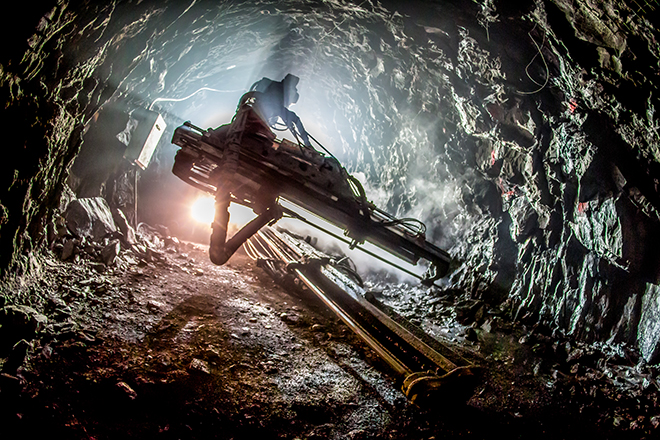
| Underground mining operations at the Mayskoye gold mine in Russia. Source: Polymetal International PLC |
Do you see it as a business risk selling concentrate to China?
It is. Apart from a very nice financial return that we will get on the economics of shifting the concentrate from China to POX, this is also a strategic risk-management activity, in a way, because, obviously, we see risks in China in terms of further potential environmental tightening, which could target the refractory arsenic-containing concentrates.
How will POX-2 affect your emissions once it is up and running?
If you take the value chain as a whole, [emissions] will actually be reduced because POX as a technology is significantly more environmentally friendly versus the roasting technology that is employed by the Chinese.
Do you take into account the emissions from roasting at the moment?
We are actually in the process of getting into reporting Scope 3 emissions. So that will incorporate the emissions by the off-takers as well.
So when POX-2 is running, you will be able to show that you’ve reduced those emissions?
Correct.
Do you see that as a potential source of green financing and sustainability loans?
For POX specifically, I’m not sure the project will be funded with green loans. It’s a difficult concept yet, and while we are targeting more green financing in the business in general, our first experience of interaction with various European banks shows that they also are yet still to develop firm criteria [of] what is green and what is not green. So the EU taxonomy, which has emerged just recently, is helpful, but this is a very generic document, so we’re now digging into more detail. In the meantime, we have a number of other projects which could be eligible for green financing, so we are actually in the process of developing some kind of a framework, which could set up the basis for finance providers and Polymetal to present the projects eligible for green financing. So it will work like an overall credit limit, with eligibility criteria for which types of projects can be funded.
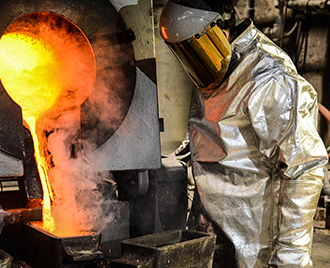 |
| Dore production at Polymetal’s Omolon hub. Source: Polymetal International PLC |
So I think within the next 12 months, we’ll be able to effectively move that project ahead, and in terms of the actual projects on the ground, we have new projects in renewable energy. There’s been a decision taken to proceed with setting up solar power plants at Omolon, one of our existing remote operations. There are a couple of ongoing projects in terms of moving into dry tailings from the traditional liquid tailing storage facilities. There is also a process of electrification of [the] underground mining fleet at Mayskoye and moving to a conveyor ore transportation system, reducing the greenhouse gas emissions. So there are quite a few projects, probably each of them of smaller size, but cumulatively, they could be eligible for green financing.
There was a US$50 million rise in capital expenditure for environmental investments mentioned in the fourth-quarter 2019 production report. Which projects does that correspond to?
So it’s a solar power plant at Omolon, and then it’s electrification and a conveyor transportation system for Mayskoye. So these are the two largest ones.
Recent Comments