

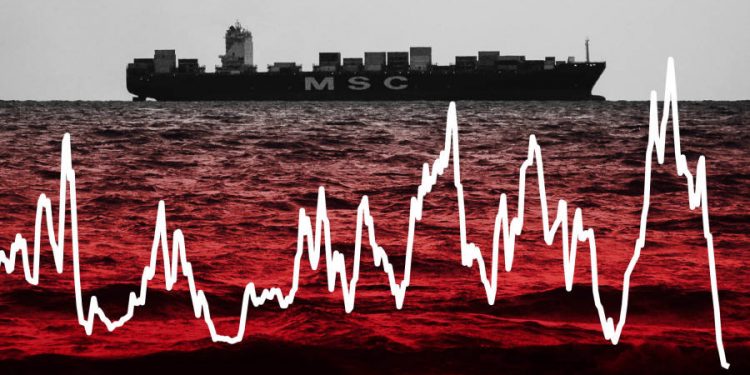
China’s slowdown in response to the deadly coronavirus has sent the global shipping industry veering off course, with transit rates falling to record lows as ships are turned away from ports.
All shipping segments from oil tankers to container lines have been hit by the economic impact from factory shutdowns and travel restrictions put in place across China to control the spread of the virus. The Capesize Index, which tracks freight costs for the largest carriers of dry bulk commodities such as iron ore, coal and grain, fell into negative territory last week for the first time since its creation in 1999, indicating that shipping companies are running at a loss on certain routes.
Brokers and analysts say the slump in demand for the transportation of goods in and out China — the world’s largest consumer of many commodities — will leave its mark on the shipping industry and commodity trading for months to come.
“It’s a mess really,” said Eirik Haavaldsen, head of research at Pareto Securities, an Oslo-based investment bank. “China is so important for everything shipping-related.”
Since the shutdown struck, shipyards have been deserted, losing owners and shipbuilders money on idle vessels awaiting servicing. One of China’s biggest shipyards in Jingjiang near Shanghai has had two successive applications to reopen turned down by the local government. “We can’t afford to be on holiday for too long,” an official at the operator said earlier this week.

At Wuhan port on the Yangtze river, another official said authorities were focusing on medicines and necessities. “We don’t have the capacity to deal with other goods,” he said.
Capacity utilisation at major Chinese ports has been 20 to 50 per cent lower than normal and more than a third of ports said storage facilities were beyond 90 per cent full, according to a survey conducted last week by the Shanghai International Shipping Institute, a Beijing-backed think-tank.
The effects on the shipping industry are likely to prove lasting. One official at China Merchants Port, a major Hong Kong-based port operator, said the epidemic could reduce annual revenue by 10 to 25 per cent if it comes under control by the end of March — and even more if it lasts longer.
Out at sea, crews have been stuck on board ships at Chinese shipyards or ports such as Singapore that are enforcing strict quarantine rules on vessels coming from China. Guy Platten, secretary-general of the International Chamber of Shipping, said that some anchored ships were running out of food.

Chinese crews, one of the most dominant nationalities of seafarers, are being forced to spend extra time out at sea — which is usually up to six months — given that quarantine restrictions are making changeover with replacement Chinese sailors difficult, brokers said.
Commodities have been stung by the outbreak. Chinese energy executives have estimated that domestic oil consumption could fall as much as 25 per cent in February, or 3 per cent of global demand, with such fears knocking Brent crude roughly 15 per cent lower this year.
As a result, rates for supertankers that carry crude oil have dropped 75 per cent in a month to $23,000 per day, a dramatic reversal from $140,000 per day four monthsearlier.
“Coronavirus is having a large disruptive effect on the marketplace and our business,” said Brian Gallagher, head of investor relations at Euronav, one of the world’slargest tanker companies.

The virus is not the only bearish force in the tanker market. More tankers could be made available for use, since US sanctions related to Iran were lifted on a unit of Cosco, China’s largest tanker owner, at the end of January. That potential pressure on transit prices is compounded by a tendency for demand to fall after Chinese new year.
One potential source of comfort for tanker operators is the prospect that the ships could be used as floating storage for oil while land-based storage is running short. Mr Gallagher said he had received some inquiries about this service, but for now, it was not economical to do it.
Other shipping segments have also been slammed by the epidemic. AP Moller-Maersk, a major container shipping company, has cancelled 20 sailings out of China since the outbreak began. Some shipowners were not allowing their vessels to sail to China because of the risks, while others were charging a premium for voyages there, one Asia-based broker said.
Optimists in the industry forecast it will bounce back with expected stimulus measures from Beijing once the spread of the virus has successfully been contained. But prolonged economic disruption could ultimately make several industries including shipping reflect on over-reliance upon one country and consider relocating some operations outside of China.
“You have the trade war and then on top of it the coronavirus outbreak,” said Erik Broekhuizen, head of tanker research at Poten & Partners, a broker. “You’ll have people say ‘wait a minute . . . we need a plan B’.”
Recent Comments