

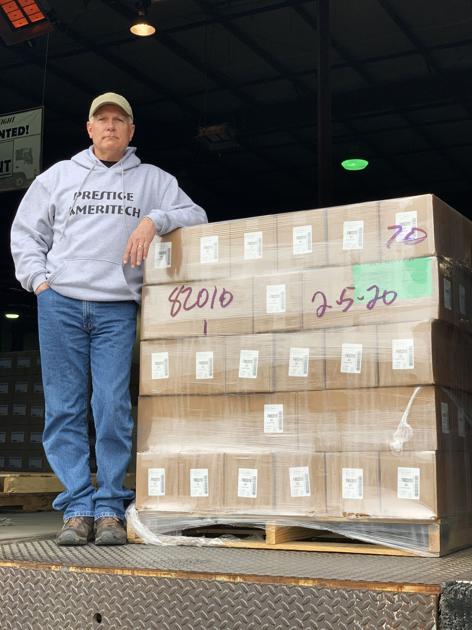

As the number of coronavirus cases in China skyrocketed in the past week, a small Texas manufacturer was inundated with orders from 8,000 miles away. Then, Stephen Bannon reached out.
Prestige Ameritech, the largest full-line domestic surgical mask manufacturer, was producing 600,000 masks each day but struggling to meet demand. Mike Bowen, the company’s executive vice president, received cold calls on his cellphone from people saying they represented foreign governments and wanted to make bulk purchases. The Hong Kong government and airport wanted more. Everyone was hunting for masks.
Instead of celebrating the business boom, Bowen was indignant. This is the precise scenario he began warning about almost 15 years ago, when he started pleading with federal agencies and lawmakers to boost U.S. production of medical masks. He had predicted there would eventually be a health scare and there wouldn’t be enough manufacturers. He was right.
So there Bowen was Wednesday as a guest on Bannon’s “War Room: Pandemic” podcast, tormented that no one in power had listened. Bannon, a former top adviser to President Donald Trump, has long cautioned about the decline of U.S. manufacturing.
“What I’ve been saying since 2007 is, guys, ‘I’m warning you, here’s what is going to happen, let’s prepare,’” Bowen said on the program. “Because if you call me after it starts, I can’t help everybody.”
The coronavirus outbreak has led to a health crisis, a diplomatic fiasco and, increasingly, an economic mess. It has also exposed major vulnerabilities in the supply chain of medical supplies. Many U.S. companies, especially hospitals and pharmaceutical firms, rely on Chinese manufacturers for products, ranging from the active ingredients of prescription drugs to protective gear like masks and gloves. Now, much appears upended.
There is no global, centralized plan for fast-tracking production of what’s known as personal protective equipment. There is no streamlined process for deciding where to send masks, disposable gowns, goggles and gloves. There is Bowen and his cellphone, and Bannon’s podcast, and Asian governments and people scrambling for masks on Amazon and eBay, and the stack of letters Bowen sent White House officials over three administrations — but that he’s not sure anyone ever read.
“Prestige Ameritech is presently the lone voice warning of the insecure U.S. mask supply,” Bowen wrote to President Barack Obama in June 2010. “Apathy and inertia are our biggest hurdles.”
“The U.S. protective mask supply could — and mostly likely would — be disrupted, confiscated or diverted in the event of a pandemic,” Bowen wrote to President Trump three years ago.
In an interview, Bowen said he could make 1 million masks a day if he ran his machines around the clock, a huge quantity for his firm that would barely make a dent in global demand. He’s hesitant, however, to ramp up production at the facility outside Fort Worth, scarred by the boom-bust mess that occurred after the swine flu pandemic in 2009.
Facing a potential pandemic, U.S. government officials are considering buying more products from domestic sources, such as Bowen’s firm, to meet increased demand, according to an industry source who spoke on the condition of anonymity to share ongoing discussions.
That may not be good enough for Bowen.
“A lack of planning on their part is not an emergency on my part,” Bowen said. “They had their chance. I told them over and over.”
There are also third-party dealers who could submit big orders to resell masks. Bowen’s dilemma about how to proceed illustrates how the coronavirus epidemic is straining the global manufacturing sector, particularly for items needed by front-line health-care workers. The outbreak has sickened more than 66,000 and killed more than 1,500. All but three deaths have occurred in China. Most cases have been milder illnesses. The disease is most often transmitted through respiratory droplets from an infected person’s cough or sneeze, similar to the way the flu spreads.
The more commonly worn surgical masks will limit — but not eliminate — the chance of inhaling large, infectious particles circulating near the face. The Centers for Disease Control and Prevention recommends that health-care workers interacting with coronavirus patients or suspected cases wear stronger masks, known as N95 respirators, along with gowns, gloves and eye protectors. The N95 filters out 95 percent of airborne particles. But they cost more and must be specially fitted.
China is a significant provider of such essential protective gear, and major manufacturers have factories there. Up to 95 percent of surgical masks are made outside the continental United States, in places like China and Mexico, according to a 2014 briefing released by the office of preparedness and response in the U.S. Department of Health and Human Services. As the outbreak has grown, Chinese authorities have increased manufacturing lines domestically, slashed their exports and put their own orders first. As China consumes more of the protective gear it is producing, the rest of the world is fighting over what is left.
U.S. health officials and industry executives are planning for how to supply enough masks to critical personnel. That plan relies on a complicated supply chain already strained by U.S.-China trade tensions and in which even the most basic information is closely held. Proprietary information makes it difficult for the health-care industry — and the U.S. government — to know how much inventory manufacturers have at any given time.
Tedros Adhanom Ghebreyesus, director general of the World Health Organization, said earlier this month that demand is 100 times higher than normal for the protective gear and that prices are up to 20 times higher.
“This situation has been exacerbated by widespread inappropriate use” of personal protective equipment outside of patient care, he said.
“There is limited stock of PPE and we have to make sure we get it to the people who need it most, in the places that need it most,” Tedros said.
Prestige Ameritech typically sells a case of 500 ear-loop masks for less than $50 to hospital distributors. But in the past week, 250 of the firm’s tie-on masks were posted on Amazon for $370 through a third-party seller. Bowen, alarmed by such a steep price, said he was frustrated by the reality that “once someone buys our masks, we cannot control what they do with them.”
Manufacturers and health officials are up against an almost-impossible calculus. It is difficult for certain firms to rapidly surge production, making it hard to meet large, sudden increases in demand. More than 3,000 companies in China, including carmakers, energy giants, diaper companies and underwear manufacturers, have added masks, protective clothing, thermometers and medical devices to their production line since the start of the outbreak, according to official Chinese media reports.
Health officials don’t know how the outbreak will progress or how deadly it will be. One day conditions appear to be improving, and then they get worse. Distributors must weigh how to prioritize who gets to tap into a limited supply.
During the 2009 H1N1 swine flu pandemic, demand for N95 respirators and face masks spiked dramatically. Orders overwhelmed manufacturers, creating a two- to three-year backlog, according to a 2017 report about shortages. U.S. officials had to dip into the government’s secret cache in the Strategic National Stockpile and release about 100 million respirators and face masks to states.
“We don’t have a plan in place for that scenario that allows for [the] quick decision-making that you’d like to see,” said Asha George, executive director of the nonprofit Bipartisan Commission on Biodefense.
In the panic of the swine flu epidemic, HHS contacted Prestige Ameritech to ask how many more masks it could produce, Bowen said. That was about the same time the company moved into a larger factory and hired 150 people.
But after the pandemic, demand declined, and it took months for hospitals and distributors to go through the surplus of masks they had ordered but never used. Prestige Ameritech had to let most of its new workers go.
“Everybody said they’d stay with us. The day after the pandemic they forgot who we were. We nearly went out of business,” Bowen said on Bannon’s podcast, his voice beginning to crack. “I can’t do that. I can’t put our company — I can’t fire 100 people again.”
In the United States, there is enough finished product to supply hospitals and other front-line health workers for the next four weeks, according to an industry expert who works with manufacturers but spoke on the condition of anonymity to share ongoing discussions.
The coronavirus epidemic is expected to last longer than that. Major U.S. airlines have canceled flights to China through late April, a date that could be moved back again if necessary.
”We’re trying to do some projections,” the person said. “How do we get to the next three weeks, and how do we get to the three weeks after that?”
Routine annual production in the United States has been estimated to be 1.5 billion N95 respirators and 3.6 billion surgical masks, according to a 2017 report in the journal Health Security. The report estimated that 1.7 billion to 3.5 billion N95 respirators and 100 million to 400 million surgical masks would be needed to protect health-care workers in the event of a severe influenza pandemic.
U.S. companies that depend on China are especially vulnerable, having endured two years of uncertainty throughout President Trump’s protracted trade war with Beijing. Despite these challenges, U.S. officials have begun shifting their response to better protect the public in the weeks ahead, even as scientists’ understanding of the virus changes almost daily. U.S. health officials say the number of confirmed cases is expected to grow, which is why they are enforcing quarantines to prevent spread but also taking steps to control a much broader increase in cases.
”At some point, we are likely to see community spread in the United States,” said Nancy Messonnier, the top official overseeing CDC’s response. On Thursday, health officials announced they would be using flu labs to also test for coronavirus in five cities — San Francisco, Los Angeles, Atlanta, Chicago and New York — to gauge the spread of the virus, which causes mild symptoms in many people.
Already, some in the health-care industry “are reporting higher than usual demand for select N95 respirators and face masks,” Messonnier said in a briefing Wednesday.
CDC does not recommend face masks for the general public. But CDC recently recommended that health-care facilities consider strategies to conserve their N95 supplies.
U.S. officials are also talking daily with about one dozen protective equipment manufacturers and 20 distributors that sell products in the United States.
One reason there aren’t more U.S. firms that manufacture medical masks: the profit margin is low and imports from Mexico and China are much cheaper for hospitals and others to buy (this has been a particular focus of Bannon and Peter Navarro, one of Trump’s top trade advisers).
Bowen, from Prestige Ameritech, said he had pushed policy makers to encourage the American health care system to buy domestic, but his overtures often fall flat. Bowen estimates that his masks cost 10 percent more than ones made in Mexico, and prices on Chinese goods can be less than the “cost of raw materials.”
He had hoped that with Trump, things might be different, believing in the “Buy American and Hire American” initiative that the White House had pushed in 2017. But after a few months, he was disillusioned, particularly after the U.S. government gave surgical mask contracts worth more than $1 million to a supplier that made many of its masks in Mexico.
And then at the end of 2018, one of its major customers took $3 million worth of business to China.
”I take two steps forward and one step back,” Bowen said.
Even now, Bowen says any pleas from the government to increase production during the crisis would be “too little, too late.” He’ll keep supplying his normal customers. He’ll try to manage the onslaught of requests flooding his email — 110 on one day alone.
”Until three weeks ago, I didn’t get one call per month” from new customers, Bowen said.
Recent Comments