

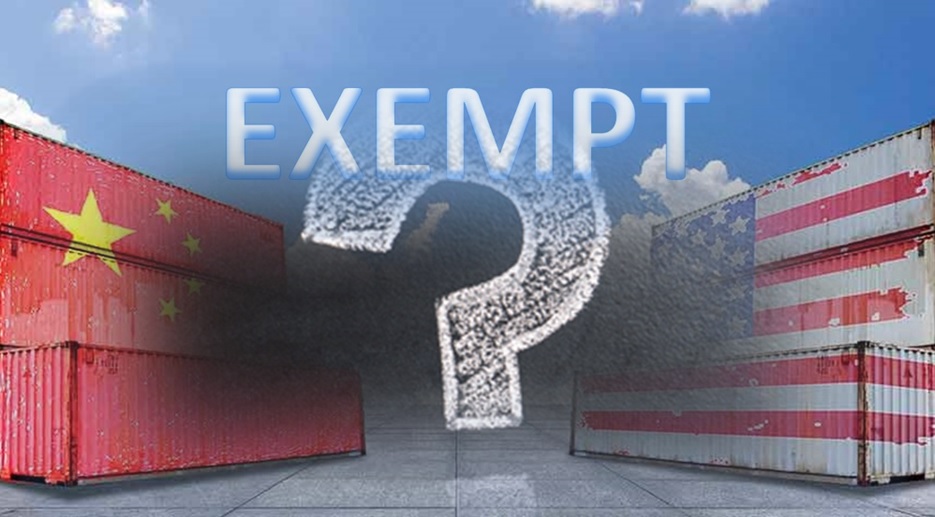

HIGH POINT — The latest round of exclusions from 25% tariffs on Chinese-made goods, which included very narrow exclusions for upholstered seating and furniture made of metal and high-pressure laminated bamboo, has generated more questions than answers for furniture importers.
According to a listing published in the Feb. 5 Federal Register, the exclusions are retroactive to Sep. 24, 2018, and run through Aug. 7 this year, so importers have a window until that August expiration date to apply for refunds on the additional duties already paid.
Confusion exists, however, as to the exclusions’ scope, particularly as they relate to upholstered seating. Does it cover motion and/or stationary, sectionals or stand-alone pieces? Is there flexibility beyond the specified product dimensions?
To get some clarity — where it can be achieved — Furniture Today reached out to Sam McClure, director of compliance and customs services at freight forwarder and customs broker CV International, to get his take on interpreting the new exclusions, which he said have generated “literally hundreds” of tariff refund requests from customers.
His bottom line: The exclusions must be read exactly as written. For example, the new upholstered seating exclusion has very specific dimensions for subject goods, “at least 144 cm but no more than 214 cm in width, at least 81 cm but no more than 89 cm in height and at least 81 cm but not more than 163 cm in depth.”
In other words, if you’re importing upholstery outside that range, don’t bother applying for a refund. The narrow range is a result of individual companies applying for exclusions that cover only what they make.
“Exclusions work so that if one company gets it, everyone gets it; if you have something that fits the specifications, take it,” McClure said. “Companies looking for exclusions make it as narrow as possible so their friends down the street might not get it.
“The Section 301 exclusions granted for the most part have been very narrow, although there are some notable exceptions such the exclusion for upholstered dining chairs, which is relatively broad,” he added. “Of the1,429 individual exclusion granted, only 29 are extended to all goods covered by the 10-digit tariff code. None of those have any impact on the furniture industry.”
Some answers, some questions
Many importers are wondering exactly what types of products the new upholstered seating exclusion covers.
McClure’s take is that “upholstered seats with wooden frames other than chairs” would include products such as sofas, loveseats, chaises and ottomans – within the exclusion’s specified dimensions.
A big question is whether that exclusion is for motion, stationary seating or both, and McClure had a more definite answer there.
“Stationary and motion seating is treated the same. As long as the exclusion does not specify motion or stationary in the scope, there would be no difference in applicability,” he said. “Unless it’s written into the exclusion, motion and stationary are the same.”
How about sectionals? While a full sectional set could be well over the some 56.7 to 84.3 inches in width, 31.9 to 35 inches in height, and at least 31.9 to 64.2 inches in depth specified in the exclusion, individual pieces could fall into that range. McClure has seen no guidance on this, but he does have an opinion.
“I would expect that the dimensions would apply based on the unit as imported or as sold at retail,” he said. “I understand that this could vary, so I think the rule to follow would be how it is invoiced from the supplier, as on piece or as a set.
“In this case, however, the importer might have to be able to show that it is sold in the same configuration.”
He said the new exclusions for cut-and-sewn fabrics and cut-and-sewn leather have to be taken specifically as written: “Parts of seats, consisting of fabric or leather cut to shape, including liner parts, partially sewn, with zippered cushions, welt cords or piping.”
“I would think the imported product would have to meet all of the listed description,” McClure said. “There is also an exclusion for covers or shell liners of textile material cut to shape.”
You have to ask
Requests for retroactive refunds on tariffs paid since September 2018 must be made directly to the U.S. Customs department. McClure suggests that importers contact their customs broker or a customs attorney for advice on getting refunds or applying for their own exclusions.
“The window to apply for exclusions themselves has closed, but it may be open again down the road,” he said. “The wording on these exclusions can be very convoluted, but they have to be taken literally. If Customs wanted something outside of what is in the exclusion, they would not have written the limitations in.”
Furniture Today also reached out to the American Home Furnishings Alliance for this report, but the organization is still looking for answers to exclusion-related questions itself.
“AHFA is soliciting clarification from authorities on several key issues raised by the exclusions, but answers are slow in coming,” said CEO Andy Counts in an e-mail.
Recent Comments