

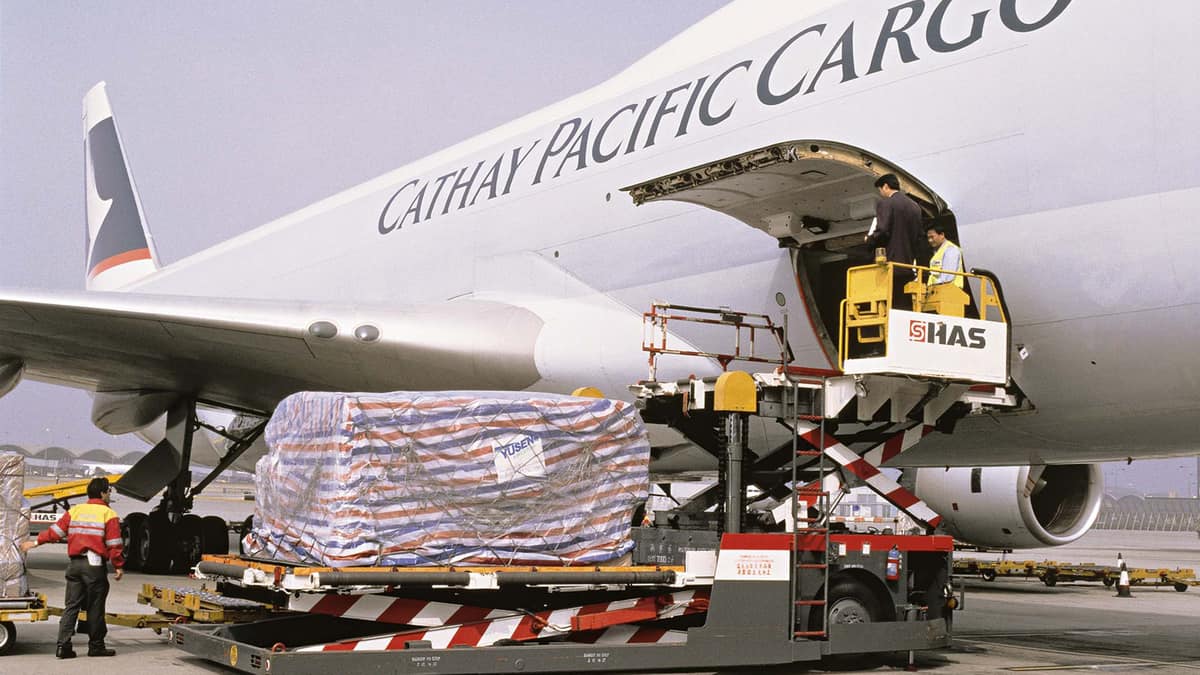

The coronavirus is playing havoc with the air cargo industry as airlines, logistics providers and cargo owners scramble to implement contingency plans for moving goods. With nearly all passenger aircraft removed from China service, experts are warning businesses to prepare for a significant spike in freight rates once economic activity in China picks up again.
The emergency has flipped normal shipping patterns that were skewed to outbound volume because of China’s manufacturing dominance. Instead, most airfreight activity involves imports of medical and hygiene supplies being rushed to China on dedicated freighters, while very little is being produced that could go out on a plane. And logistics managers say the closure of the Chinese market is having ripple effects for airfreight in other parts of the world.
“We are seeing a capacity crunch for both outbound and inbound, but we’re moving more relief items and medical supplies into China at the moment,” said Brian Bourke, chief growth officer at Chicago-based SEKO Logistics.
For the first time this century, it appears load factors from Europe and the Middle East to China and Hong Kong are higher than the westbound load factor, according to analysis from CLIVE Data Services, a data application provider.
Under the circumstances, all-cargo carriers are reducing regularly scheduled flights and throwing planes into charter missions.
Charter rates and spot prices on the Frankfurt-to-Shanghai lane have jumped 193% from the average to about $2.78 per kilogram because of the influx of inbound charter traffic, Freight Investor Services said in a report Monday. Trans-Pacific charter rates fluctuated between $500,000 and $800,000 one way last week, it said.
Slow recovery
Chinese factories and freight facilities are slowly returning to work as authorities continue to grapple with the deadly outbreak of the flu-like disease, but considerable uncertainty remains about when production might return to normal. More plants are expected to resume operations this week. However, output will be constrained because quarantines and travel restrictions in many cities prevent many people from reaching their jobs, factories and offices must apply for government permits and undergo inspections before they can reopen, and parts are often in short supply.
There have been 72,000 confirmed cases of coronavirus and 1,860 deaths in China, according to the World Health Organization.
DB Schenker, the third-largest global logistics provider by revenue, said more than two-thirds of its freight management offices and contract logistics sites have resumed work at various levels, while others are waiting for a green light from regulators to open. The company’s offices in Wuhan, the epicenter of the outbreak, and Zhengzhou remain closed.
Wuhan city officials have ordered businesses to remain closed through Friday.
The company says it is trying workarounds to overcome challenges from labor gaps; shortages of required masks, sanitizer and other hygiene equipment; and administrative backlogs getting facilities approved.
Meanwhile, there is nowhere for most shipments to go since few trucks are operating and airlines have pulled down passenger aircraft — and the extra cargo space they offer — from their schedules.
“Truck resources supporting airfreight are restricted in the east, west and north, with approximately 30% of resources available,” which is adequate for the moment, DB Schenker said on its website.
About 70 airlines have canceled all international flights to mainland China, and an additional 50 have curtailed operations, resulting in an 80% reduction in foreign airline capacity and a 40% reduction by Chinese airlines.
Last week, American Airlines (NASDAQ: AAL) and United Airlines (NASDAQ: UAL) suspended service to China and Hong Kong until late April, while Air Canada, British Airways and Finnair extended flight suspensions to mainland China until late March and cut more flights to Hong Kong.
On Monday, Hong Kong’s Cathay Pacific (OTCUS: CPCAY) and sister airline Cathay Dragon announced an escalation of their network-wide capacity reduction to 40% from the previous 30% cut, due to low demand. The flight reduction is likely to last into April, they said.
OAG Aviation Worldwide, an industry data aggregator, said in a blog post that so much passenger capacity has been removed that China has gone from the third-largest aviation market to the 25th in the span of five weeks.
Prior to the outbreak, airlines had planned to increase capacity by 9% on international routes to and from China in the first quarter, compared to the same period a year ago. The overall reduction in passenger capacity will reduce gross operating revenues by $4 billion to $5 billion for airlines worldwide, according to a preliminary economic forecast from ICAO.
Hong Kong International Airport on Sunday reported that year-over-year passenger traffic dropped 11.7% in January and cargo throughput decreased 10.4% to 359,000 tons because of the coronavirus, Lunar New Year holiday and anti-government protests that have rocked the semi-autonomous enclave since last summer.
Freighter operators have filled the breach to some degree but have been careful to commit too much capacity for regular, scheduled service until outbound demand picks up.
Global logistics service provider DSV Panalpina warned customers on its website to expect supply chain disruptions anywhere because scheduled airlines can’t fly normal routes with the aviation contraction in China. All-cargo airlines tend to arrange global flight rotations with intermediate stops in several cities to drop and collect shipments. An airline that usually starts a global rotation in the U.S., for example, with a load of pharmaceuticals for the European market and then picks up milk powder for China will find its aircraft stranded due to port closures, making some deliveries outside of China difficult too.
Air and ocean freight delays are likely once factories resume running at full tilt, logistics practitioners say, because product backlogs will congest terminals and overwhelm China Customs’ ability to swiftly process exports.
SEKO Logistics is informing airfreight purchasers to anticipate one to two days of extra transit time and a jump in rates from mid-March to late April as pent-up demand from China and Hong Kong to Europe and the U.S. outpaces available capacity, and shipments that rode in passenger bellies look for a home on dedicated freighters.
“Space and rates may become further stretched with Huawei, Samsung and Sony products due to be released in March … and taking up already limited capacity,” SEKO said in a note to clients.
SEKO recommends sea-air service as an alternative for the predicted rush, with transshipment points in Dubai, South Korea or Singapore determined to optimize transit time at the lowest possible cost. Such products are common during peak seasons and combine a rapid ocean and premium air leg. Shipments travel by vessel to the intermediate port, where they are transferred from ocean containers to airfreight pallets within 12 to 36 hours and tendered to an air carrier for delivery to the destination airport.
That type of flexibility, as well as frequent forecasting, hyper-communication with logistics partners, and taking advantage of freight financing, were among recommended shipper actions from forwarder Flexport last week.
The capacity shortage and bump in rates will probably be short-lived. That’s because airline capacity for the past 20 months has far exceeded demand, and it’s not clear the virus can reset the freighter demand curve this year, aviation consultant Alan Hedge said during a conference call hosted by investment firm Susquehanna Financial Group.
But that calculation could change if passenger capacity remains well below normal. Helane Becker, an equity analyst at investment firm Cowan, predicts air traffic to and from China will not return to normal this year and that the aviation market there has lost a year of growth. “We do not believe it will be business as usual in China even after cases peak and start to decline, until after this summer at the earliest. As travelers plan their summer vacations, we believe China is off the list for now,” she wrote in a research report.
Recent Comments