


This is an opinion piece written by Lou Longo, international consulting practice leader at Plante Moran. Opinions are the author’s own.
U.S. businesses can finally welcome some good news on the trade front.
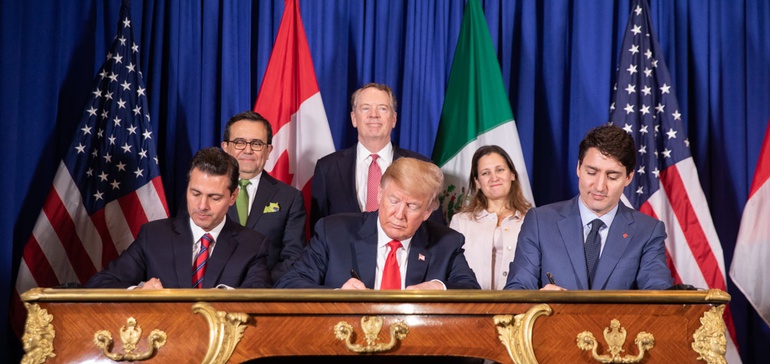
The new normal of trade disruption is here to stay, but phase one of the U.S.-China trade deal signed in January signals a ceasefire after nearly two years of mounting tariffs and tensions. And the signing of the revised NAFTA deal between the U.S., Mexico and Canada (USMCA) eliminates a major source of uncertainty while creating some big supply-chain opportunities and challenges.
The trade war with China awaits a phase two deal
The interim deal with China allows for a rollback of some U.S. tariffs and an agreement not to implement the full, threatened tariffs in return for Beijing’s commitment to buy more U.S. agricultural and manufacturing products.
Washington’s agreement to stop labeling China a currency manipulator marks a big win for Beijing and removes another element of volatility in the relationship for U.S. business.
By placing a bookmark on the dispute, businesses don’t have to look over their shoulders every day for the next tariff hike or tweet.
Still, the deal itself is far from comprehensive, leaving plenty of room for future conflict if China doesn’t do its part to reduce the U.S. trade deficit. For example, the agreement fails to meaningfully address the intellectual property theft issue that is a priority for U.S. businesses.
China has committed to investigate IP violations as part of the deal, but there’s no mechanism to really force it to clamp down on a problem estimated to cost U.S. businesses up to $600 billion a year.
In effect, Beijing and Washington have agreed to play nice for a while. But U.S. businesses shouldn’t take that as a cue to sit back and do nothing. On the contrary, they should be using this period of calm to take a detailed look at their supply chains, operations and customers to ensure their business is well placed to cope with future trade disruptions, which are bound to come.
Now’s the time to be looking for new relationships, finding new markets, and testing out new suppliers. It’s an opportunity to increase your focus on the revenue side by speaking to customers to understand where you should be located and what products you should be providing.
I worry that too few businesses are taking these kinds of steps. A survey of around 250 participants in a recent Plante Moran webinar on the China trade issue found 27% of respondents were not planning any changes to their supply chain while 41% were still assessing how to respond. Discouragingly, none of the respondents said they had created a cross-functional effort to deal holistically with tariffs.
The USMCA reduces free trade uncertainty, but could create new disruption
The USMCA deal with Mexico and Canada, which includes an up to 16-year sunset clause, represents stability for businesses across the region. But its provisions, especially around Mexican labor and local production, also signal disruption and opportunity.
Under the deal, Mexico has committed to strengthen its labor rights laws and protections. By 2023, more than 40% of auto parts in the region must be made by workers who make at least $16 per hour — around three times the current average hourly pay in Mexico.
This is a major shift that will prompt big changes in the supply chain, making some parts of the U.S. auto sector competitive with Mexico.
The requirement that a lofty 75% of auto components (up from 62.5%) be made within the three countries to qualify for zero tariffs is another very significant step that will bring a lot more activity into the three countries.
But there will also be challenges. Businesses will need to educate themselves about these big changes and understand how to take advantage of them. Many will struggle to implement the right changes due to the high level of complexity for their supply chains and operations.
For example, the USMCA has strict enforcement provisions that will require levels of data collection and reporting across the supply chain that many businesses will be challenged to provide. It’s foreseeable that significant ERP and other IT changes will be needed to comply. For instance, if your supply chain includes global sourcing, to get a USMCA certificate you’ll have to provide great detail about how much of the product meets USMCA content requirements, which many current ERP systems are not configured to provide.
The era of trade disruption is likely far from over given the ascendancy of protectionist, nationalist policies globally. The U.S.-China ceasefire and the USMCA represent rare respites that businesses should pounce on soon to build their resilience and flexibility.
This may be a good time to identify which major markets will represent your greatest opportunities for sales growth in the future and consider including them in your supply chain and possibly in your manufacturing footprint. This strategy can help decrease currency risks by providing a natural hedge through buying and selling in the same currency, reduce logistics costs and provide greater flexibility to move production across markets during times of disruption.
A nimble and flexible supply chain in strategic growth markets may be your best insurance policy in unsettled times, as the current trade ceasefire provides an opening to take action.
Recent Comments