

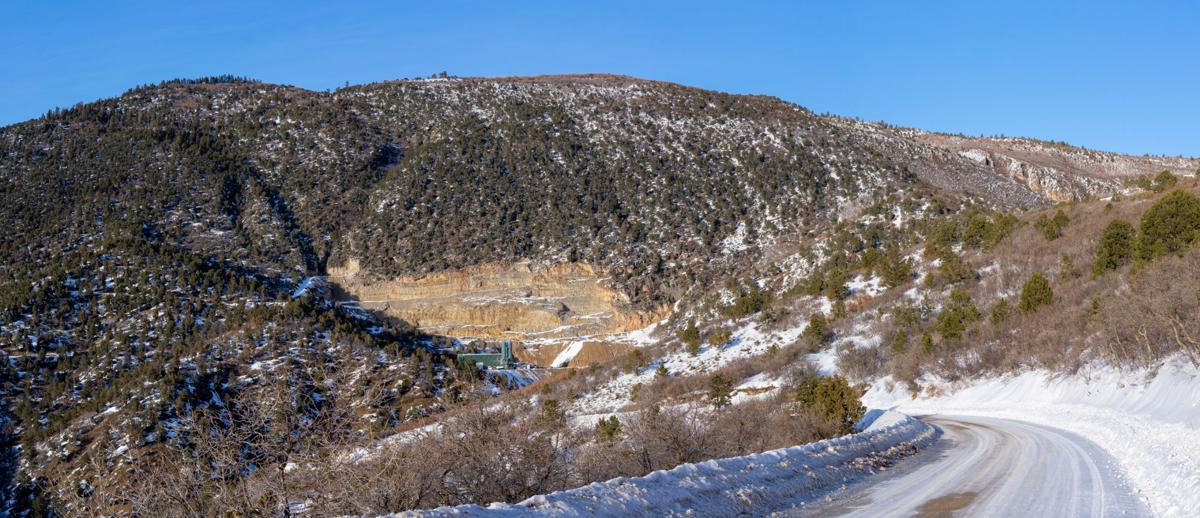

The City of Glenwood Springs released a report from the Colorado Natural Heritage Program on Wednesday that concluded the proposed Mid-Continent Limestone Quarry expansion near Glenwood Springs would have widespread and long-lasting environmental impacts to the area.
The city commissioned CNHP, a program through Colorado State University’s Warner College of Natural Resources, to conduct two biological surveys — one in July 2018 and another in June 2019 — in the area within the proposed quarry expansion. If approved, the quarry’s existing 15.7 acres would be built to 321 acres.
Delia Malone, the first name and “boots on the ground” researcher on the report (as her co-author Jill Handwerk described her), depicts a dramatic ripple effect into surrounding ecosystems should the Bureau of Land Management approve quarry proprietor Rocky Mountain Resources’ plan.
“An ecosystem is a process. It took decades to develop; it’ll take decades to recover,” she said.
RMR Chief Executive Greg Dangler emphasized in a January interview in his Denver office that the project is a tiered one that would progress over the course of at least 20 years.
“You do a couple little steps a year. It’s very basic in that regard,” he said.
And as the project moves down the mountainside, those steps are reseeded and reclaimed, he continued, a process that is outlined in several sections of the two-inch thick plan.
But Malone maintains that reclamation is only feasible on the flattops of those steps, not the vertical rise. Even if reclamation efforts are effective — “there’s a lot of examples of poorly done restoration,” Handwerk noted — it would be centuries before the area returned to its current state, if ever.
“I don’t mean this to be anything but straightforward, maybe in 250 years,” Malone said. “For that reclamation to take hold and to become what it is today, is going to take many, many, many, many, many decades. Yes, you will, over time, maybe. Maybe not — because we’ve got this little thing going on called climate change. Right now, you’ve got this complex system of ecosystems that have taken hundreds of years to develop.”
Those ecosystems are particularly diverse, according to the report released Wednesday.
“Surveys further revealed that habitat throughout the survey site is a complex mosaic of plant communities which provide important ecosystem functions essential to the viability of native wildlife populations,” per the report’s executive summary. “Specifically, the survey site provides forage and important migration routes during critical times of the year for elk, deer and bighorn sheep, and provides breeding habitat for several native wildlife species that are designated by the state as species of concern.”
Then there are the areas adjacent to the proposed expansion site, Malone said, known as edge effects.
“Conceptually, say you put in a road, and the road is 100 feet wide,” she offered. “And obviously it changes the habitat in that 100-foot swath, but the effects of the road on wildlife extends — and this is what the research shows — the effect of the road on that wildlife and plants and climate extends at minimum 50 meters, and probably more like 150 meters, past the edge of that road.”
As for real-world application of the concept regarding the proposed quarry expansion, Malone said the impacts are soil-deep, and that is indeed quite deep.
“You actually get changes as far reaching as a change in soil moisture because you get more drying,” she said of the proposed development. “The soils are the foundation of these ecosystems. When the soil’s dry, the trees dry, and the trees consequently die. And when the trees die, the animals that rely on those trees leave. Often the [neighboring] habitat is already spoken for, so they die as well. It sort of ripples through the ecosystem.”
The ecosystem as it currently exists, because of its steep typography, offers an increasingly rare commodity to wildlife: habitat undisturbed by humans, she said, even with the existing quarry operations.
“If this was 150 years ago, yeah, who cares?” Malone said about RMR’s proposal, noting the steady decline in undisturbed public lands on the Western Slope. “But it’s not 150 years ago. It’s important because of its human-induced rarity. That’s not a political statement. Look, we have these habitats that used to be common; they’re no longer common. You make your decision, but this is the situation.”
A deeper look
Richard Rhinehart would likely agree with all of the points outlined in the CNHP report, but the Colorado Cave Survey member’s reasons for opposing the proposed quarry expansion have more to do with what exists beneath the site — or rather, what would likely be destroyed should the existing plans be approved, he said.
As Halloween approached last year, he and fellow cave expert Rob McFarland went for a walk, though it wasn’t a leisurely stroll.
“Last October, Collier Consulting, they did a paper for BLM and RMR of studies they had done in 2018,” he said of the Texas-based geoscience and engineering firm RMR contracted to perform geophysical studies of the Leadville Limestone strata immediately north of the Glenwood Caverns. Part of Collier’s task was to determine whether any unknown caves existed in the area between Transfer Trail Road and the White River Plateau, he said.
When the Glenwood Springs Post Independent ran an article mentioning that the firm’s report was publicly available through a request to the BLM, Rhinehart read with particular attention.
“So that’s exactly what I did,” he said. “When I looked through it, looking at the graphs that they had in that particular report, I could see that there were multiple instances of what looked like cave signatures to me in their data.”
He consulted with fellow caving scientists in his network, and everyone agreed that some misinterpretations of the data existed in the report, he continued.
“We were sort of skeptical. With that report in hand, I reached out to Rob in Rifle,” Rhinehart recalled. “I said, ‘Hey Rob, we’ve spoken before about doing some cave hunting in the mountain. Let’s see if there’s any signs of caves there.’”
The rest has become very recent history. After spending hours one Saturday searching for any signs of a cave along Transfer Trail Road, Rhinehart and McFarland split up to cover more ground as evening approached.
“Literally, no more than three or four minutes into our walking separately, Rob’s shouting down to me, ‘Come on up!’” Rhinehart said. “I was sort of surprised; he couldn’t have found something that quickly. I headed back up the hill, and sure enough, he showed me this big hole in the side of the mountain that you literally couldn’t see within five feet of the entrance just because of bushes — it’s very well hidden.”
McFarland dubbed his find “Witches’ Pantry” in an ode to the upcoming holiday and the skeletal remains found in the cave.
Several skilled cavers from the National Speleological Society’s Colorado chapters aided Rhinehart and McFarland in further uncovering their discovery over the next several weeks, which they reported to the BLM in December and formally announced to the public in January.
But then the snows came, making accessing Witches’ Pantry difficult and effectively ceasing additional exploration. Plus, Rhinehart said, the caving community is awaiting response from the BLM regarding permission to go any deeper underground.
“In a normal situation — if this was any other place than right where it’s located — they would absolutely say, ‘You have permission,’” he said. “The caving members of this community in Colorado have been working with BLM for decades. It’s been a very cooperative, friendly, co-working relationship all these years. But with the quarry, it’s like all rules are now thrown out.”
BLM public affairs specialist David Boyd underscored that the agency, like the caving community, is eager to learn more information about Witches’ Pantry.
“The more information we have, the better analysis we can do,” he said.
Currently, the BLM is undergoing an environmental analysis — not to be confused with the more comprehensive environmental impact statement, or EIS, as part of the National Environmental Policy Act process that informs any final decision regarding approval for the quarry expansion.
Rhinehart hopes that the discovery of Witches’ Pantry will add a new layer to the environmental considerations, citing the Federal Cave Resources Protection Act of 1988.
But, he acknowledged, that’s not the only legislation at play in this scenario. The oft-cited General Mining Act of 1872 specifically protects mining claims when the commodity is of a certain high purity.
“If the limestone can be shown through chemical analysis to be exceptionally and uncommonly pure — in excess of 95 or 97 percent — RMR could then claim the rock was a precious mineral and not subject to federal fees that apply for aggregate rock,” Rhinehart wrote in an article in Rocky Mountain Caving.
“You literally have two conflicting laws that the government is told to follow,” he said.
That could put the BLM between a rock and a hard place when it comes to enforcement, he continued. But upon further inspection of the language of the caving law, Boyd and his colleagues realized there’s an outright hierarchy.
“I asked a geologist this other day,” Boyd said of the 1988 protective legislation. “It explicitly says nothing in this [law] would affect ongoing or future mines under the 1872 mining law. It explicitly says that. We have more flexibility if the mineral exam shows that this falls under materials regulations of BLM versus the 1872 mining law.”
When asked why RMR is so doggedly pursuing a quarry expansion so vehemently opposed by locals, Dangler repeatedly references the quality of the limestone in the expansion site, though that’s yet to be determined by a mineral exam study.
“This is a supreme deposit of minerals, very rare. If this was not going to be developed and expanded by us, someone else would do it. It’s a chemical-grade material, so it’s a high purity,” he said.
Recent Comments