


Tech News, Magazine & Review WordPress Theme 2017
  • Home
  • Supply Chain Updates
  • Global News
  • Contact Us
  • Home
  • Supply Chain Updates
  • Global News
  • Contact Us
No Result
View All Result
No Result
View All Result
Home Supply Chain Updates

Rising Coronavirus Tallies In China, Elsewhere Leave Investors Feeling Jittery

usscmc by usscmc
February 21, 2020
Rising Coronavirus Tallies In China, Elsewhere Leave Investors Feeling Jittery
Share on FacebookShare on Twitter

Getty Images

Getty Images


Getty Images

Key Takeaways:

  • The 10-year yield fell below 1.5%, and the 30-year yield hit an all-time low below 1.92%
  • Gold advanced to just under $1,650 per ounce—a level not seen since 2013
  • Coca-Cola warned earnings will take a hit from the coronavirus outbreak

Wall Street’s risk-off mood appears to be continuing this morning as rising coronavirus tallies seem to have investors on edge.

Even as this earnings season continues to be generally better than expected, investors and traders seem to be focusing instead on the outbreak’s potential impact on corporate earnings as the number of cases jumped in China overnight, and South Korea and Japan are also reporting substantial numbers of infections.

From a corporate standpoint, investors were particularly worried after Coca-Cola (KO) said the outbreak would reduce its earnings. As fears mounted market participants flocked to the relative safety of U.S. government debt, pushing the yield on the 10-year Treasury note below 1.5% and that of the 30-year bond to an all-time low below 1.92%.

Other corporate news was brighter, however, as Deere (DE) reported solid earnings of $1.54 per share, well above the $1.25 third party consensus. Revenue also came in ahead of consensus. The cautious tone for 2020 struck by CEO John May didn’t seem to dampen enthusiasm for the stock. DE was up 6% in premarket trading.

Keep in mind that we’re heading into a weekend, which means the selling might be stronger than it otherwise would be as investors and traders may want to not carry as much risk over the two-day break when no one knows what the headlines will hold.

A Head Scratcher

Yesterday, the main three U.S. indices ended the day lower after recovering some ground from a sharp intraday drop. Meanwhile, there was an uptick in demand for U.S. government debt, which pressured yields; gold prices rose; the Cboe Volatility Index (VIX) moved up; and the U.S. dollar jumped.

The general pressure on stocks and rise in safe-haven investments indicated that investors were in a risk-off mood because of worries about the coronavirus outbreak. But the magnitude of sharp intraday downturn was a bit of a head scratcher, defying ready explanation.

There’s always the chance someone made a large trading mistake, but if this had been a fat-finger situation where by one big desk sold more shares than it meant to, then it seems likely that the market would have bounced back more than it did. Perhaps a combination of virus fears and pre-election uncertainty, plus a stock market that has run out of near-term catalysts to move higher, has stoked a bit of hair-trigger volatility in the market.

Whatever the selling catalyst, it seems that investors wanted to book some profits from the market’s recent strength. But it was encouraging to see that investors also wanted to buy the dip.

Another Mini-Mystery

While the Financials sector did end the day slightly lower on pressure from falling Treasury yields, bank stocks didn’t do that badly in general, and regional banks were actually up for the day.

Often banks will do worse when Treasury yields fall because it can squeeze the margin between what they can charge on loans and what they earn on deposits. But it seems that the traditional inverse relationship between yields and bank shares wasn’t entirely in place yesterday.

Sometimes, when traditional relationships seem to be out of whack and you’re not sure of the cause, it could be best to use caution.

Not Stuck in a Rut

It was notable that although the Russell 2000 Index (RUT) also took a downturn during the session it managed to recover into positive territory.

Perhaps investors were rotating some money from large names that have done well recently and into small-cap stocks. But the RUT was also helped as regional banks had a pretty good day, because they make up a good chunk of the index.

It may also be a case of investors having an increased appetite for smaller domestic companies that have less exposure to China than some large multinationals.
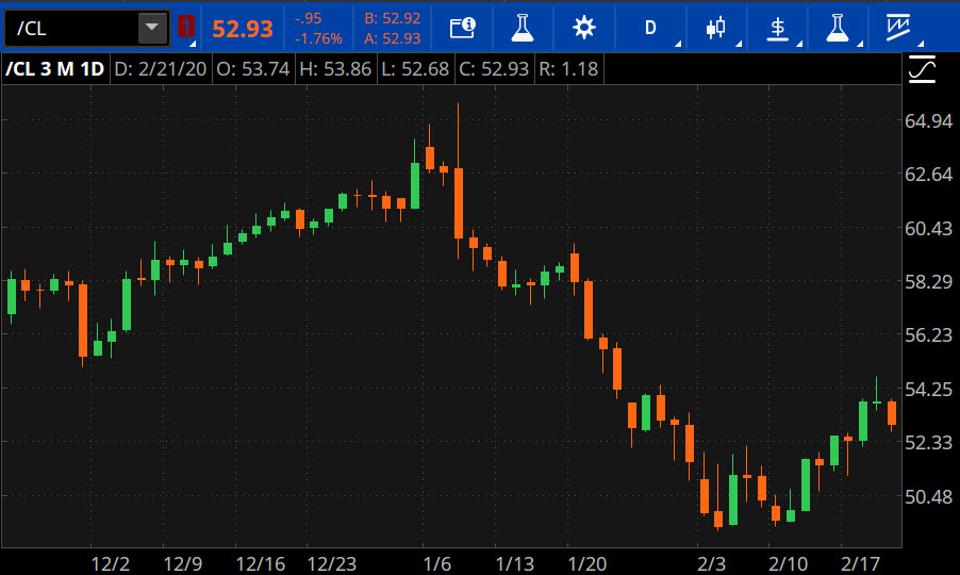
Data source: CME Group. Chart source: The thinkorswim® platform from TD Ameritrade.

Wall Street’s risk-off mood appears to be continuing this morning as rising coronavirus tallies seem … [+] to have investors on edge. Even as this earnings season continues to be generally better than expected, investors and traders seem to be focusing instead on the outbreak’s potential impact on corporate earnings as the number of cases jumped in China overnight, and South Korea and Japan are also reporting substantial numbers of infections. From a corporate standpoint, investors were particularly worried after Coca-Cola (KO) said the outbreak would reduce its earnings. As fears mounted market participants flocked to the relative safety of U.S. government debt, pushing the yield on the 10-year Treasury note below 1.5% and that of the 30-year bond to an all-time low below 1.92%. Other corporate news was brighter, however, as Deere (DE) reported solid earnings of $1.54 per share, well above the $1.25 third party consensus. Revenue also came in ahead of consensus. The cautious tone for 2020 struck by CEO John May didn’t seem to dampen enthusiasm for the stock. DE was up 6% in premarket trading. Keep in mind that we’re heading into a weekend, which means the selling might be stronger than it otherwise would be as investors and traders may want to not carry as much risk over the two-day break when no one knows what the headlines will hold. A Head Scratcher Yesterday, the main three U.S. indices ended the day lower after recovering some ground from a sharp intraday drop. Meanwhile, there was an uptick in demand for U.S. government debt, which pressured yields; gold prices rose; the Cboe Volatility Index (VIX) moved up; and the U.S. dollar jumped. The general pressure on stocks and rise in safe-haven investments indicated that investors were in a risk-off mood because of worries about the coronavirus outbreak. But the magnitude of sharp intraday downturn was a bit of a head scratcher, defying ready explanation. There’s always the chance someone made a large trading mistake, but if this had been a fat-finger situation where by one big desk sold more shares than it meant to, then it seems likely that the market would have bounced back more than it did. Perhaps a combination of virus fears and pre-election uncertainty, plus a stock market that has run out of near-term catalysts to move higher, has stoked a bit of hair-trigger volatility in the market. Whatever the selling catalyst, it seems that investors wanted to book some profits from the market’s recent strength. But it was encouraging to see that investors also wanted to buy the dip. Another Mini-Mystery While the Financials sector did end the day slightly lower on pressure from falling Treasury yields, bank stocks didn’t do that badly in general, and regional banks were actually up for the day. Often banks will do worse when Treasury yields fall because it can squeeze the margin between what they can charge on loans and what they earn on deposits. But it seems that the traditional inverse relationship between yields and bank shares wasn’t entirely in place yesterday. Sometimes, when traditional relationships seem to be out of whack and you’re not sure of the cause, it could be best to use caution. Not Stuck in a Rut It was notable that although the Russell 2000 Index (RUT) also took a downturn during the session it managed to recover into positive territory. Perhaps investors were rotating some money from large names that have done well recently and into small-cap stocks. But the RUT was also helped as regional banks had a pretty good day, because they make up a good chunk of the index. It may also be a case of investors having an increased appetite for smaller domestic companies that have less exposure to China than some large multinationals.


Data source: CME Group. Chart source: The thinkorswim® platform from TD Ameritrade.

Manufacturing Recovery Continues: This week has been relatively good for manufacturing data, a good sign considering the sector has been beaten up and has only recently begun showing signs of a recovery. On Tuesday, the general business conditions index of the Fed’s February Empire State Manufacturing Survey rose to 12.9 when only a 6.3 reading had been expected in a Briefing.com consensus. Then, yesterday, a key index in the Philadelphia Fed’s February Manufacturing Business Outlook Survey jumped to 36.7 when 10.7 had been expected. All this is on the heels of the closely watched Institute for Supply Management’s manufacturing index earlier this month surprisingly returning to expansionary territory after five straight months of contraction.

But Will Virus Infect Factory Recovery? The coronavirus outbreak is casting a shadow of uncertainty over the domestic factory sector. As the outbreak wears on, Chinese manufacturing is hamstrung by employees who can’t get to work, and the global air and sea freight system has also taken a big hit. That means U.S manufacturers may have trouble getting parts they need, which could crimp the recovering sector. “While weakness in manufacturing appears to show signs of softening, the COVID-19 outbreak may impact manufacturing supply chains in the U.S. in the coming months,” Conference Board senior director of economic research Ataman Ozyildirim said in a statement accompanying the release of the think tank’s January leading indicators report yesterday.

Shelter From the Storm: While domestic manufacturing might take a ding from the outbreak of COVID-19, the U.S. housing market might be one place that’s better able to weather the fallout from the epidemic. Low interest rates have been one thing helping demand for housing, and the coronavirus-spurred flight to U.S. government debt could help keep rates low. Further, it seems likely that if the outbreak begins to truly dent economic growth around the globe and in the United States, the Fed would at least consider lowering its benchmark rate. The latest numbers on existing home sales are scheduled for release a little later this morning, with January sales expected to come in at a seasonally-adjusted 5.42 million, according to Briefing.com.

TD Ameritrade® commentary for educational purposes only. Member SIPC.

usscmc

usscmc

No Result
View All Result

Recent Posts

  • How Hapag Lloyd captured a major market share in the Container Shipping Industry in USA
  • Why USA’s East Coast is the Favorite Destination for Manufacturing Companies
  • How Trade Relations Between the USA and UK Improved After Keir Starmer Became Prime Minister
  • Tips and Tricks for Procurement Managers to Handle Their Supplier Woes
  • The Crazy Supply Chain of Walmart Spanning Across the Globe

Recent Comments

  • Top 5 Supply Chain Certifications that are in high demand | Top 5 Certifications on Top 5 Globally Recognized Supply Chain Certifications
  • 3 Best Procurement Certifications that are most valuable | Procurement Newz on Top 5 Globally Recognized Supply Chain Certifications

Archives

  • July 2024
  • June 2024
  • May 2024
  • April 2024
  • March 2024
  • February 2024
  • January 2024
  • December 2023
  • November 2023
  • October 2023
  • September 2023
  • August 2023
  • July 2023
  • June 2023
  • May 2023
  • April 2023
  • March 2023
  • February 2023
  • January 2023
  • December 2022
  • November 2022
  • October 2022
  • September 2022
  • August 2022
  • July 2022
  • June 2022
  • May 2022
  • April 2022
  • March 2022
  • February 2022
  • January 2022
  • December 2021
  • November 2021
  • October 2021
  • September 2021
  • August 2021
  • July 2021
  • June 2021
  • May 2021
  • April 2021
  • March 2021
  • February 2021
  • January 2021
  • December 2020
  • November 2020
  • October 2020
  • September 2020
  • August 2020
  • July 2020
  • June 2020
  • May 2020
  • April 2020
  • March 2020
  • February 2020
  • January 2020
  • December 2019
  • November 2019
  • September 2019

Categories

  • Global News
  • Supply Chain Updates

Meta

  • Log in
  • Entries feed
  • Comments feed
  • WordPress.org
  • Antispam
  • Contact Us
  • Disclaimer
  • Home
  • Privacy Policy
  • Terms of Use

© 2025 www.usscmc.com

This website uses cookies to improve your experience. We'll assume you're ok with this, but you can opt-out if you wish. Cookie settingsACCEPT
Privacy & Cookies Policy

Privacy Overview

This website uses cookies to improve your experience while you navigate through the website. Out of these cookies, the cookies that are categorized as necessary are stored on your browser as they are essential for the working of basic functionalities of the website. We also use third-party cookies that help us analyze and understand how you use this website. These cookies will be stored in your browser only with your consent. You also have the option to opt-out of these cookies. But opting out of some of these cookies may have an effect on your browsing experience.
Necessary
Always Enabled
Necessary cookies are absolutely essential for the website to function properly. This category only includes cookies that ensures basic functionalities and security features of the website. These cookies do not store any personal information.
Non-necessary
Any cookies that may not be particularly necessary for the website to function and is used specifically to collect user personal data via analytics, ads, other embedded contents are termed as non-necessary cookies. It is mandatory to procure user consent prior to running these cookies on your website.
SAVE & ACCEPT
No Result
View All Result
  • Home
  • Supply Chain Updates
  • Global News
  • Contact Us

© 2025 www.usscmc.com