

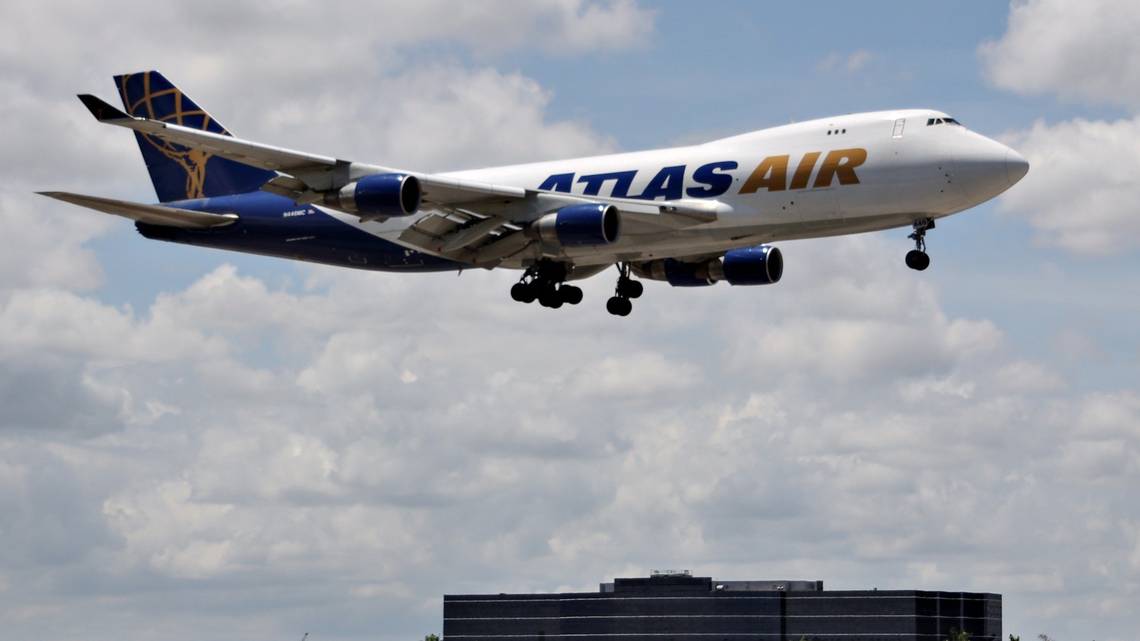

Nearly one year after Miami International Airport’s largest cargo airline Atlas Air crashed a plane killing three pilots, two top directors of the company’s training program in Miami suddenly retired this week.
Fleet captain Joe Diedrich and training director Scott Anderson abruptly left the company Tuesday. An internal email titled “Miami Training Center: Organizational Update” from senior vice president Jeff Carlson announced their departures as retirements. The shakeup comes as the National Transportation Safety Board’s final report about the fatal Feb. 23, 2019, crash is pending and the company reported a deep earnings loss for 2019.
The Atlas Air Flight 3591 crash happened as Diedrich was head of the Boeing 767 training program and Anderson was overseeing procedures, training and standards for the entire airline.
After departing Miami, the plane full of Amazon shipments suddenly increased in power and pitched upward about 40 miles outside Houston, likely in reaction to an activation of the go-around switches. Thirty seconds later, the plane nosedived 6,000 feet down into Trinity Bay, killing three people: captain Ricky Blakely, 60, of Indiana; first officer Conrad Jules Aska, 44, of Miami; and Mesa Air pilot Sean Archuleta, 36, of Texas, who was riding as a passenger on the flight.
Government crash investigators released a trove of documents in December showing that Blakely failed his proficiency test on the Boeing 767 in 2015 and was placed in a monitoring program “as a result of [his] repetitive need for additional training.” Blakely was removed from the monitoring program in February 2017. The documents also show that Atlas hired Aska despite his repeated training failures at other airlines.
“If I had that information at the time we would not have offered him a position,” Anderson told investigators about Aska. At the time of the crash, Blakely had worked for Atlas since September 2015 and had 11,000 hours of flying time, 1,250 hours on the 767. Aska had worked for Atlas since July 2017 and had 5,000 hours of flying time, 520 hours on the 767.
Atlas Air did not respond to requests for comment about the training directors’ retirements.
A Miami Herald investigation found that pilots for Atlas Air repeatedly warned company executives in the years leading up to the 2019 crash that if they did not bolster the training program and hire pilots with more experience, a plane was going to crash. At a meeting with executives in Miami in 2017, a pilot who had been with the company for two decades described an “erosion of level of experience in the cockpit.”
Carlson, the senior vice president for flight operations, agreed with the captain’s assessment. “I worry about quotas on the flight deck,” he said, according to the recording obtained by the Miami Herald. “I’m not oblivious to any of that. … We know experience level decreases over time. That’s a challenge for this group. … Regardless of the experience, the bar never changes. And I just want to make sure that sticks in the back of your mind.”
Since the crash, former CEO of the company William Flynn stepped down, and chief operating officer John Dietrich ascended to the role in January. On Wednesday, one day after the training directors’ departures, Dietrich announced a $293.1 million net loss for Atlas Air in 2019 and said the company has taken five of its Boeing 747 planes out of service due to a “softer market.” In 2018, the company reported a profit of $270.6 million.
Atlas Air Worldwide Holdings, formed in 2001, is the parent company of four cargo airlines — Atlas Air, Polar Air, Southern Air and Titan Aviation Leasing. Since 2010, the company’s fleet has grown from 29 planes to 123, boosted by contracts with Amazon and the U.S. Department of Defense.
In its interim report on the crash released in December, the NTSB found that total average flying time for new hires at Atlas Air and Southern Air dropped to around 5,600 hours in 2018, compared to 7,303 hours in 2015. Two-thirds of pilots have been with the company for less than five years. The FAA requires that new hires have at least 1,500 hours.
Taylor Dolven is a business journalist who has covered the tourism industry at the Miami Herald since 2018. Her reporting has uncovered environmental violations of cruise companies, the impact of vacation rentals on affordable housing supply, safety concerns among pilots at MIA’s largest cargo airline and the hotel industry’s efforts to delay a law meant to protect workers from sexual harassment.
Recent Comments