


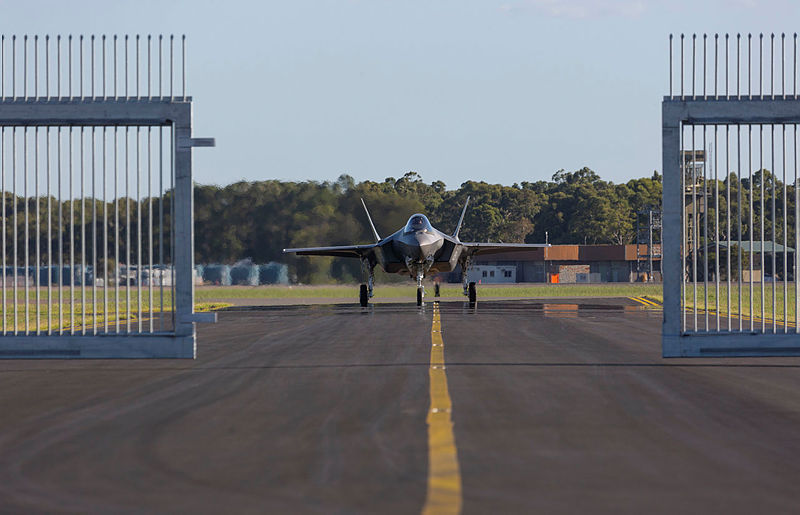
At the November 2019 supplementary Senate estimates hearing for the Department of Defence, much was made of the number of jobs created among Australia-based companies through their participation in the joint strike fighter (JSF) global supply chain program. Participation involves companies providing sophisticated components and support services for JSF aircraft sold worldwide—not just JSFs purchased by Australia.
Defence testified at the hearing that ‘currently 50 companies are sharing $1.69 billion, and certainly we’re on track to achieve our $2 billion by 2023’. The testimony went on to indicate that the program was ‘tracking to 5,000 jobs’ and that Defence had ‘great fidelity on 5,000 jobs and $2 billion of new business’. Are those claims all they seem?
Drawing on Australian Bureau of Statistics data, I estimate that for every $1 million of sales under the program around six jobs are likely to be supported each year from production—around four production jobs among program participants (‘direct jobs’) and two production jobs along the domestic supply chain supporting those companies (‘indirect jobs’).
Using that data and annual sales figures drawn from an economic impact study of the program commissioned by Defence in 2017, the table below provides a set of broadly indicative employment outcomes. Annual averages provide the most reliable guide due to the considerable volatility in program activity.
The table indicates that 2023 is a period of peak employment for JSF-related production. Nonetheless, even during that year, production job numbers are well below 2,000. Most importantly, the number of production jobs tends to be less than 1,000 when measured on an annual average basis.
Estimated sales and jobs from the JSF program, Australia, 2006–2038
| Annual | Cumulative | Annual average | |||
| 2023 | 2006–2023 | 2006–2023 | 2024–2038 | 2006–2038 | |
| Sales (A$ million)* | 293 | 2,667** | 148 | 174 | 160 |
| Production jobs | |||||
| Direct jobs (multiplier = 4) | 1,172 | 10,668 | 592 | 696 | 640 |
| Indirect jobs (multiplier = 2) | 586 | 5,334 | 296 | 348 | 320 |
| Total production jobs (multiplier = 6) |
1,758 | 16,002 | 888 | 1,044 | 960 |
* Figures taken from PricewaterhouseCoopers, Economic impact of Australian industry participation in the Joint Strike Fighter program, report prepared for the Department of Defence, 2017, 19.
** Defence’s testimony indicated a sales figure of $2 billion by 2023. However, it did not specify the currency in which that figure was expressed. The figure corresponds to a (cumulative) amount of US$2 billion by 2023 in the economic impact study. Given that ABS-based multipliers are based on Australian dollars, sales figures must be based on the same currency. US$2 billion converts to around A$2.7 billion.
Based on these estimates, at no time during the program does the number of jobs associated with producing inputs for the JSF program approach 5,000. So, what is Defence’s figure of 5,000 jobs measuring? Only the department can provide the answer. However, two potential explanations could help narrow the possibilities.
The figure might have been drawn from the economic impact study whose estimate of 5,000 jobs relates to employment during—not up to and including—2023, across the economy after considering the program’s economic benefits and costs. That is, the figure measures net employment nationally in a single year. The importance of including economic benefits and costs in any final analysis of employment has been emphasised by the ABS and by the Productivity Commission.
If Defence drew its jobs estimate from the study, the department’s testimony in November attempted to link a cumulative sales figure ($2.7 billion) to an annual jobs figure (5,000). That’s not an ‘apples with apples’ comparison. Moreover, a net employment figure of 5,000, coupled with the study’s figure of $293 million for sales during 2023, yields a net employment multiplier of 17.1. That multiplier has already been noted for being extraordinarily high and is difficult to reconcile with more recent modelling of the program’s economic impact.
A figure of 17.1 is close to three times the multiplier for JSF production—suggesting that, even after economic costs have been considered, almost twice as many jobs are created outside the program as within. But the idea that program participants have been able to leverage their experience with the JSF to generate new business outside the program on that scale is untested. Adding jobs in net terms is more difficult than it appears, because as new business increases its employment effects are partially offset by an increase in economic costs.
An alternative explanation for Defence’s employment figure of 5,000 is that it represents net job creation between 2006 and 2023 measured on a cumulative basis. That would mean the department’s sales and jobs figures are compatible because they’re both cumulative. But two issues emerge.
First, the program’s employment multiplier would be 1.85. That delivers 274 net jobs nationally on an annual average basis for the program’s first 17 years of operation—888 jobs in production for the JSF and 614 jobs lost to the broader economy due to the program’s economic costs. Under that scenario, at peak production during 2023, the number of jobs created nationally in net terms is 542—1,758 jobs in JSF production and 1,216 jobs lost elsewhere.
Second, due to its obviously limited explanatory value, cumulative employment has not been used elsewhere by Defence or by others (see, for example, here, here and here) when measuring or reporting the economic impacts of the department’s major capital equipment projects, including projects for building submarines, frigates, minehunters and military vehicles. Not even a leading company involved in facilitating Australian industry participation in the JSF program has used cumulative figures to publicise its extended contribution to job creation.
At the same hearing last November where Defence presented its JSF jobs data, the department eschewed cumulative numbers when discussing jobs for naval shipbuilding. I’ll examine that issue in part 2 of this series.
Recent Comments