


February 24th, 2020 by Steve Hanley
There is a bumper sticker you may see from time to time that says, “If you own it, a truck brought it.” When we think of shipping, we tend to think of huge ocean-going cargo ships and freight trains 100 cars long. Both certainly play a part in global commerce, but trucks bring goods to those ships and freight trains and when they get where they are gong, trucks transport those goods to distribution centers, retail outlets, and to local homes and businesses.
Many retail goods sold in America are made in other countries. They arrive in a US port like San Diego, Los Angeles, or Long Beach in shipping containers. Those containers are then hauled a few miles away to large distribution hubs where they are consigned to be delivered to one of the more than 400,000 distribution hubs across America. From there they go to retailers like Walmart or directly to end users.
The process involves many low speed yard trucks that shuttle the containers around so they can be hitched to the road-going tractors that will haul them to distribution centers around the country. Tens of millions of containers get sorted and repositioned every year, which means a yard truck — frequently known as a donkey — has to hook up, move a container, then unhitch and start the process all over again tens of millions of times. In the vast majority of cases, those donkeys are powered by diesel engines that spew out large amounts of particulate emissions along with carbon dioxide and nitrogen compounds as they perform their routine chores.
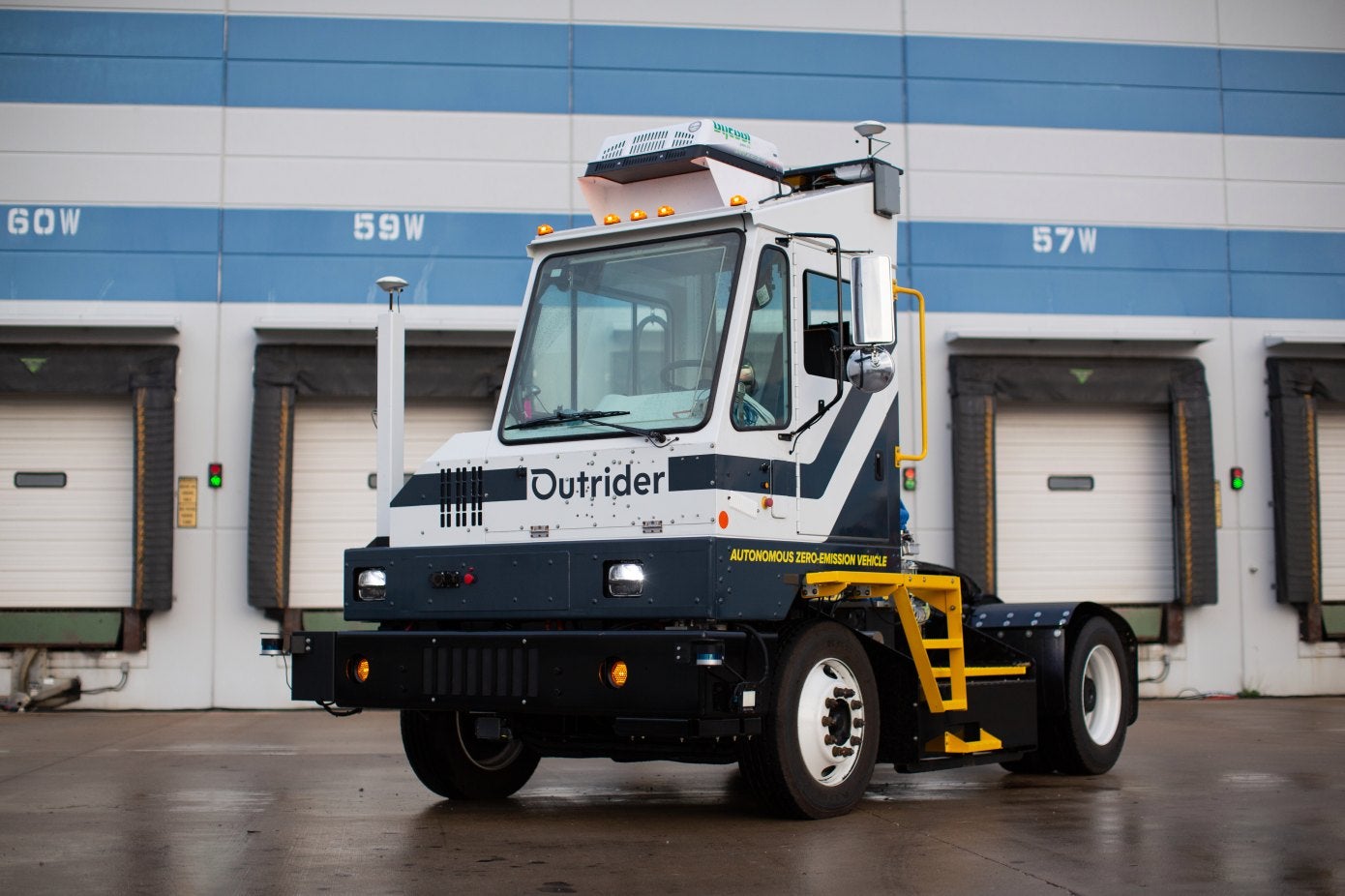
Image credit: Outrider
Outrider, a startup based in Golden, Colorado, wants to change that. CEO Andrew Smith tells TechCrunch that distribution yards are ideal environments for autonomous technology because they are well defined areas. They are also complex, chaotic, and involve many manual tasks like hooking up electric lines and compressed air hoses.
“In the United States, there’s over 10 billion tons of freight being moved by trucks on an annual basis. And a majority of that passes through distribution yards,” Smith tells Fleet Owner. “Distribution yards are those transmission points between those over the road operations and the factories, warehouses and rail yards that are moving or repackaging freight. The goals of these yards are to keep freight moving as quickly as possible to and from the road. And the problem is that the majority of these yard operations are almost entirely manual and inefficient. And it’s been that way for decades. This is why a systems approach is necessary to automate every major task in the yard,” he says.
Using a full suite of radar and lidar sensors coupled with cameras, its electric yard trucks can move trailers around a freight yard as well as to and from loading docks. The system can also hitch and unhitch trailers, connect and disconnect trailer brake lines, and monitor trailer locations.
The company has just completed a $53 million funding round and has two pilot programs underway with Georgia Pacific and four Fortune 200 companies. At present, the Outrider trucks are confined to working in designated sections of their distribution yards, but as the company and its customers become comfortable with the technology, their use will expand to include those companies’ entire logistical operations.
“Because we’re getting people out of these yard environments, where there’s 80,000 pound vehicles, we’re delivering increased efficiency,” Smith says. Not only does the system improve efficiency at distribution centers, it also helps get over-the-road semi trailers back on the road more quickly. Time is money. “We can actually reduce the amount of time the over-the-road guys are stuck sitting at a yard trying to do a pickup or drop-off,” Smith says.
“If there was ever a location for near-term automation and electrification of the supply chain, it’s here,” he adds. “Our customers and suppliers understand there’s a big opportunity for these autonomy systems to accelerate the deployment of 50,000 plus electric trucks in the market because they are a superior platform for automation.”
Efficiency and increased profits are fine, but keeping the pollution from tens of thousands of diesel yard trucks out of the atmosphere is an even better reason why the Outrider system should be adopted by every one of those 400,000 distribution points all across America.
 Follow CleanTechnica on Google News.
It will make you happy & help you live in peace for the rest of your life.

About the Author

Steve Hanley Steve writes about the interface between technology and sustainability from his homes in Florida and Connecticut or anywhere else the Singularity may lead him. You can follow him on Twitter but not on any social media platforms run by evil overlords like Facebook.
Recent Comments