


One reason I find discussions about “the blockchain” and how it might affect collecting information for supply chain traceability projects fascinating is because opinions about the role it will play are pretty polarized.
You either believe a decentralized ledger or database such as blockchain can simplify data verification or you think the current state of pilot-itis is an annoying distraction keeping companies from improving systems already in place. “Let’s get on with it,” I can hear many of you declare in frustration.
Regardless of your position, there’s one thing upon which we can agree: More attention must be paid to how data enters the mix of any supply chain traceability solution. “Garbage in, garbage out” as the saying goes. The good news is there is real innovation happening when it comes to the various sensors and “markers” that could be used for validation — everything from near field communications (NFC) tags to DNA and biome tracers.
Some of those technologies were central to the Organic Cotton Traceability Pilot (PDF), a project backed by several major apparel companies: C&A, Kering, PVH and Zalando. The work was coordinated by Fashion for Good, which encourages experimentations with innovations that could contribute to sustainable production; the field trials were run on farms in India affiliated with Pratibh Synex Ltd.
Emily Franklin, innovation associate at Fashion for Good, said the goal of the pilot (carried out from January 2019 to September) was straightforward: to test the viability of using various data verification across the multiple touchpoints of a complex supply chain. The design used blockchain to keep tabs on the information.
The group chose to test organic cotton because it is one of the most widely used fibers across the fashion industry, and good systems are in place for certifying where it came from, even if the process takes time. Plus, the field conditions involved with harvesting cotton and turning into yarn can be pretty rough — the spinning, chemical treatments, high temperatures and dyeing can take a toll. It stands to reason that if a tracer can handle cotton, it can handle other natural fibers.
The group tested four systems:
- DNA tracers from Haelixa, used to associate the cotton with individual farms; they’re applied manually, by being sprayed on
- NFC forensics tags from IN-Code Technologies, used to collect data at specific points of the process
- An artificial intelligence tool from CoreBiome that helps measure “naturally occurring” biomes more quickly
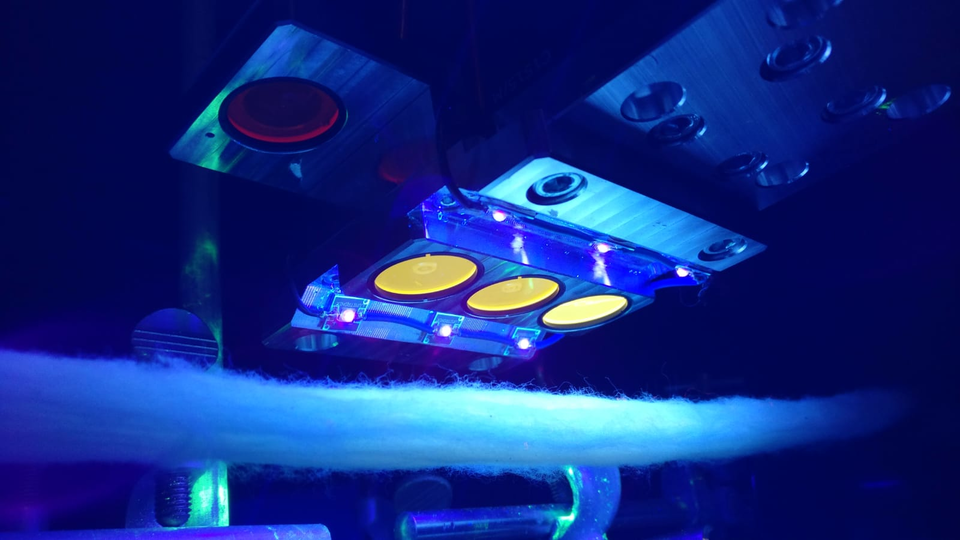
- A technology from Tailorlux that uses fluorescent tracer fibers to create a “fingerprint” that can be blended with the cotton for identification
Bext360, a blockchain technology company that has worked on improving traceability across the coffee supply chain (and other places I can’t mention yet), was the lead technical partner.
By using these markers to validate that a certain shipment of cotton did, indeed, come from a specific farm, companies may be able to comply with organic cotton verifications and audits more quickly. “You could map the geography to the measured biome. Then, you could correlate that with other information, such as the social conditions in that region,” Bext360 CEO Daniel Jones told GreenBiz.
In essence, the tracers could provide more objective proof of sustainable agricultural processes. IN-Code Technologies, which are edible, making them potentially appropriate for food or pharmaceutical applications, fared particularly well in the pilot — they worked farm to farm. Some of the other tracers can only be used for specific steps in the process. “IN-Code hopes that the concrete results of this world-first traceability project leads the amazing brands involved to fund a full market program to develop the first farm-to-retail traceability global program in organic cotton,” the company’s CEO, Joe Tilley, told me via email.
Apparel company Kering, which owns the Gucci and Stella McCartney brands, among others, sought to understand the roles different tracers can play. For example, the CoreBiome technology could be used to conduct spot checks of shipments while NFC tags could be capable of collecting real-time information along the way.
“One of the main positive takeaways was that the technologies do work through some various harsh processes,” said Christine Goulay, senior manager for sustainable innovation with Kering.
One of the company’s commitments is to provide 100 percent traceability for all of its key raw materials, including cotton, cashmere, silk and the livestock for wool and leather, by 2025, Goulay noted. This is actually Kering’s second publicly discussed initiative involving tracers: It also has allied with New Zealand company Oritain and supplier Supima that is focused on verifying the provenance of 100 percent organic cotton.
What’s next? Look for another partner in the project, the Organic Cotton Accelerator, to seek ways that this sort of approach might be scaled on behalf of the industry.
Meanwhile, Fashion for Good plans to turn a demonstration of the various verification technologies into an exhibit at its museum in Amsterdam, visited by more than 100 people daily. “The more consumers know, the better equipped they are to change the industry,” Franklin said.
This article first appeared in GreenBiz’s weekly newsletter, VERGE Weekly, running Wednesdays. Subscribe here. Follow me on Twitter:@greentechlady.
Recent Comments