

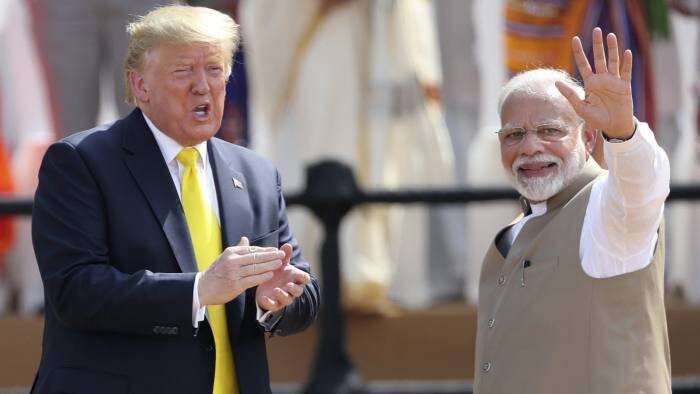

U.S. President Donald J. Trump trip to India on February 24 for a two-day visit, came amid protests in New Delhi against the controversial Citizenship Amendment Act which left 38 dead and many more wounded.
Trump’s visit also comes during the time of explosive tensions between the U.S. and Iran, the first-ever trilateral naval exercise between Iran, Russia, and China, explosions and seizures of tankers in the Persian Gulf which is known as one of the world’s most important choke-point of global oil supplies. Accounting for a third of the world’s sea-borne oil (and a fifth of the world’s total oil exports), the strait links to oil and gas producers in the Middle East with consumers around the globe, including those in Europe, Asia and America.
To make things worse are the rampant attacks by Yemeni Houthis on Saudi Arabia, one of which hit Aramco’s largest oil processing site, knocking out 50 percent of the country’s oil production.
Getting back to Trump’s India visit: U.S. elections are slated for November. The four million affluent Indian-American community has traditionally leaned towards the Democratic party. Some say Trump’s relationship with Indian Prime Minister Narendra D. Modi has already helped boost his standing among Indian-Americans.
Washington is wary of the emergence of China to the world stage, rise of Russia again as a major global power and the Islamic Republic’s influence in the region. Trump is seeking an alliance with India in order to counter the rising powers.
Due to the scope of this article, my focus will be on China. China is under political and economic pressure amid Hong Kong protests and the trade wars with U.S. and coronavirus outbreak.
India and China share a 4024-km (2,500-mile) border. China is the main supporter of Pakistan. Guadar Port is a deep sea port on the Arabian Sea at Gwadar in Balochistan province of Pakistan. It is located just 600 kilometers from the Strait of Hormuz. The port was made possible only after China lobbied for it because of its growing interest for landlocked Afghanistan and the region.
On January 14, Gwadar port officially started taking cargo under the Afghanistan-Pakistan Transit Trade Agreement (APTTA). However, the port is far from being operational.
Gwadar port lies 172.2 kilometers (107 miles/92.98 nautical miles) to the west of Chabahar Port. To counter China’s influence in the region the development of the Chabahar Port got a waiver from Trump’s “Maximum Pressure” sanctions on Iran.
During an interview with the Tehran Times in 2017, the former Indian Ambassador Saurabh Kumar pointed that Chabahar Port is an important part of North-South Transport Corridor (NSTC), the multi-model sea, rail road route to move freight between India, Russia, Iran, Europe, the Caucasus, and Central Asia will benefit India and Iran economically. He added that “the private sector will be major Indian investor and it needs a lot more exposure to Chabahar and the facilities there.”
On February 2, India allocated $14 million to Chabahar port, report the Financial Tribune. Last year India opened a special account on its annual budget for Chabahar Port and allocated $22.5 million for the development of the port. In May 2016 Indian government agreed to equip two terminals at the port with equipment worth $85 million. India’s EXIM bank has also promised $150m credit for the development of phase 1 of the port.
Chabahar is considered as India’s answer to China’s One Belt One Road policy under which it is developing via Gwadar port in Pakistan. Worth mentioning is that the Islamic Republic has cordial ties with all the above-mentioned countries.
Due to anxieties about Beijing’s intentions and its alliance with Iran and Russia, Washington has steadily deepened security and defense ties with New Delhi. In the past decade India and America have started an annual foreign and defense ministers’ dialogue, upgraded a trilateral relation with Japan and revived quadrilateral dialogue that includes Australia.
Economic agenda
Trump’s visit comes at a turbulent time for India, Asia’s third largest economy. The country is battling a severe economic slowdown. Growth has tumbled for six consecutive quarters to a six-year low of 4.5 percent. The recent outbreak of coronavirus will impact recovery negatively.
India has the largest number of Trump towers outside North America, but the sales are cool in an ailing market for luxury real estate.
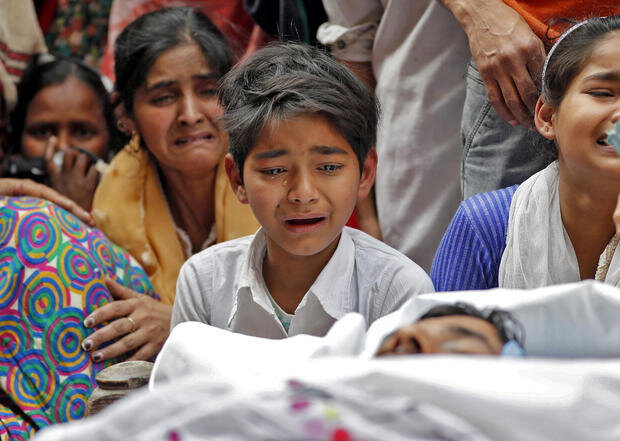
People mourn next to the body of Muddasir Khan, who was fatally wounded Tuesday in a clash between people demonstrating for and against a new citizenship law, in New Delhi, India, February 27, 2020. (Photo: Adnan Abidi / Reuters)
Trump’s visit did not come amid intentions of signing bilateral trade deals. The U.S. Trade Representative Robert Lighthizer cancelled a planned trip to India this month, reports Financial Times. Lighthizer had earlier dropped out of a visit for negotiations with Indian Commerce Minister Piyush Goyal.
Last May Trump stripped India of Special Trade Status that exempted billions of dollars of its products from American tariffs, part of a deepening clash with India’s projections for its markets. The measure hit some Indian exports and products like textiles, jewelry, auto parts and agricultural products.
However, India signed a deal on Tuesday to buy $3.5 billion arms deal, which would see the sale of 24 Sikorsky MH-60R Sea Hawk multi-role helicopters for the Indian Navy and six Boeing AH-64E Apache Guardian attack helicopters for the Indian Army. The Arms deal came through as Washington seeks a counterweight to China. While making the announcement Trump urged India to look at the U.S. as its “premier defense partner”.
Energy deal
Today U.S. has become world’s largest crude producer. In 1917 India bought 1.9m tons (38,000 bpd) of crude from the U.S. The Business Standard of India quoted the U.S. Energy Secretary Dan Brokvillette on Tuesday that India’s sixth-largest oil supplier is now the U.S. Indian imports of U.S. oil jumped 10 fold to 250,000 bpd in the last few years said
In the first six months of the current fiscal year (2019-20) U.S. supplied 5.4m tons of crude to India.
Obviously during his trip to India Trump did not forget his energy secretary.
Iraq is India’s top crude exporter, supplying one-fourth of India’s needs at 26m tons from April to September. Saudi Arabia has traditionally been India’s top oil source but has been relegated to second spot, exporting 20.7m tons in first six months of fiscal year.
Nationalist agenda
The leaders of the world’s two largest democracies should exemplify the virtues of democracy and respect for universal right, yet Trump and Modi are pursuing dangerous, a nationalist versions at odds with their countries’ founding values.
Trump and Modi have been known to be good friends. After all, they must have something in common.
When Trump came to power in 2016 he clearly manifested his nationalist far right supremacist agenda. Trump implemented a travel ban targeted at Muslim countries, ripped away children of migrants from their parents, defended white supremacists who attacked a crowd at a rally in Charlottesville, regularly demonizes immigrants and told members of the U.S. Congress (all of whom are Americans) to “go back” to their countries just because they are not white.
Since being re-elected to a second term in 2019, Modi has brazenly embraced an agenda that discriminates against Muslims and minorities. India has been at boiling point since December, when Modi’s government enacted the controversial Citizenship Amendment Act, making millions, mainly Muslims, stateless. The act lays out a fast-track path to citizenship for followers of all South Asia’s major faith – except Islam – from neighboring three countries.
Trump’s first visit to India coincided with four days of protests against CAA in New Delhi. At least 38 people were killed and over 200 injured in the sectarian riots not seen in decades.
Last August, Modi terminated the enshrined autonomy of Jammu and Kashmir, India’s only Muslim-majority state, implemented the longest communications blackout in the history of any democracy, and detained political leaders there for months without charge.
Pramila Jayapal, an Indian-American congresswoman from Seattle, is pushing a bipartisan resolution urging New Delhi to restore Kashmir’s internet services and free hundreds of Kashmiri political and civil society leaders who have been detained without charge since August.
Senator Bernie Sanders, a Democratic presidential candidate, posted on Facebook that “shutting out U.S. lawmakers who are standing up for human rights is what we expect from authoritarian regimes – not from India”.
Recent Comments