

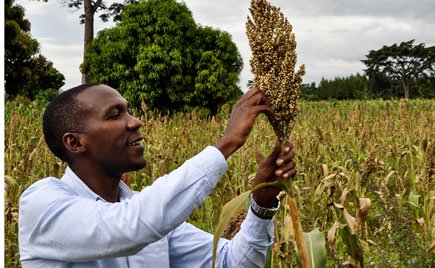

How would you briefly introduce yourself in context of your role at Uganda Breweries Limited (UBL)?
My name is Joseph Kawuki. I work with UBL, leading the agriculture team, which oversees working with communities that grow locally sourced brewing raw materials.
We have an arrangement with government in which we use locally resourced materials and pay less excise duty tax. It is in the spirit of encouraging local sourcing of materials. Capital flight reduction is another benefit to the economy. When you are buying materials across the border, it means you are losing money to another economy yet if you source locally the money will revolve within the economy.
When and how did Uganda Breweries start working with farmers?
For now, we will concentrate on UBL’s story of working with farmers from the 1980s. UBL began working with farmers on a barley growing programme that was initiated in 1987 mainly due to the need to save on limited forex on malt imports.
Here was a new regime and limited forex in circulation to import raw materials, especially from Europe. The alternative was to grow material locally, with major focus on barley growing on the slopes of Mt Elgon. The project was closed in 1997 following the liberalisation of the economy in mid-1990s where raw material importation became cheaper than local generation amid other challenges.
In 2006, the local raw materials agenda was re-ignited under a Private Public Partnership where brews made from 75 per cent locally grown raw materials by weight attracted a tax incentive in a tax rebate arrangement. This followed a 2003 Ministry of Finance, Planning and Economic Development (MFPED) finance Bill that introduced the excise duty incentive.
UBL re-introduced barley cultivation agenda on the northern slopes of Mt Elgon in Kapchorwa (which gave birth to new other districts of Bukwo and Kween). UBL also extended to Kigezi highlands, slopes of the Rwenzoris, the highlands of Zombo (then Nebbi) in West Nile and Agoro hills in Lamwo/Kitgum. Today, the local raw material agenda has expanded to other crops including sorghum, maize, cassava, sugarcane, at some point rice, working with farmers across the entire Uganda.
Please give us a sense of growth in terms of how many farmers you started out with to the current number.
In the beginning, UBL worked with about 250 barley growing households in the highlands where we grow winter barley varieties.
The required volumes at the time were low. As the local raw material demand grew, we expanded the acreage and today we are working with more than 50,000 registered households. As the demand for LRM grows, UBL will continue to explore available expansion opportunities and working with more and more households in the farming communities.
About how many farmers have you engaged for the raw material project and how has the tax levied on beer affected your business chain?
A tax increase has hugely affected demand on beers subsequently affecting UBL’s cassava consumption. The monthly consumption of more than 350 tonnes of cassava flour has dwindled to 25.
When the volumes go down, it means laying off quite a sizeable number of households we work with. The tax hike is not only affecting cassava but to a large extent sorghum. UBL is consuming only half what had been anticipated. That alone translates to numbers of households and farmers left out of the value chains.
In the beginning, the tax incentive encouraged more local value development as it was more lucrative. The beers were more affordable. With the dwindling tax benefit, the beer consumption price has gone up which affects demand. This affects local raw material demand and households we work with.
Under what arrangement does UBL work with farmers and how does it ensure quality parameters are met and respected?
Production targets are set. The brewing team then determines the volumes of raw materials required for agriculture team to engage farming communities.
That is translated to the required acreage and planting material for sorghum, barley, corn and cassava. Poachers and alternative users of our local raw material lines are considered the agricultural operations preparations. The UBL agriculture team and partners then undertake the task of mobilising and sensitising growers and farming communities.
The required agro inputs are then determined and availed to farmers which include seed, fertilisers and agrochemicals, and agri-machinery among others. Where UBL needs support, they link farmers to agri-input partnering companies. Continuous visits and trainings are conducted from planting through crop management to harvesting, post-harvest handling and delivery of the crop to the buying points.
Sensitisation on quality parameters and how-to achieve them is very key and highlighted at all points in value chain engagements. Small scale farmers are linked with aggregators who deliver the harvest to UBL. Where UBL deploys third party actors in the value chain, a follow up is made to ensure growers are paid and on time to help keep them motivated.
As a professional who continuously interacts with farmers, what has been the benefit in this mutual arrangement with them and communities within which they hail?
A lot. UBL consumes materials worth between Shs40b and Shs50b. More than 80 per cent of that money directly goes back to the farming communities. This money has done a lot and touched lives in the farming communities:
• New and better accommodation has been realised.
• Improved transport through acquisition of bicycles, motorcycles, cars, etc.
• Improved access to medical services, etc.
That is on top of our corporate social responsibility (CSR) activities such as tree planting, sinking boreholes and a scholarship programme under which we support children in vocational institutes. There is a scholarship scheme of 30 students per year to the farming communities.
Is there anything you would like government to act on, as a partner?
The tax arrangement that the brewing industry previously enjoyed to promote local production and value is dwindling. This affects the demand for local beer and in tandem affects the relationship with farmers. In return, it affects the local household economy.
Favourable tax regimes foster better returns and bigger budgets for local companies to involve more in sports development, community wellness campaigns such as responsible drinking, tree planting, etc. At some point, the brewing companies had football clubs in the elite league but have since pulled out due to tighter budget.
Location
Expound about the tree planting initiative, on where it has been rolled out?
UBL has carried out tree planting in areas of Mpigi and Butambala, among others. Recently we organised a successful run to Gulu dubbed ‘We are running out of trees’. We have been involved in Kapchorwa before.
Recent Comments