

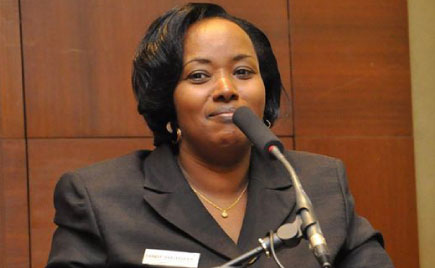

At the 2015 Great Lakes regional awards, Jennifer Mwijukye, the founder of Unifreight, was named the most influential woman CEO in the logistics and shipping industry.
The 2016 MTN Women in Business Awards added their voice on her growing stature honouring her as the keynote speaker to challenge women in business to “up their game”.
As a champion of change in the industry, Mwijukye explains how she built her empire that extends to Kenya through dedication and hard work.
Her story
Until 1994, Mwijukye was a purchasing assistant at British American Tobacco (BAT) as a purchasing assistant.
She worked with BAT for five years after graduating from the National College of Business Studies, Nakawa (current MUBS) from 1989-1994.
Afterwards she joined Urgent Cargo Handling. This is when dots connected. At BAT she was involved so much into client service provider basis and she got to know all about clearing and forwarding. The prior knowledge at BAT gave her an edge during the job interview where she was recruited as a customer service supervisor.
After two years, she spotted an opportunity to start her own business.
“I started with one of my clients who saw potential in me to be a businesswoman that I didn’t know,” Mwijukye recalls. Zak Fontana, the owner of Fontana Auto Parts, encouraged her to start business.
In 1996, she opened doors to Unifreight to do customs clearing with a partner who left in 2002. At the time she was interested in doing airfreight which she thinks was her biggest advantage.
“I think I was good at coordinating airfreight. There was little sea freight at the time until 1995 when the Nairobi offices diversified into trucking,” she adds.
Work started with two clients and towards the end of 1998 the company started attracting the attention of corporate companies like Celtel and Coca-Cola, who came on board. By the year end, she got a contract with her former employers, BAT.
“That was for me a landmark and a highlight of my confidence because when I was leaving BAT I promised them that I would return in another form. It felt good leaving as an employee and returning as a service provider.”
“In 2000, as a response to the clients’ demands, we started sea freight.”
“When we diversified into truck, we had to bring in other partners. We invited my husband, Robert Mwijukye, who was at the time working with SGS and he invested in trucks and we became a related business entity,” she says. Robert manages the trucking business but strategically they offer services as a group and occupy the same office space at Banda, on Kampala-Jinja Highway.
In 2000, she launched the company’s first business plan, four years since she had started doing business.
“That is something I always encourage entrepreneurs to do. An entrepreneur hits the road and it is along the way that you start asking how it is done. Most of the time when you do a business plan, you end up not implementing it. People are always scared but funders don’t fund start-ups as they prefer ongoing entities.
Mwijukye started with $1,500 ( Shs5.5m)from her husband and she says the mystery of capital should not tie anyone down.
“The relationship with potential customers is the secret to starting a business,” Mwijukye says. “There are customers willing to support you even when you don’t have a single penny. What matters most is the uniqueness of your idea and the clientele. I personally had clients willing to invest their money to help me start,” she says.
She adds that service-based businesses require less capital with the most important idea being client relationships.”
The industry she enterd at 30
At 30 years, Mwijukye entered the logistics industry which she describes as being disorganised at the time full of mafia and various uncertainties.
“Not many agents cared about quality service. They preferred to make it a game of lies. Clients would still come back because there were no choices. That is something I wanted to change by being professional and making customers happy,”
She only employed one employee, a typist. But she did the clearing including being the cargo driver.
“When you are young, you don’t fear any risks. But now I calculate the risks. I was just excited to be doing my own business.”
Mwijukye opens up about how difficult it was to be taken seriously in the industry as a young woman.
“People used to laugh at me when I got into my pick-up to deliver cargo. I would only just look at them and laugh because I knew I was excited to make clients happy,” she adds.
She first advertised her business 10 years later in 2006 but she thinks she had had established a line of happy clients all along. Most of her clients were got through referrals of happy customers,”
“From 1998 we were making profits from the three clients she had on board, Celtel, BAT and Coca-Cola.
“I never think of myself as a woman. I feel that we need to build relations and that does not mean you are a man or woman. Then fulfilling commitments.
This is something she inherited from her childhood. She recalls her late father, an honest cattle keeper, who died in 2009, as the role model for his entrepreneurial ideas.
She is training her children in logistics and she is happy her legacy will continue.
Concern for the future
Mwijukye is concerned with the regulatory issues, saying that the government is taking logistics industry lightly.
“Uganda being a land linked country, there is a huge opportunity for logistics. Logistics could turn around our economy in terms of GDP contribution more than manufacturing,” she explains.
She thinks making Uganda a distribution hub would be paramount to the growth of the industry.
“We need government to have a vision for the industry with supportive regulations.”
Ever since 2007 when South Sudan businesses boomed, the amount of goods for that market show a great opportunity. She estimates that about three quarters of the goods stored in warehouses is meant for the DR Congo and South Sudan markets.
Countries like Dubai, Singapore, Netherlands and their economies are mainly run by logistics and it shows how much you can gain when you have a hub.
Attitude towards work from the Ugandan employees remains a big challenge for her as a businesswoman because of inadequate training in terms of logistics.
“If you close your eyes, you will lose your business. You have to keep reminding them of their responsibility,” she says.
She employs 76 people including those at the terminal as a KPA outsourced company at Mombasa Port.
Passion for environment
Mwijukye explains that when a business grows, it must be re-aligned to meet the needs of the community. When the company rebranded in 2016, she wanted to focus on the relevance of her business to the community.
“We want to become the first choice and trusted partner in solving logistics problems. That means that being trusted partners involves all stakeholders. Our values demand us to engage in environmental conservation. We are demonstrating that we are responsible business people. We are responsible for the environment we live in to be relevant to our communities,” she says.
Unifreight is involved in conservation activities after defining themselves as eco-logistics company that promotes a clean environment. In 2016, the company was involved in fruit tree planting at Uweso Masulita Children’s Village. Then in December last year, Unifreight donated 1,500 eucalyptus seedlings to Air Serve Foundation, where each child is offered 100 seedlings which in turn will be used as a source of income for their school fees needs.
She has requests at the Rotary Club, Lions International and several clubs who are involved in conservation but many are yet to commit.
The company is involved with the Ministry of Water and Environment in designing a long-term strategy of tree planting partnership.
“I hate to be moving and see people throwing bottles. If all of us were responsible for our environment, there would be a big difference. The problem is that we are not sensitised enough to know our responsibility towards the environment.
Who is she?
Mwijukye describes herself as an entrepreneur and business leader who also founded the Uganda Freight Forwarders Association (UFFA from which she retired as chairman in 2017.
Mwijukye’s quick hits
What time do you get up in the morning?
That is if I sleep. 2am is once in a while. I normally wake up at around 4am and then I start doing my work by sending my employees messages about tasks that are on my head. That is the time I look at their e-mails and offer guidance. I also offer my devotions to motivate myself spiritually.
How do you unwind in the evening?
(Long laughter) I love talking to people but of recent I think I find the people in my networks I used to share the social life have moved away. I am still repositioning myself. But I would have loved to spend that time mentoring people in business. I am trying to identify partners who have young people who wish to be mentored on business. That would be my best time if I got that engagement.
What was your first job?
When I was working with BAT, I was involved in purchasing as a purchasing assistant but I dealt with importation, especially preparation of documents and following up consignments. BAT imported everything they used apart from tobacco and it was a busy place to start your journey.
What did you always want to be while growing up?
I did not know that I would end up as a businesswoman. I grew up dreaming of working in UN bodies like World Bank or IMF or any international jobs. Those were my aspirations. But when I was growing up I remembered I had promised my dad that I would be a veterinary doctor. Of course I had wanted to please him because he loved cows. But during my O-Level at Trinity College Nabbingo, I dropped sciences because I did not like them. I am happy, God led me to the right place.
What is your top tip for a new company?
I would tell someone to be very clear of what they want to do and know how to do it differently because there is no area in business that is not occupied. You must be ready to come and compete and know how to compete. It is also important to listen to what your customers are saying and respond properly. Widen your network and look for more opportunities. Be wide open to possibilities and keep existing relationships.
What is the best piece of advice you have ever been given?
By the way I have been looking for a mentor because I have motivated myself this far. I have decided to be self-learning and being alert. I like knowledge because it makes me better. I have been keen to serve and improve myself.
What is the worst piece of advice you have gotten from someone?
Recently I had an exchange with our Mombasa director in terms of our strategy. I think I took his advice I shouldn’t have taken it. We had different approaches to dealing with customers. Our business has brokers and they happen to be clearing agents. My instinct was against working with clearing agents as I preferred working with importers. I would have done better. But because I did not want to impose something on someone who was on ground, I agreed.
What is your motto?
Mine is a philosophy. I believe for a great company you need to develop great people. I like to transfer skills and knowledge into my staff so that even if I am not here, Unifreight would stay in business. In the service industry, always focus on the people.
Recent Comments