

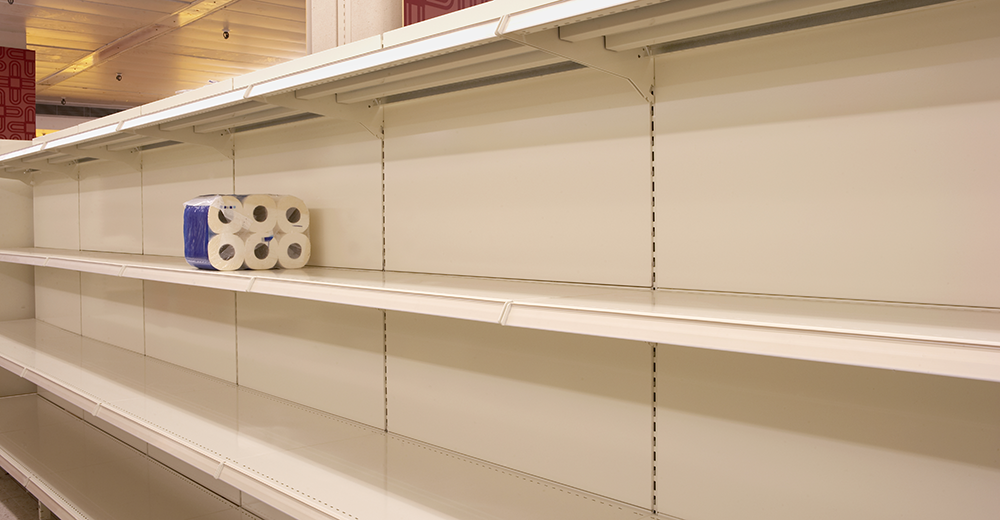

As fears escalate over the global spread of the coronavirus, consumers are scrambling to build “pandemic pantries” of food, health care and other essential products to prepare for potential supply disruptions or the need to stay home.
The weekend saw widespread media reports of shoppers crowding supermarkets and big-box retailers like Costco Wholesale and Walmart and emptying shelves of items such as hand sanitizer, disinfectant wipes and household cleaners as well as dry groceries like rice, pasta and canned foods.
Consumer market researcher Nielsen said Monday that the hoarding of emergency supplies for what’s becoming called “pandemic pantries” began in China and Italy and now appears to have spread to the United States.
“We expect the rush to stock up to have an almost immediate impact on supply chains for manufacturers of the most sought-after goods,” Nielsen stated. “Stocks of hand sanitizers and medical face masks have already dried up in some markets, with no clear indication of when supplies will be replenished.”
What’s more, consumers worldwide have begun planning beyond emergency items, scooping up basic foodstuffs like canned goods, flour, sugar and bottled water, Nielsen reported. That’s also having ripple effect into nonfood essentials, with rising sales of supplements, fruit snacks and first aid kits, for example, in the U.S., the researcher noted.
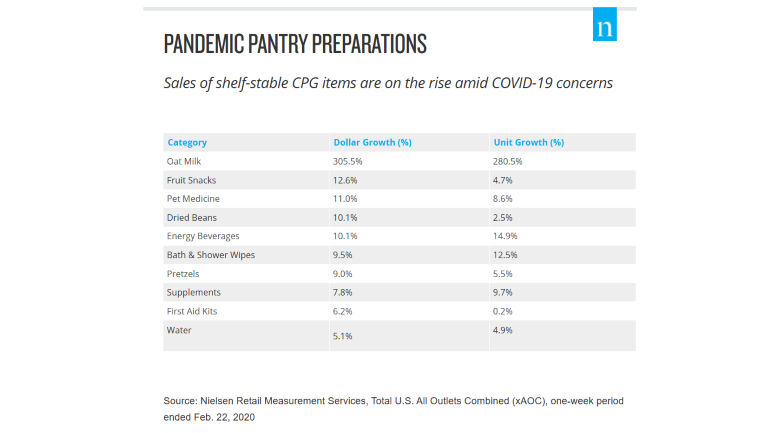
“Beyond health preparedness, U.S. consumers aren’t waiting until it’s too late to stock up on shelf-stable essentials, which parallels what we’ve seen in other regions,” said Nielsen. For example, in Vietnam, 45% of consumers polled said they’ve increased what they’re stocking at home, and 25% are buying more items online. Similarly, in Taiwan, instant noodles have been plucked from shelves and are now difficult to find in stores.
“The U.S. may experience similar trends if recent sales are an indication of what’s to come,” Nielsen added.
As of March 2, the World Health Organization (WHO) reported 89,527 confirmed cases of novel coronavirus (COVID-19) globally, with 90% of the cases in China. Countries with 1,000 or more confirmed cases include South Korea (4,212), Italy (1,689) and Iran (1,501), and overall 67 nations have reported incidence of COVID-19. Worldwide deaths from the virus totaled 3,056, about 96% of which occurred in China. WHO has classified the global risk level for coronavirus as “very high.”
The United States had 16 confirmed cases as of March 2 plus another 27 people who tested positive and confirmation was pending, according to the Centers for Disease Control and Prevention (CDC). States with confirmed or presumed-positive cases include California, Washington, Oregon, Arizona, Illinois, Wisconsin, Massachusetts, New York, Rhode Island and Florida. The CDC said 17 people are currently hospitalized with coronavirus, and two deaths have been reported, both in Washington.
Grocery industry analysts say consumers’ worry about coronavirus will continue to disrupt supply chains and shopper spending behavior at supermarket chains and other mass retailers, though the degree and length of the impact remains unclear. Analyst Kelly Bania of BMO Capital Markets described the coronavirus situation as “rapidly fluid.”
“We see risk for a scenario in which COVID-19 virus significantly alters the food consumption patterns of Americans on a short-term and possibly uncertain timeframe. We also see increasing risk from the emotional impact on consumer confidence/spending patterns, given near correction status on the market,” she wrote in a research note Friday. “Going forward, it will be increasingly difficult for investors and companies alike to discern the underlying cause of these potential shifts and or areas of weakness.”
One likely trend, however, will be a shift from purchases of food away from home to meals made at home, according to Bania.
 “Under a scenario where U.S. consumers retreat from eating out, entertainment activities, traveling, etc., we see foodservice distributors as the most at risk,” she explained in her report. “As much as we think Walmart and Costco are two of our favorite long-term retailers to own, near-term, pure-play food retailers and even retail-distributors could benefit the most under such a scenario, as consumers shift to at-home eating, given supply chain risks for discretionary retailers.” She added that, at its recent investor day even, Walmart noted that China sales have veered toward consumables and delivery, “a scenario that we think could also occur in the U.S.”
Among grocery retailers, supermarkets are likely to feel less of an impact than mass retailers, which have more exposure to supply chain issues in categories beyond food, according to Oppenheimer & Co. analyst Rupesh Parikh.
“As we look at exposure to the coronavirus for our [retail coverage] group, we would generally view the impact as comparatively less than other parts of the U.S. retail backdrop. Our pure-player grocers, the club channel and Dollar General are the least affected. Dollar Tree could be more impacted as the year progresses, to the extent there are more significant supply-chain disruptions given the significant portion of product sourced abroad,” Parikh said in a research note Friday.
“For grocers, we would expect the chains to benefit on a relative basis from a risk off market and potential greater in-home consumption should there be a more widespread impact in the U.S. For a name such as Costco, growth in consumables could help to offset softer demand for more discretionary items and modest negative impacts should supply chains be disrupted in certain categories, such as electronics,” he wrote. “Walmart already called out an adverse impact in its China business. Outside of Walmart, Costco has exposure to Asia, but we wouldn’t expect a material negative impact on the business, as consumables strength could offset softer discretionary spending.”
Indeed, in a report on Monday, Parikh and his team at Oppenheimer highlighted the impact at a local Costco from consumers’ rush to get prepared for coronavirus. Photos in the report showed empty or near-bare pallets of bottled water, toilet paper, paper towels, household disinfectant wipes and sprays, juice, rice, canned and frozen food, vinegar, half and half, and pet food.
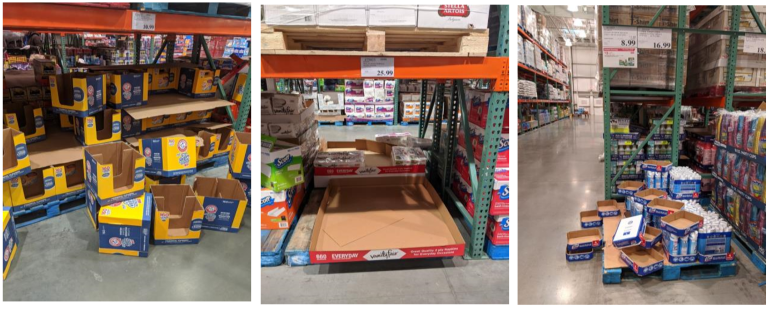
At this Costco in Wayne, N.J., Oppenheimer analyst Rupesh Parikh and his team found a number of depleted grocery product categories as consumers stocked up amid coronavirus concerns. (Photos courtesy of Oppenheimer & Co.).
“Over the weekend, we spent time at the Wayne, N.J., Costco. Consistent with other media reports, we observed significant increases in traffic versus a typical weekend day. Per our conversations with store employees/management, the pickup in traffic started on Thursday and continued at least through Saturday,” Parikh wrote in the note. “The discretionary parts of the store, such as electronics, had minimal traffic.”
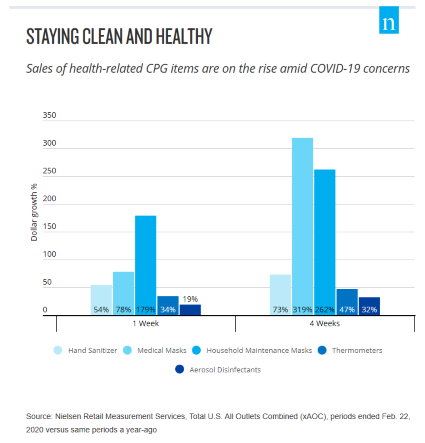
Through the week ended Feb. 22, U.S. dollar sales have jumped year over year for several health-related categories, according to Nielsen. They include hand sanitizer (+54%), medical masks (+78%), household maintenance masks (+179%), thermometers (+34%) and aerosol disinfectants (+19%). The increases are even sharper over the four-week period, the researcher said.
On the pantry side, dollar sales are up for oat milk (+306%), fruit snack pieces (+23.6%), dried beans (+10.1%), bath and shower wipes (+9.5%), pretzels (+9%), dietary supplements (+7.8%) and water (+5.1%) during the week ended Feb. 22. Also seeing growth outside the pantry were multipurpose cleaners (+27.3%), kitchen cleaners (+3.3%) and hand/arm lotion (+1.9%).
Other complementary purchases may include such categories as disposable diapers, baby food, baby needs, sanitary protection, prepared food dry mixes, dry vegetables and grains, deodorant, desserts/gelatins/syrup, breakfast food, and canned/bottled juice and drinks.
Nielsen noted that it’s keeping an eye on how coronavirus might impact purchases of fresh produce.
“As consumers assess their purchasing decisions around what can be stored for long periods and what cannot, there’s little doubt that buying will shift toward shelf-stable and frozen options,” the researcher explained. “In January 2020, produce departments in the U.S. garnered average weekly sales of $1.18 billion. Those sales are clearly at risk in the coming weeks, but ‘pantry produce’ — frozen and shelf stable — could fill the gap if positioned to consumers properly. For example, frozen fruit sales were up 7% in the week ended Feb. 22.”
To help grocery retailers, FMI-The Food Industry Association on Friday released materials and launched a website to help boost industry preparedness.
“FMI understands that a pandemic, if it develops, will necessitate engagement across a host of areas, including health care, store operations, supply chain, food safety, workforce, emergency management and media,” the food industry trade group said in a statement. “We want to make you aware of FMI resources available around crisis planning and the steps we’re taking to ensure the food supply chain is actively engaged with key government agencies.”
Among the resources developed by FMI are a “Coronavirus Preparedness Checklist” and the “Coronavirus and Pandemic Preparedness for the Food Industry” guide. FMI added that it has compiled background information on the website to support planning and communication.
“It’s a fluid time, and retailers are balancing between keeping enough of the most sought-after supplies on their shelves while making contingency plans for longer-term gaps in their product portfolios,” Nielsen said. “Fresh foods, for example, will face challenges as shoppers steer away from anything that may have travelled long distances, such as fruit and vegetables, or may have been exposed to the airborne virus. We also expect products that come off factory lines or go through distribution systems in impacted countries to face challenges.”
Recent Comments