

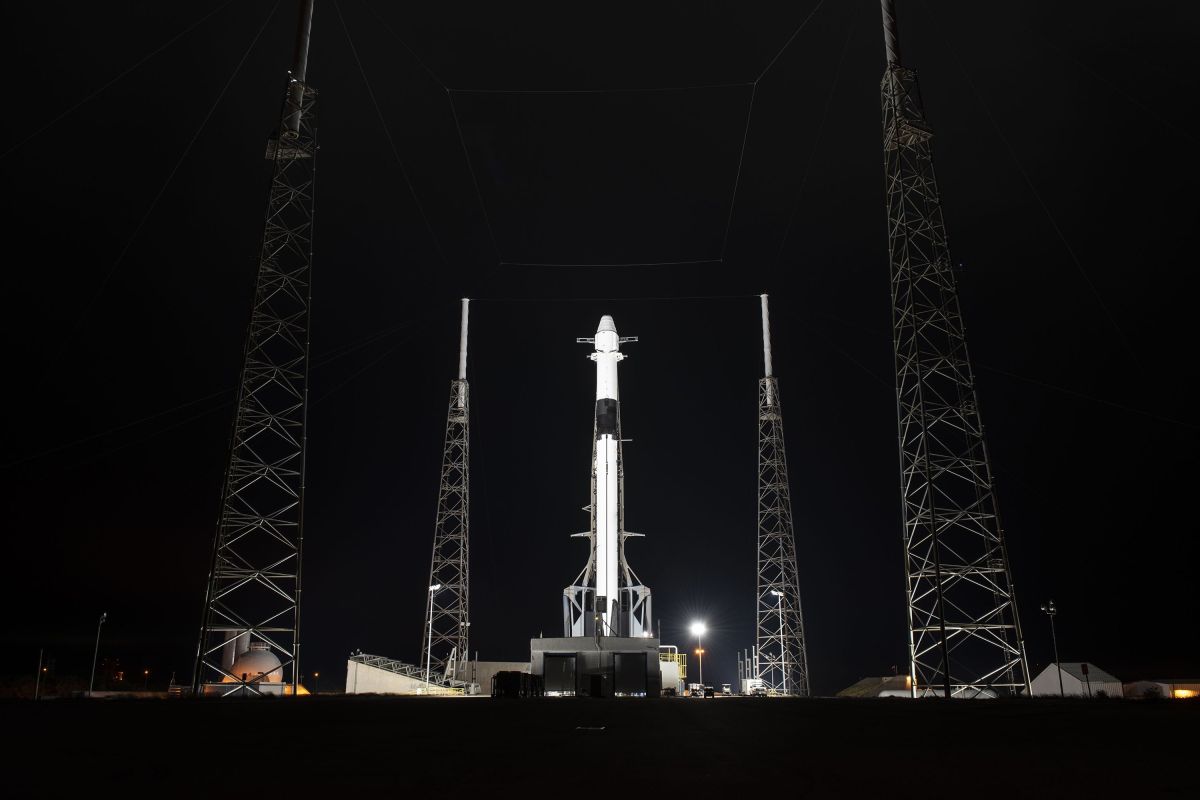

CAPE CANAVERAL, Fla. — SpaceX has fired up the Falcon 9 rocket that will ferry the company’s next cargo resupply mission for NASA into space this week.
SpaceX conducted a static-fire test on Sunday (March 1) of its Falcon 9 booster at Space Launch Complex 40 at Cape Canaveral Air Force Station here ahead of a planned launch on Friday (March 6).
The routine preflight test kicked off the countdown to the final flight of the company’s first version of its Dragon cargo capsule. The spacecraft is bound for the International Space Station, carrying with it more than 5,600 lbs. (2,540 kilograms) of cargo, including research experiments and crew supplies.
Related: See the evolution of SpaceX’s rockets in pictures
Around 11 a.m. EST (1600 GMT) Sunday, the Falcon 9 rocket roared to life, as smoke billowed from its engines during the preflight test. The brief ignition, known as a static-fire test, is a standard part of prelaunch procedures and one of the last major milestones before liftoff.
“Falcon 9 static fire complete — targeting March 6 launch from Pad 40 in Florida for Dragon’s twentieth resupply mission to the Space Station, the final flight of the first version of Dragon,” Spacex wrote in a Twitter update shortly after the successful test-firing.
Falcon 9 static fire test complete — targeting March 6 launch from Pad 40 in Florida for Dragon’s twentieth resupply mission to the @Space_Station, the final flight of the first version of DragonMarch 1, 2020
During the test, the rocket is held down on its pad while its nine first-stage engines are briefly fired. This allows crews to ensure that all systems are working properly and that the rocket is ready to fly. Shortly after the test, SpaceX tweeted that the static-fire test was a success and that the company planned to launch on Friday at 11:50 p.m. EST (0450 GMT on Saturday, March 7).
The flight marks SpaceX’s fifth mission of the year and the 20th operational Dragon resupply mission to the space station since 2012. The first-stage booster is expected to land back at Cape Canaveral Air Force Station approximately 8 minutes after liftoff. If everything goes according to plan, the supply ship will spend two days trailing the space station before arriving at the orbital outpost early Monday (March 9).
The Dragon spacecraft supporting this mission previously flew in support of our tenth and sixteenth commercial resupply missions – this will be the third Dragon to fly on three missions pic.twitter.com/AvqACtjoAoMarch 1, 2020
Both the Dragon capsule and its launcher are veteran space fliers: the Falcon 9 previously hoisted the last resupply mission in December 2019 and the Dragon carried cargo for CRS-10 (February 2017) and CRS-16 (December 2018).
SpaceX’s Dragon cargo capsule debuted in 2010 and made its first trip to the space station just two years later, marking the first time a commercial vehicle reached the outpost.
With the retirement of the space shuttle program in 2011, NASA and other agencies around the world depended on Russia alone to transport both cargo and crew into space.
To end that sole reliance, NASA turned to the private sector, proposing that commercial companies would send cargo and eventually crew into space. The first of those contracts was awarded in 2008, with SpaceX and Northrop Grumman winning the coveted contracts. Through a series of Dragon missions, SpaceX would help ensure the International Space Station was well-stocked.
That first contract under NASA’s Commercial Resupply Services program specified that SpaceX would fly a total of 12 missions, delivering a minimum of 44,000 lbs. (20,000 kg) to the space station. SpaceX was subsequently awarded two contract extensions — one in 2015 and one in 2016 — bringing the current total number of flights to 20.
In 2014, SpaceX was one of two companies that won a highly sought-after NASA contract to develop a spacecraft that would ferry astronauts to and from the station. (Boeing was the other.) SpaceX upgraded its Dragon cargo capsule to fly astronauts. The following year, the company was also awarded a second resupply services contract that would keep the space station stocked through 2024. In 2019, SpaceX launched its first uncrewed Crew Dragon test flight to the space station and aims to launch its first astronauts in May of this year.
Following the launch on Friday night, SpaceX plans to land its first-stage booster at its landing site at Cape Canaveral Air Force Station. If successful, this would mark the 50th booster recovery.
Follow Amy Thompson on Twitter @astrogingersnap. Follow us on Twitter @Spacedotcom or Facebook.
Recent Comments