


This article is part of our continuing Fast Forward series, which examines technological, economic, social and cultural shifts that happen as businesses evolve.
Derrick Gaddis knew his equipment was nearing the end of its useful life. Two of his logging skidders — the heavy-duty machines that haul cut timber — needed to be replaced. But most manufacturers at the time had shifted gears to bigger and heavier models, he said, and no longer made the size of skidders required for what is known as selective harvesting, the type of logging his company does.
He and his co-owners of Henderson Timber Inc., in Sigel, Ill., devised a solution: What if John Deere, the original manufacturer, could remanufacture the skidder to repair and upgrade it, comporting with current technology? Deere, which already had remanufactured some of its products, was receptive. A beta test in the woods was in the works.
“When you take a puzzle apart with that many pieces, I thought there would be something wrong. But that was not the case,” said Mr. Gaddis, whose company is near the middle of the state, between St. Louis and Indianapolis, and who subsequently had a second skidder “relived,” as he called it.
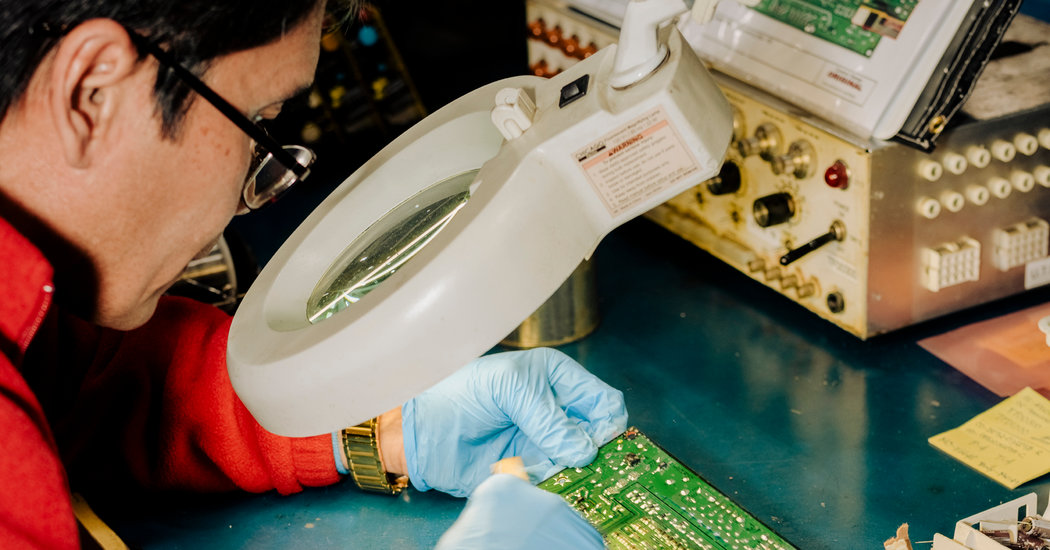
Welcome to the expanding sector of remanufacturing. The practice essentially involves taking products or components, whether in disrepair or at the end of their useful lives, to a like-new condition. Accomplished through a variety of processes and advanced by new technologies like 3-D printing, products as small as a coffee maker and as large as a medical imaging machine can now be upgraded. Rather than recycling or merely refurbishing the item to its original state, the process also enhances the product to make it comport with the latest technology.
While at first glance it seems similar to refurbishing, the results differ. A refurbished engine, for example, might be equivalent to one in excellent working condition but has already been in service for 30,000 miles, while a remanufactured engine should be equivalent to one that has not yet been in service, so it is like new, said Nabil Nasr, the director of the Golisano Institute for Sustainability at the Rochester Institute of Technology.
While still a relatively small subset of manufacturing, its use is likely to grow as a result of recent technical advances like additive manufacturing, data analytics and the internet of things, also known as IoT. And it is an integral part of the circular economy that strives to keep materials in the economy and out of landfills.
“Remanufacturing is a smart way to continue to advance without creating a lot of waste. The development of new technology is allowing remanufacturing to grow stronger,” Dr. Nasr said. “Most of the emission and waste from manufacturing comes from material mining and processing.”
From an environmental standpoint, the process is superior to recycling, which captures materials, but loses the labor used in initial manufacturing and uses significant amounts of energy, Dr. Nasr said.
While remanufacturing does not have a glamorous connotation, companies involved are on the cutting edge of both manufacturing and data privacy.
CoreCentric Solutions, for example, processes close to two million pieces of core — or components — each year for use in both industrial and consumer products, said Tom Healy, the company’s president and chief executive.
CoreCentric’s remanufacturing process identifies the parts that have already failed, and with an intricate propriety database, it can predict which parts “are highly likely to fail.” The company, based in Carol Stream, Ill., identifies and replaces the broken parts, and replaces components that have a high probability of failing.
But technology also creates new issues. The refrigerator with the touch screen that allows you to send notes home as well as order food? It can store personal data. That smart sous-vide machine that you got as a gift? It can access your devices for recipes. And the robotic vacuum cleaner that spares your back? It not only remembers furniture placement, but also uploads a map of your home to the cloud.
When those products break, remanufacturing requires another layer because of the inherent privacy risks. CoreCentric, as a result, needs to ensure not only that the smaller appliances are physically cleaned, “but these devices need to be cleared and the data removed from the cloud before it can be remanufactured and resold,” Mr. Healy said.
Data security is a concern for more than just consumer products. Medical equipment, like those used for M.R.I.s, captures and keeps health information, but at GE Healthcare, Siva Balakrishnan, the general manager for refurbished and remanufactured products, said that for both remanufacturing and refurbishing, all patient health information “is erased from the device. Then, the device undergoes any necessary software updates to ensure compliance with any updated cybersecurity requirements.” But even copiers, which are often remanufactured, “store and reproduce images,” Dr. Nasr said, adding that the manufacturers must delete the data before remanufacturing.
Presuming that data is removed from devices, remanufacturing is an important component of the circular economy. Original equipment manufacturers now realize that if they wait to think about a second life for a product or component until it is in disrepair or outdated, it could be too late.
A growing trend for companies is to plan for remanufacturing in the initial design of a product. “The circular economy starts at the design phase — you can’t remanufacture a product if it’s not designed to be recycled,” said Zoe Bezpalko, a manager of sustainable strategy at Autodesk, which makes both industrial design and consumer software products and is based in San Rafael, Calif. “For example, gluing can prevent recycling. Even black plastic can interfere, because it’s not recognized by machines at the waste management facility.”
While Mr. Gaddis of Henderson Timber suggested remanufacturing to John Deere for his machinery, the company actually began remanufacturing in 1996, said Jena Holtberg-Benge, who oversees the company’s global remanufacturing. “We quickly realized that it’s a wonderful opportunity for dealers because the remanufactured parts improve their capabilities.
“At Deere, they bring in the failed part, disassemble it, clean and qualify the subparts, reclaim some and bring them back to new. Then we machine them, reassemble them and send them to the dealers for installation.”
One of the biggest challenges is determining the integrity of the components. That is where the use of X-rays and data from sensors comes into play. The REMADE Institute, one of 14 consortiums nationwide bringing together companies, academics and the government to expand advanced manufacturing in the United States, is, among other goals, looking at technology to assess the condition of products and components to determine use. REMADE, which is also led by Dr. Nasr, opened in 2017 to focus on greater sustainability in manufacturing.
Sensors can provide “more information about what happened in use and manufacturers can make better decisions about whether it’s worth remanufacturing,” said Michael Thurston, the technical director at the Rochester Institute of Technology’s Golisano Institute and a professor at the school. “If there’s a heat problem, you might suspect damage, but the sensors can provide additional information about what can be reused.”
But manufacturers say that the internet of things is only beginning to change remanufacturing. “IoT offers a huge opportunity as long as it’s connected with the original part and doing things like predictive failure analysis,” said Peter Anderson, the vice president of global supply chain for Cummins Inc., an engine and power systems company. “It is more pervasive in the aerospace industry, but we’re not doing it today.”
Additive technology — such as 3-D printing — is, however, increasingly used to fabricate parts that a company may not store, said Ms. Holtberg-Benge, who is based in Springfield, Mo. “To make a part by the original process in low volume can be expensive, so we’re increasingly using 3-D printed parts.”
As the technology has improved, the use has become more sophisticated. “There are pieces we couldn’t manufacture but could only create with a 3-D printer,” said Mr. Anderson, based in Columbus, Ind. “It enabled our designers to design unconstrained.”
There are concerns that selling remanufactured products could cut into sales of companies’ new inventories, since they can cost from 20 percent to 50 percent less than a new product. “But it’s actually a huge opportunity,” said Joe Iles, the circular design program lead of the Ellen MacArthur Foundation, a British organization that promotes the circular economy. “There are already secondhand sales for many products, and the person who buys a remanufactured item might not pay the extra to buy it new.”
Recent Comments